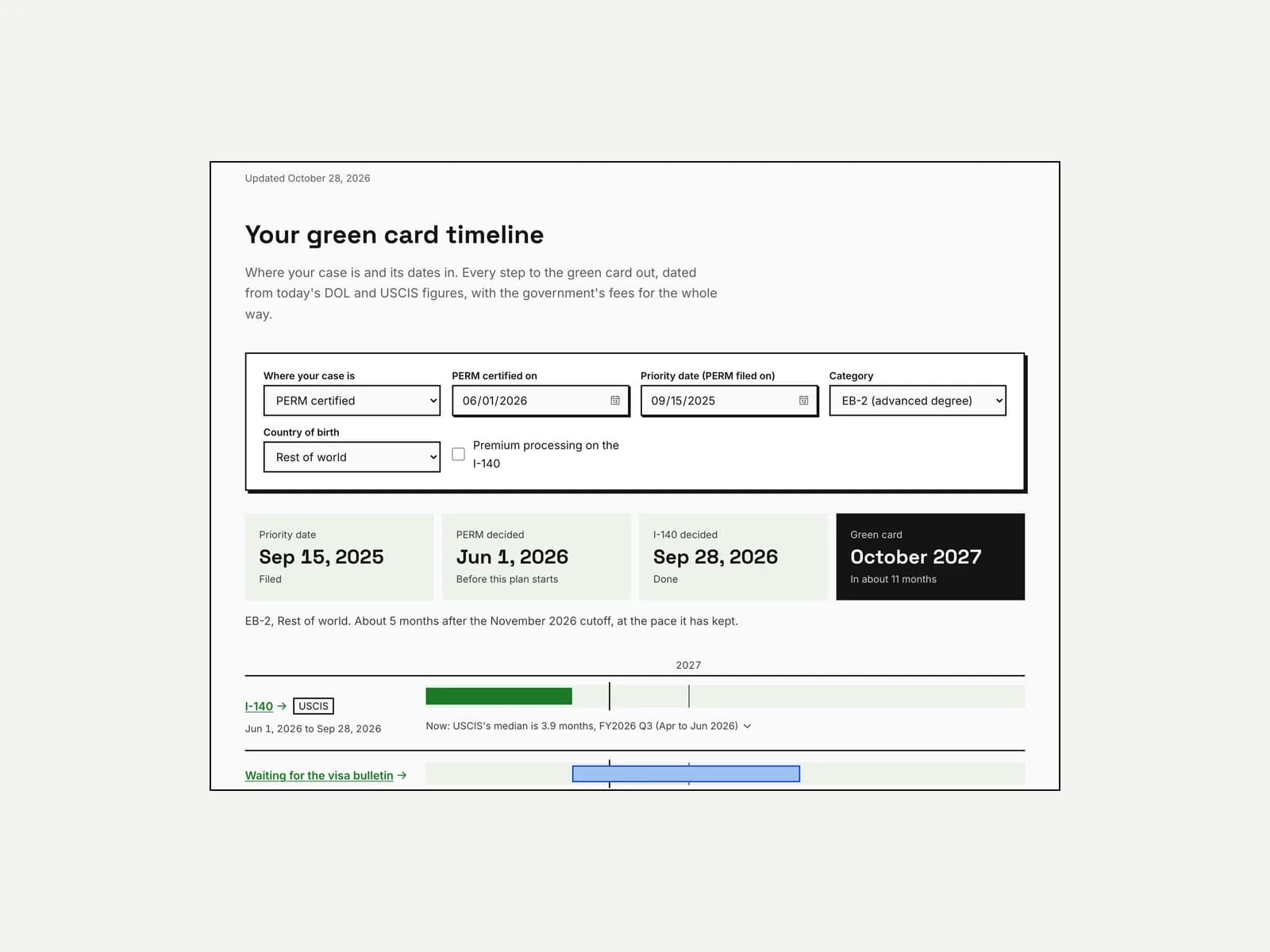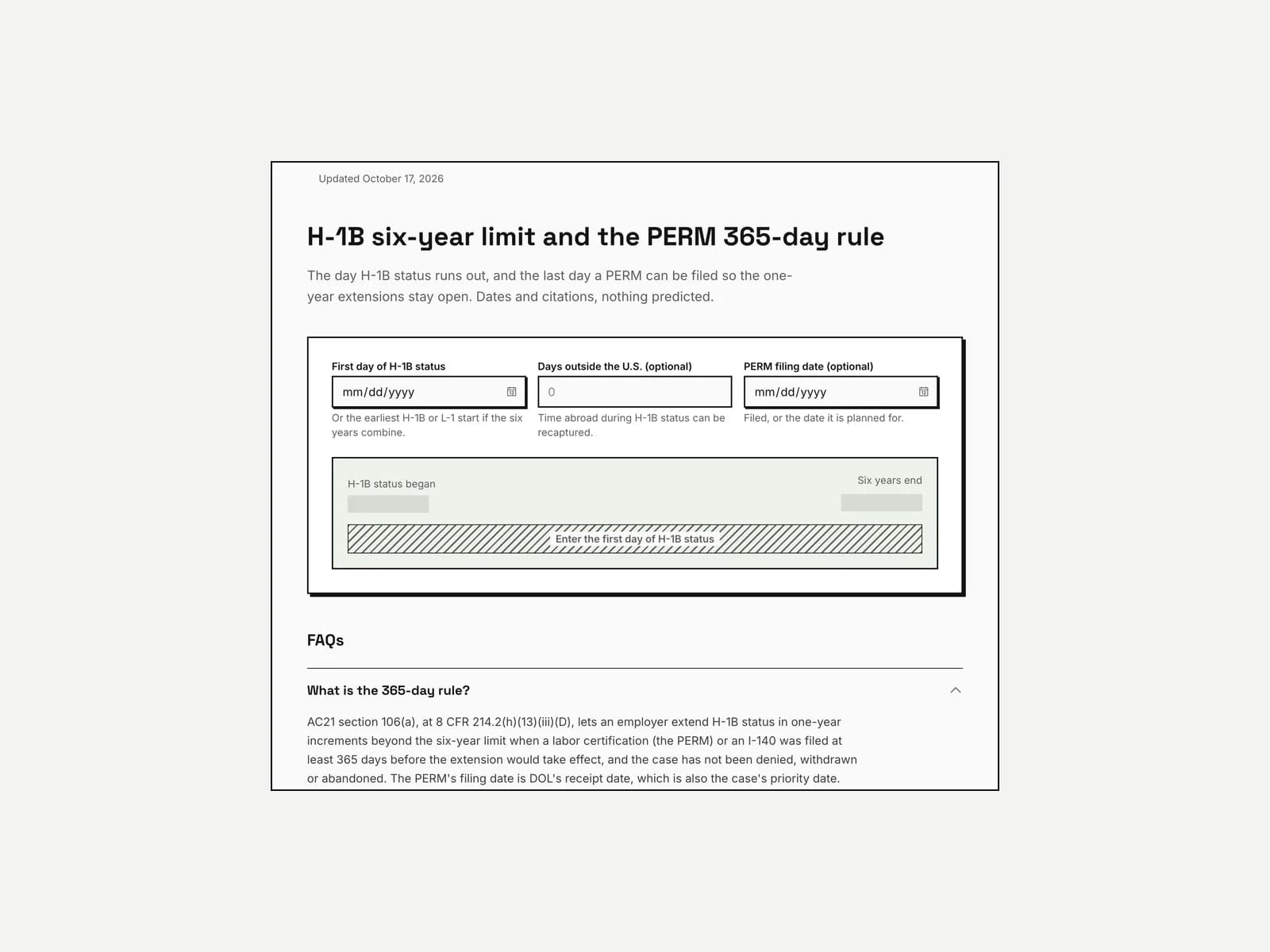
This guide is for anyone whose I-140 is approved and who has an offer from a new employer, or has lost the old job. The I-140 is the immigrant petition an employer files with USCIS once DOL certifies its PERM. Your place in line usually comes with you when you move. The job offer stays behind. PERM Tracker's free priority date retention calculator takes your approval and I-485 dates and prints the day each protection starts, with the rule behind it.
The short answer
Your priority date, the date that holds your place in the green card line, stays yours for a new employer's petition. It survives even if the old employer withdraws the I-140, unless USCIS revokes the approval for one of four reasons, fraud among them (8 CFR 204.5(e)). The job offer doesn't travel, so the new employer files its own PERM and its own I-140. The exception is an I-485 that has been pending 180 days. Then a same or similar job can carry the old case on Supplement J.
The three dates on your paperwork
Three dates decide what you keep. The three-dates guide works through each one, so here they're in brief.
| The date | What it protects | The rule |
|---|---|---|
| Your priority date: the day DOL accepted the old PERM for processing | Your place in line, for any later EB-1, EB-2 or EB-3 petition | 8 CFR 204.5(d) and (e) |
| The I-140 approval date, plus 180 days | The approval itself. From then on, a withdrawal leaves it approved | 8 CFR 205.1(a)(3)(iii)(C) and (D) |
| The I-485 receipt date, plus 180 days | The whole case, moved to a same or similar job | INA 204(j), 8 CFR 245.25 |
The first row surprises people. The priority date doesn't wait for the 180 days. 8 CFR 204.5(e)(1) says an approved petition "accords the alien the priority date of the approved petition for any subsequently filed petition for any classification under section 203(b)(1), (2), or (3) of the Act for which the alien may qualify." Paragraph (e)(2) takes the date away only for fraud, a DOL revocation of the labor certification, an invalidation of it, or a material error. A withdrawal isn't on that list.
DHS said the same when it wrote the rule. The beneficiary "may be able to retain his or her priority date even if approval of the petition is revoked due to withdrawal or business termination" (81 FR 82398, 82416, November 18, 2016).
So the 180 days after approval protect the approval. An approval that still stands is what an H-1B extension past six years leans on, and it's what Supplement J carries to a new job.
Two ways to move
A new employer either starts its own PERM and I-140, or, once your I-485 is old enough, the existing case moves with you.
| A new PERM and I-140 | Supplement J | |
|---|---|---|
| When it fits | Any time after the old I-140 is approved | Your I-485 has been pending 180 days or more, and the I-140 is approved or is later approved |
| The new job | Any job the new employer sponsors, in any EB-1, EB-2 or EB-3 category you qualify for | A full-time, permanent job in the same or a similar occupation |
| What the new employer files | A wage request, recruitment, a PERM application, then an I-140 | Nothing with DOL. You file Supplement J describing the new offer |
| Your priority date | The old one, carried to the new I-140 | The old one |
| The rule | 8 CFR 204.5(e)(1) | INA 204(j), 8 CFR 245.25 |
USCIS's Supplement J page says the new offer "must be in the same or a similar occupational classification as the job offered to you in the Form I-140." Its Policy Manual lists what an officer compares, including DOL's occupational codes, the duties, the required skills and experience, and the wage. It adds that an applicant who ports "retains the priority date of the underlying petition."
What the new employer files, in order
The new employer starts from the beginning with DOL. Only the priority date skips ahead.
A prevailing wage request
The new employer asks DOL what the job must pay, on Form ETA-9141. The wage request calculator shows where DOL's queue stands for the month it goes in.
Recruitment
It advertises the job to US workers under 20 CFR 656.17(e) and posts a notice of filing. The deadline calculator lays out the windows.
The PERM application
It files Form ETA-9089 with DOL. DOL's published average from filing to decision is 300 days as of October 31, 2026.
A new I-140
Once DOL certifies it, the I-140 has to go in within 180 days. The certification "expires if not filed in support of a Form I-140 petition with the Department of Homeland Security within 180 calendar days of the date the Department of Labor granted the certification" (20 CFR 656.30(b)(1)). Give its attorney your old approval notice, so the new petition can carry the old date.
The I-485, once your date is current
If the old date is already current when the new I-140 goes in, the I-485 can go in with it (8 CFR 245.2(a)(2)(i)(B)). The visa bulletin by category shows where your line stands.
Your H-1B past six years
This is where the old approval earns its keep. An approved I-140 lets a new employer extend your H-1B past six years, up to three years at a time, when the per-country limit is all that holds your visa back (8 CFR 214.2(h)(13)(iii)(E)). The rule says "The H-1B petitioner need not be the employer that filed the immigrant visa petition" ((E)(4)).
That's also where the 180 days count. A withdrawal inside them revokes the approval, unless an I-485 has been pending 180 days, and the three-year route through it closes. Your priority date survives either way.
There's a one-year route as well. It needs a PERM or an I-140 filed for you at least 365 days earlier, and the new employer's own PERM can be the one that qualifies ((D)(1) and (D)(6)). The six-year guide and the H-1B six-year calculator work through both routes with dates.
A worked example
In this example the old I-140 was approved on Monday, March 2, 2026. No I-485 is pending, because the date isn't current yet.
| Date | What it means |
|---|---|
| Monday, March 2, 2026 | The I-140 is approved. Its priority date is yours for any later EB-1, EB-2 or EB-3 petition |
| Saturday, August 29, 2026 | 180 days since approval. A withdrawal from here on leaves the approval standing |
| The day the new I-140 is approved | It carries the old priority date, and the wait in line doesn't start over |
Say the old employer withdraws the I-140 on Friday, August 28, 2026, the 179th day. The approval is revoked, so it can't support a three-year H-1B extension. The priority date is still yours, because a withdrawal isn't one of the four grounds in 204.5(e)(2). Had the withdrawal come one day later, the approval would have survived too.
What this guide can't tell you
This guide can't see USCIS's file, judge a new job's occupation, or say how long a new PERM will take.
- Whether the old employer withdrew the I-140. The withdrawal goes to USCIS, and DOL's record doesn't show it.
- Whether a new job counts as same or similar. USCIS decides that on Supplement J, from the facts of both jobs.
- How long the new PERM will take. The processing time calculator estimates it from a filing month.
- Anything that turns on your own facts. A revocation on other grounds, a move between EB-3 and EB-2, or a gap in your status each changes the answer. Ask the attorney on the new case.
Nothing here is legal advice.