This guide is for H-1B workers whose six years are running out while a green card case is still at DOL or USCIS. The short answer: a PERM filed at least 365 days before the extension would start is enough for one-year extensions, and an approved I-140 with a backlogged date is enough for three-year ones. Both come from a 2000 law, AC21, and both are written into USCIS's regulations.
The two ways past six years
| One-year extensions | Three-year extensions | |
|---|---|---|
| The law | AC21 section 106(a) and (b) | AC21 section 104(c) |
| The regulation | 8 CFR 214.2(h)(13)(iii)(D) | 8 CFR 214.2(h)(13)(iii)(E) |
| What you need | A PERM, or an I-140, filed for you at least 365 days earlier | An approved EB-1, EB-2 or EB-3 I-140, and a visa unavailable only because of the per-country limit |
| Length of each extension | Up to 1 year | Up to 3 years |
| Ends when | The certification expires, or there's a final decision denying, revoking or closing the PERM, the I-140 or the green card application | The I-140 approval is revoked, or the green card application or immigrant visa is decided |
| Must the H-1B employer be the one that filed? | No, (D)(6) | No, (E)(4) |
The law behind the first column says the six-year limit "shall not apply" when "365 days or more have elapsed since the filing" of a labor certification or an immigrant petition. The second says someone "eligible to be granted that status but for application of the per country limitations" may be extended "until the alien's application for adjustment of status has been processed and a decision made thereon." The six-year limit itself is at 8 CFR 214.2(h)(13)(iii)(A).
Worked through with dates
Say your six years of H-1B time, after any time recaptured, end on Thursday, September 30, 2027. An extension would start on Friday, October 1, 2027.
When the PERM has to have been filed
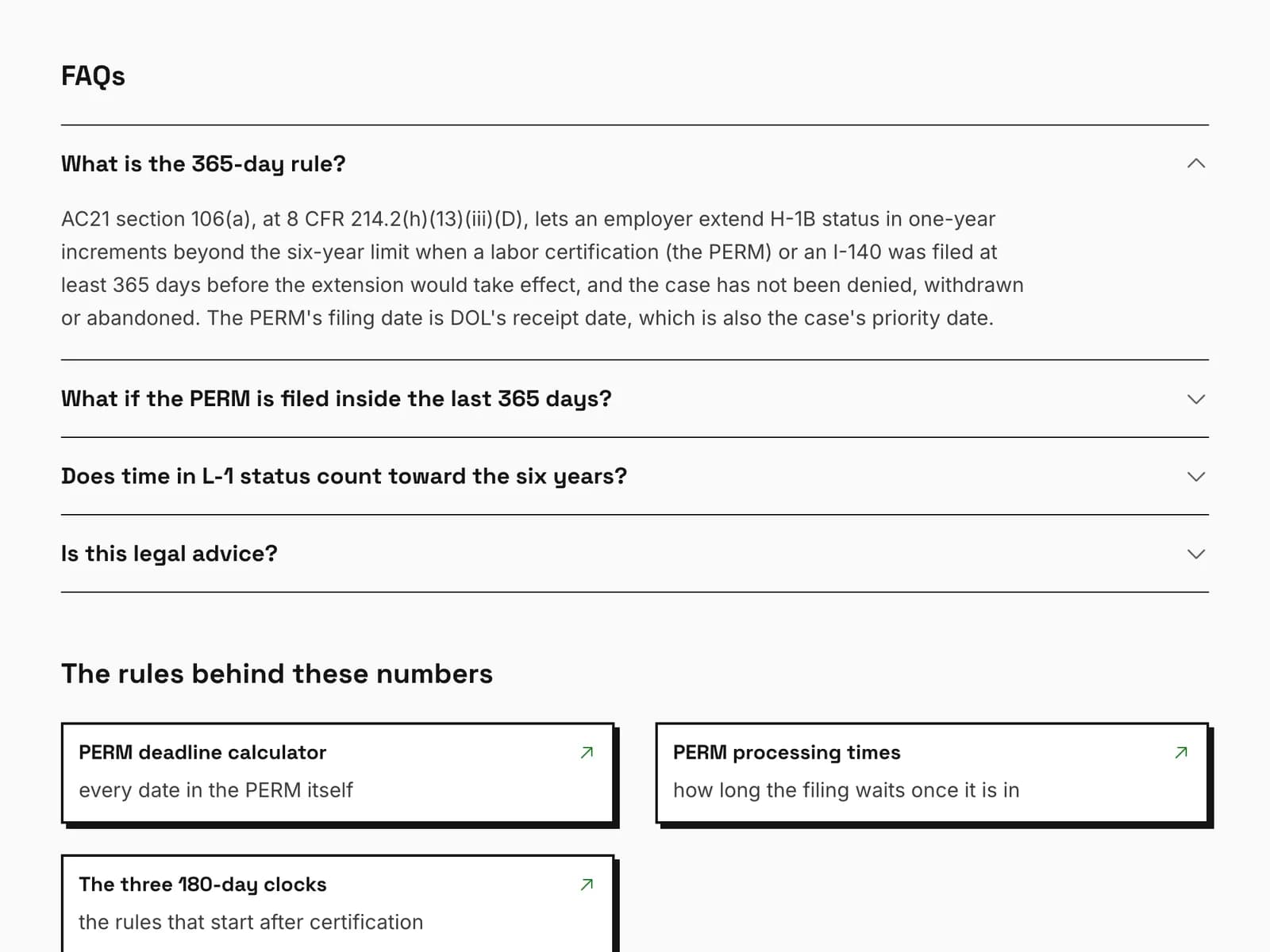
At least 365 days before the extension starts: by Thursday, October 1, 2026. The regulation allows the petition to be filed earlier, "provided that the application for labor certification or immigrant visa petition must have been filed at least 365 days prior to the date the period of admission authorized under this exemption will take effect" ((D)(5)).
When the H-1B petition can go in
Within 6 months of the requested start date, so from about Thursday, April 1, 2027.
What happens after that year
Another one-year extension, and another, for as long as the PERM or I-140 stays alive. The next one doesn't have to rest on the same filing ((D)(7)).
When the I-140 is approved
If your date is held back by the per-country limit, the next petition can ask for up to three years at a time under (E).
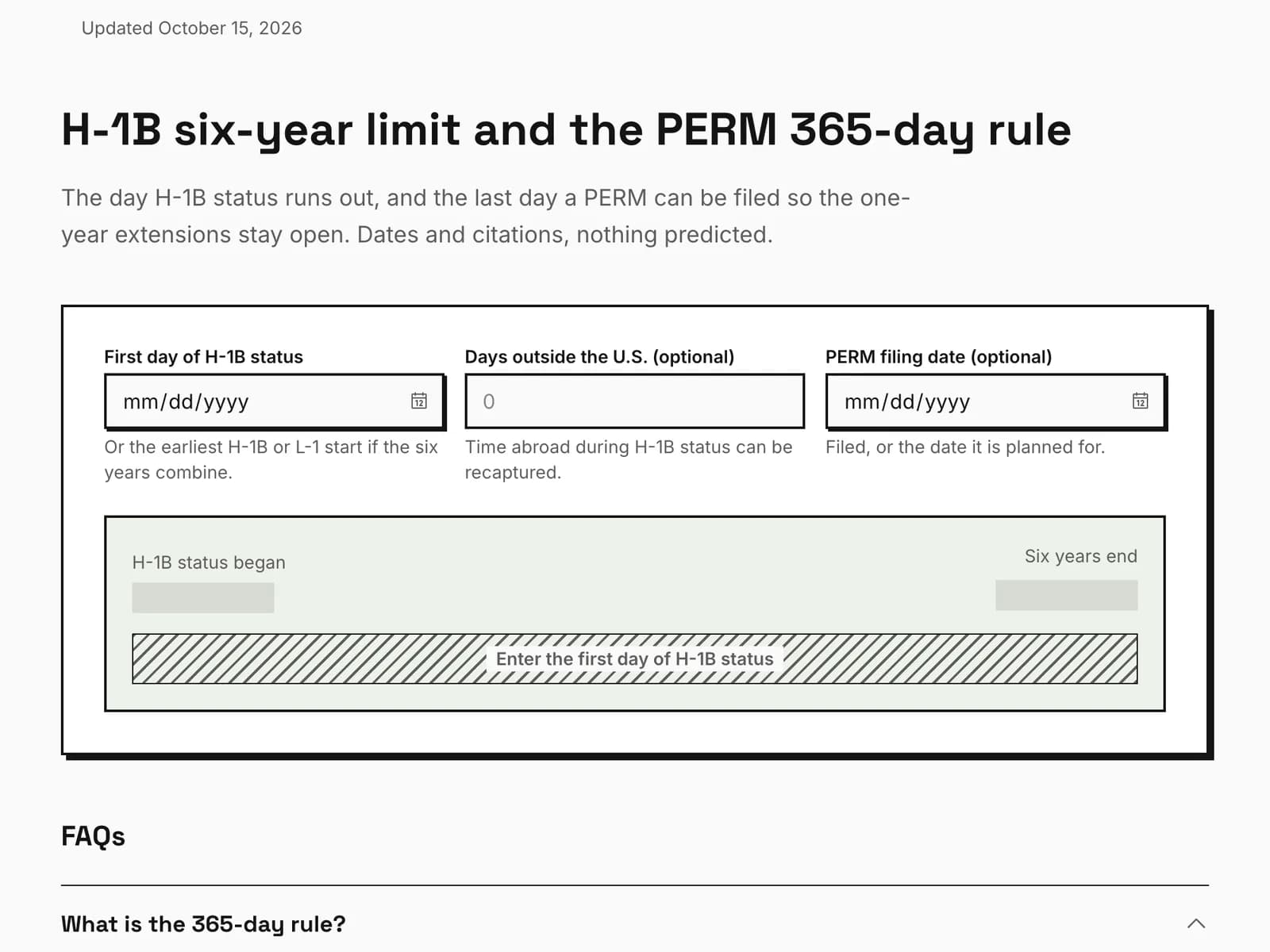
A PERM filed in August 2026 passes its 365th day in August 2027. Count the 365 days from the filing date on DOL's record, which case status shows for your case number. The six-year limit calculator does the arithmetic with your dates, including recaptured time.
Recaptured time moves the end date
Time spent outside the United States for more than 24 hours during an approved H-1B doesn't count toward the six years, and "such remaining time may be recaptured in a subsequent H-1B petition" (8 CFR 214.2(h)(13)(iii)(C)). It's the petitioner's job to prove it, with passport stamps, I-94 records or tickets. Recapture can push your end date past the PERM's 365th day.
What ends the one-year route
- A final denial of the PERM or the I-140. A denial isn't final while the time to appeal is open or while an appeal is pending ((D)(3)).
- A certification that expires unused. If no I-140 is filed within 180 days of certification, the certification expires (20 CFR 656.30(b)(1)) and the PERM no longer supports anything.
- A withdrawal or closure. The regulation counts a case that's "administratively or otherwise" closed ((D)(2)(iv)).
- Not filing the I-485 in time. If your I-140 is approved and you don't file for a green card within one year of a visa becoming available, you lose the one-year route ((D)(10)). USCIS can excuse it for circumstances beyond your control.
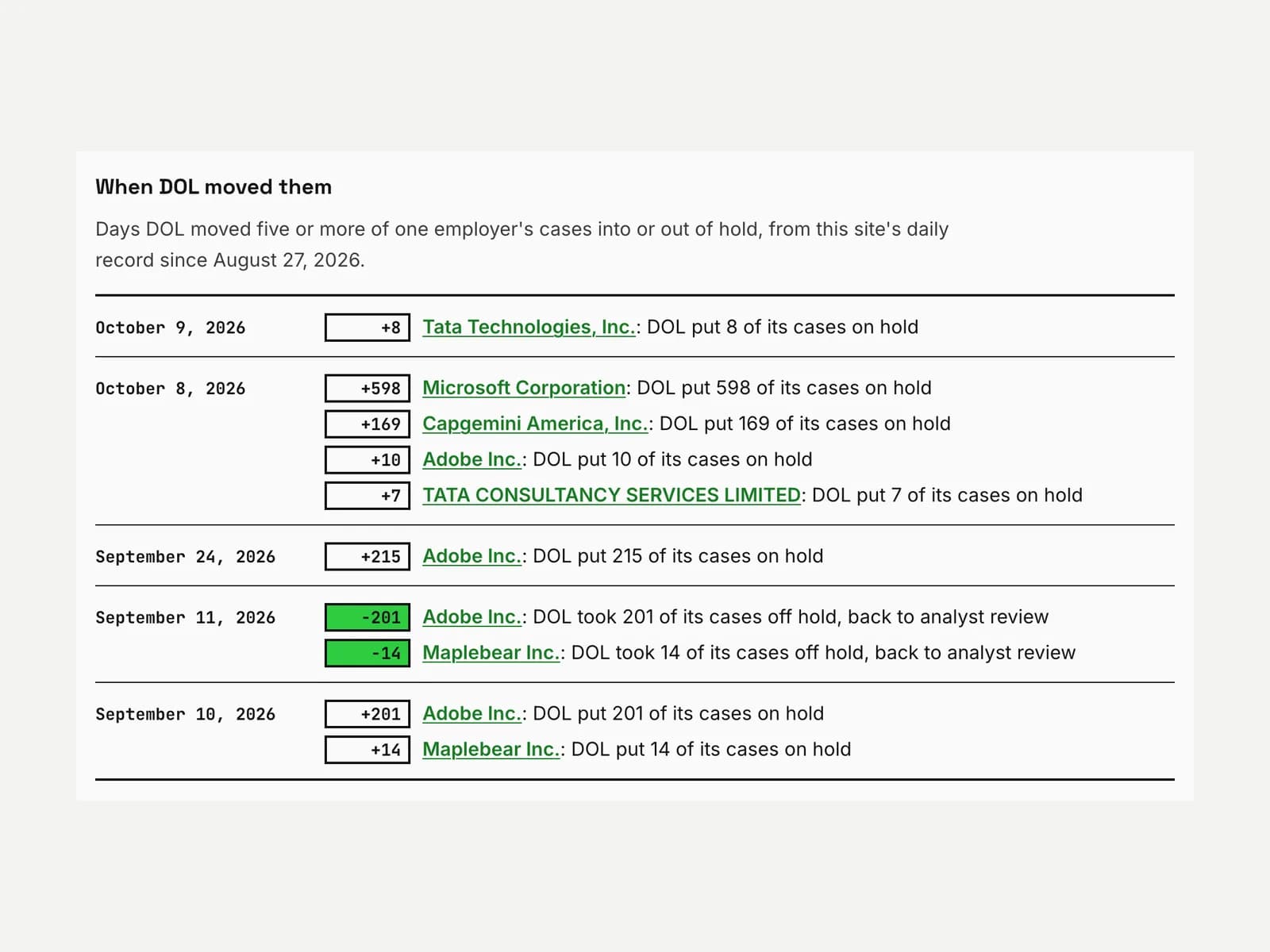
A case on hold isn't on that list. DOL's suspension of some employers' PERM cases in October 2026 put cases on hold, and a hold isn't a final decision. The suspension guide takes that stage by stage.
A proposal to watch
DHS proposed on October 14, 2026 to remove 8 CFR 214.1(c)(5), under which USCIS generally gives deference to a prior approval when deciding an extension on the same facts (Federal Register document 2026-20941). It's a proposal. Comments close Friday, November 13, 2026, and nothing changes unless a final rule is published. If it became final, USCIS would no longer give a prior approval that deference.
Nothing here is legal advice. The H-1B petition is the employer's, and the attorney filing it decides which exemption to claim.
What this guide can't tell you
- Your exact six-year end date. It depends on every entry and exit, which only your own records hold.
- Whether USCIS will approve a given extension. The rule says who's eligible. USCIS decides each petition.
- When your PERM will be decided. The processing time calculator estimates it, and case status shows where it stands today.