This guide is for anyone with an employer-sponsored green card case who is thinking about a new job, or has been handed one by a layoff. Whether you can move without starting over comes down to three dates, each with its own 180-day rule. Find yours, and the answer follows.
- The certification date. A certified PERM has to be used for an I-140 within 180 days.
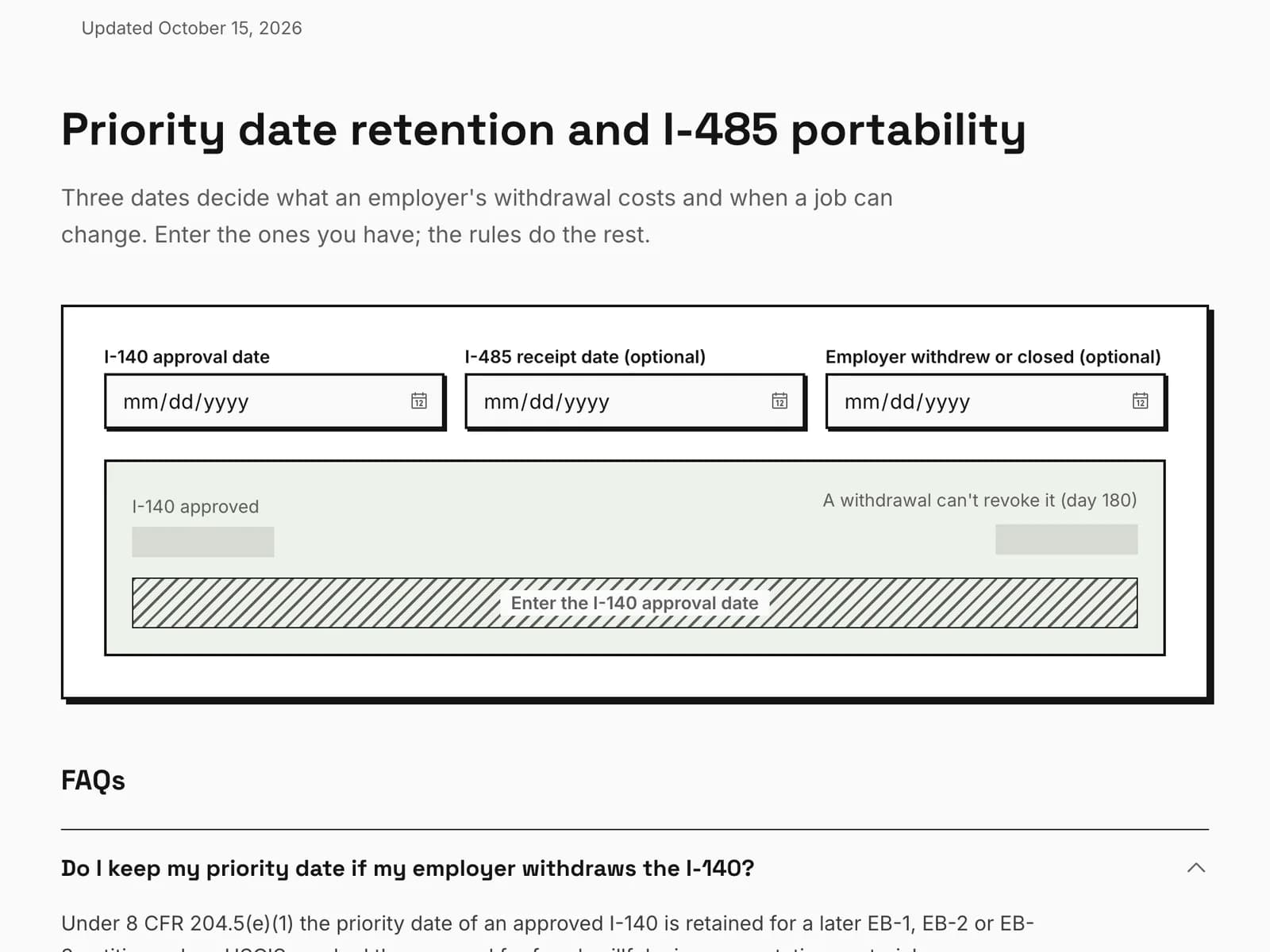
- The I-140 approval date. 180 days after it, an employer's withdrawal can no longer revoke the approval.
- The I-485 receipt date. 180 days after it, the case can move to a new job in the same or a similar occupation.
If you leave now, what you keep
| Where your case is when you leave | What you keep | What starts over | The rule |
|---|---|---|---|
| PERM pending, or certified with no I-140 | Nothing from this case. The PERM is the old employer's offer of a job | A new employer files a new PERM, with a new priority date unless an earlier I-140 gives you one | 20 CFR 656.30(c)(2) |
| I-140 approved less than 180 days ago, no I-485 pending 180 days | The approval only if the old employer doesn't withdraw it | The job offer | 8 CFR 205.1(a)(3)(iii)(C) |
| I-140 approved 180 days or more ago | The approval, and the priority date for a new employer's petition | The PERM and I-140 at the new employer | 8 CFR 205.1(a)(3)(iii)(C), 204.5(e) |
| I-485 pending 180 days or more, I-140 approved | The whole case, if the new job is same or similar | Nothing, if USCIS accepts the new job on Supplement J | INA 204(j), 8 CFR 245.25 |
Date one: the certification, good for 180 days
20 CFR 656.30(b)(1) says an approved labor certification "expires if not filed in support of a Form I-140 petition with the Department of Homeland Security within 180 calendar days of the date the Department of Labor granted the certification." The certified form prints its last day, 179 days after the certification date. The regulation offers no extension.
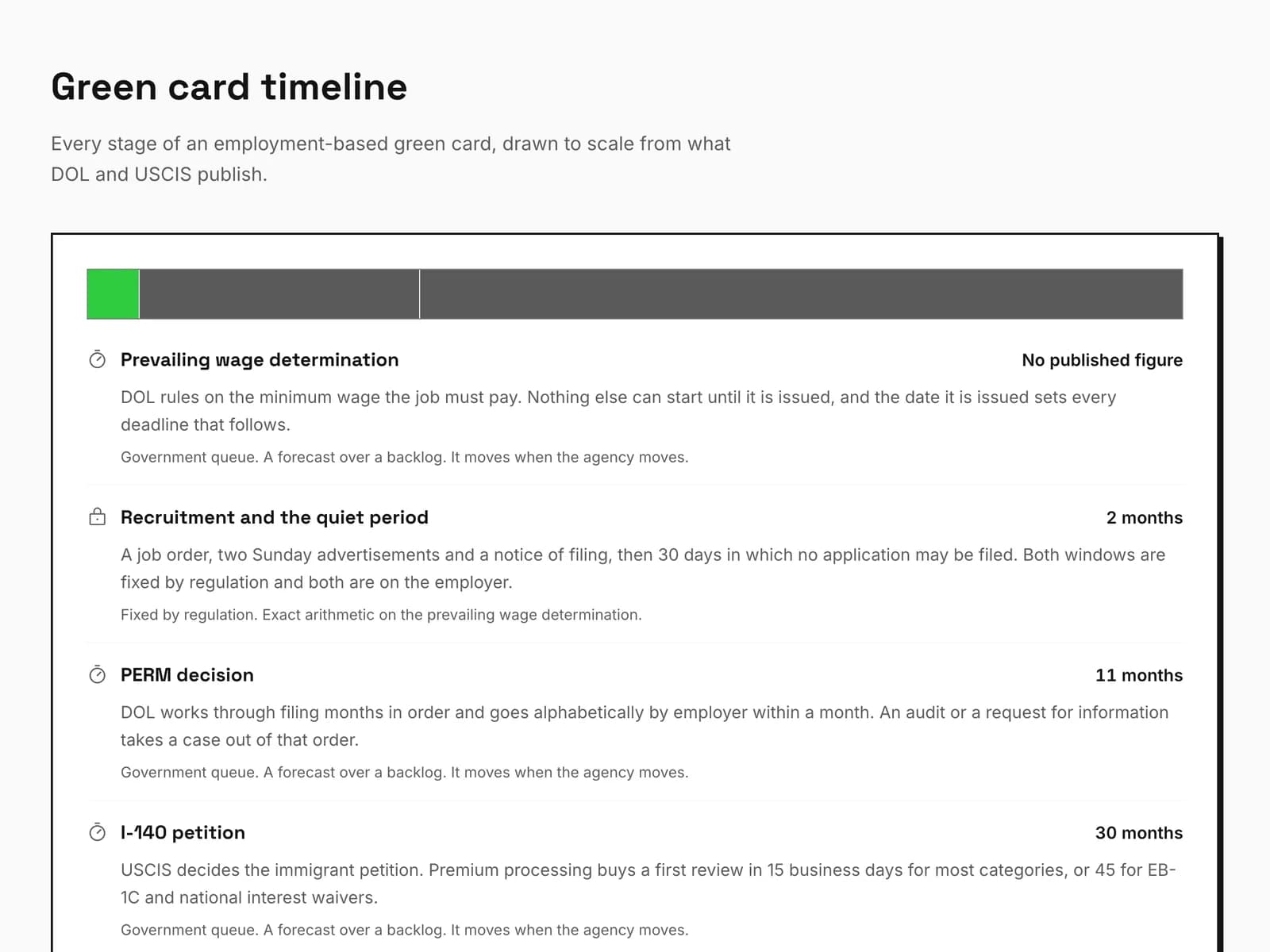
A certification is tied to one job. It's "valid only for the particular job opportunity, the alien named on the original application ... and the area of intended employment" (656.30(c)(2)). So if you leave before the I-140 is approved, the new employer can't use it. Starting again costs a new prevailing wage, new recruitment, and another wait in DOL's queue, whose published average is 336 days as of October 5, 2026.
Date two: the I-140 approval, protected after 180 days
8 CFR 205.1(a)(3)(iii)(C) is the rule. Automatic revocation follows a withdrawal "where the withdrawal is filed less than 180 days after approval of the employment-based preference petition, unless an associated adjustment of status application has been pending for 180 days or more." And a petition "withdrawn 180 days or more after its approval, or 180 days or more after the associated adjustment of status application has been filed, remains approved unless its approval is revoked on other grounds."
Two triggers, either one enough: 180 days since the approval, or 180 days since the I-485 went in. The same split applies if the employer goes out of business ((iii)(D)).
What survives is narrower than people expect. The withdrawal rescinds the job offer, and you "must obtain a new employment-based preference petition" unless portability under date three applies. So a surviving I-140 keeps your place in line. It doesn't keep the job.
The priority date is the best part of it. A new employer's PERM and I-140 can carry the date from an approved I-140 (8 CFR 204.5(e)(1)). It's lost only if USCIS revokes the approval for fraud or willful misrepresentation, a DOL revocation of the labor certification, an invalidation of it, or a material error (204.5(e)(2)). A withdrawal isn't one of the four. The retention calculator runs your dates, and the revocation guide goes through each case.
Date three: the I-485 receipt, portable after 180 days
This is the one that gives the worker something. Under INA 204(j), a petition for someone whose I-485 "has been filed and remained unadjudicated for 180 days or more shall remain valid with respect to a new job if the individual changes jobs or employers if the new job is in the same or a similar occupational classification as the job for which the petition was filed."
8 CFR 245.25 adds the conditions: the I-485 pending 180 days or more, and the I-140 approved (or pending, and approved later). The mechanics are a form, I-485 Supplement J, showing either that the original offer continues or that a new qualifying one exists. The Supplement J guide covers it.
"Same or similar occupational classification" decides these cases, and USCIS judges it on the job's duties. That's the point where an individual case needs an attorney.
A worked example
Say your I-140 was approved on Monday, April 20, 2026, and your I-485 was received on Monday, May 4, 2026.
| Date | What changes that day |
|---|---|
| Saturday, October 17, 2026 | The I-140 has been approved 180 days. A withdrawal from here on leaves it approved |
| Saturday, October 31, 2026 | The I-485 has been pending 180 days. A same or similar job can carry the case |
Leave on November 2 and both protections hold. Leave on October 1 and neither does yet, so the timing of the move is worth a conversation with the attorney first.
What this guide can't tell you
- Whether your old employer has withdrawn the I-140. The withdrawal goes to USCIS, and DOL's record doesn't show it.
- Whether a new job counts as same or similar. USCIS decides that on Supplement J.
- How long a new employer's PERM would take. The processing time calculator estimates it from a filing month.
Related
- Employer layoffs and your PERM
- PERM certified: what happens next
- H-1B past six years with a PERM pending
- The green card timeline, drawn to scale
Nothing here is legal advice. The specific facts matter more here than at any other stage, and what this guide is for is knowing which question to ask.