This guide is for anyone who has left an employer, or been laid off, with an approved I-140 behind them. The question is usually "can they take it away?" The answer turns on one date: how long the I-140 had been approved when the employer withdrew it.
The short answer
Withdrawn less than 180 days after approval: automatically revoked, unless an I-485 based on it has been pending 180 days. Withdrawn 180 days or more after approval: it "remains approved unless its approval is revoked on other grounds" (8 CFR 205.1(a)(3)(iii)(C)). Either way, the old employer's job offer is gone. After 180 days, what survives is the approval and its priority date.
The timing, case by case
| What happened | When | Result | The rule |
|---|---|---|---|
| The employer withdrew the I-140 | Less than 180 days after approval, and no I-485 pending 180 days | Automatically revoked | 8 CFR 205.1(a)(3)(iii)(C) |
| The employer withdrew the I-140 | 180 days or more after approval, or 180 days or more after the I-485 was filed | Remains approved | 8 CFR 205.1(a)(3)(iii)(C) |
| The employer went out of business | Less than 180 days after approval, and no I-485 pending 180 days | Automatically revoked | 8 CFR 205.1(a)(3)(iii)(D) |
| The employer went out of business | 180 days or more after approval, or 180 days or more after the I-485 was filed | Remains approved | 8 CFR 205.1(a)(3)(iii)(D) |
| The labor certification behind it was invalidated | Any time | Automatically revoked | 8 CFR 205.1(a)(3)(iii)(A) |
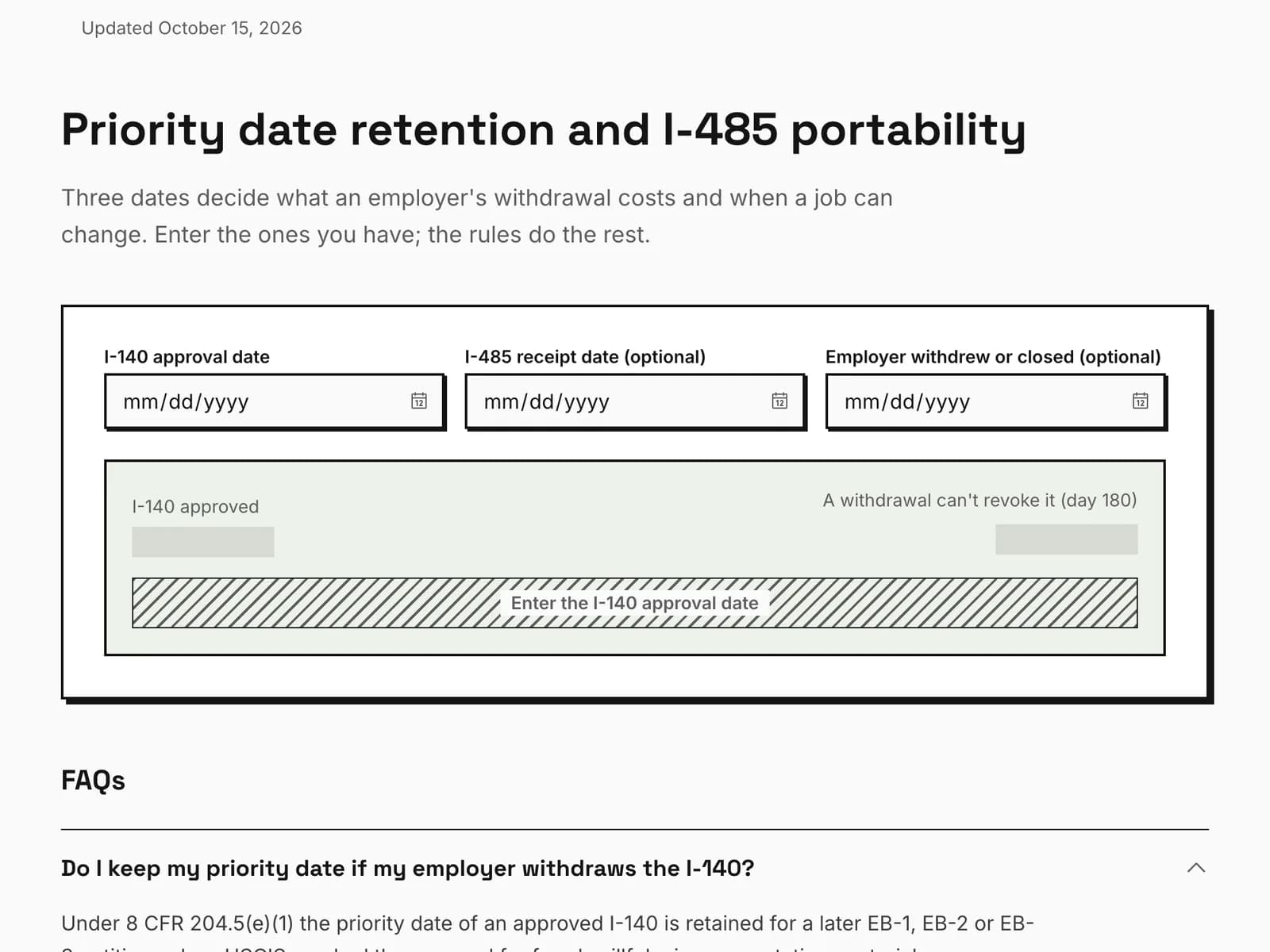
A worked date. An I-140 approved on Monday, April 20, 2026 reaches 180 days on Saturday, October 17, 2026. A withdrawal filed on October 16 is "less than 180 days after approval" and revokes it. One filed on October 17 or later leaves it approved.
What the employer can still take away
A withdrawal after 180 days rescinds the job offer. The regulation says that when a petition is withdrawn, "the job offer of the petitioning employer is rescinded and the alien must obtain a new employment-based preference petition in order to seek adjustment of status or issuance of an immigrant visa". So the surviving approval keeps your place in line. It doesn't, by itself, get you a green card.
The exception is portability. If your I-485 has been pending 180 days, INA 204(j) keeps the petition valid for a new job "in the same or a similar occupational classification", filed on Supplement J (8 CFR 245.25).
The priority date: kept, with four exceptions
An approved petition gives you its priority date "for any subsequently filed petition for any classification under section 203(b)(1), (2), or (3)" (8 CFR 204.5(e)(1)). A new employer's PERM and I-140 can carry it. The date is lost only if USCIS revokes the approval because of one of four things (204.5(e)(2)):
- Fraud, or a willful misrepresentation of a material fact
- DOL revoking the labor certification behind it
- USCIS or the State Department invalidating that labor certification
- A USCIS determination that the approval rested on a material error
An employer's withdrawal isn't on that list. The priority date retention calculator walks your own dates through the rules.
Revocation on other grounds
Separately from withdrawal, USCIS can revoke an approval "upon notice to the petitioner on any ground other than those specified in § 205.1" (8 CFR 205.2). That takes a notice of intent, a chance to respond with evidence, and a written decision. The petitioner has 15 days after the notice of revocation to appeal. The notice goes to the petitioner, which is the employer, so a former employee may not hear of it directly. Ask the attorney who represents you now to keep watch.
What it means for your H-1B and your family
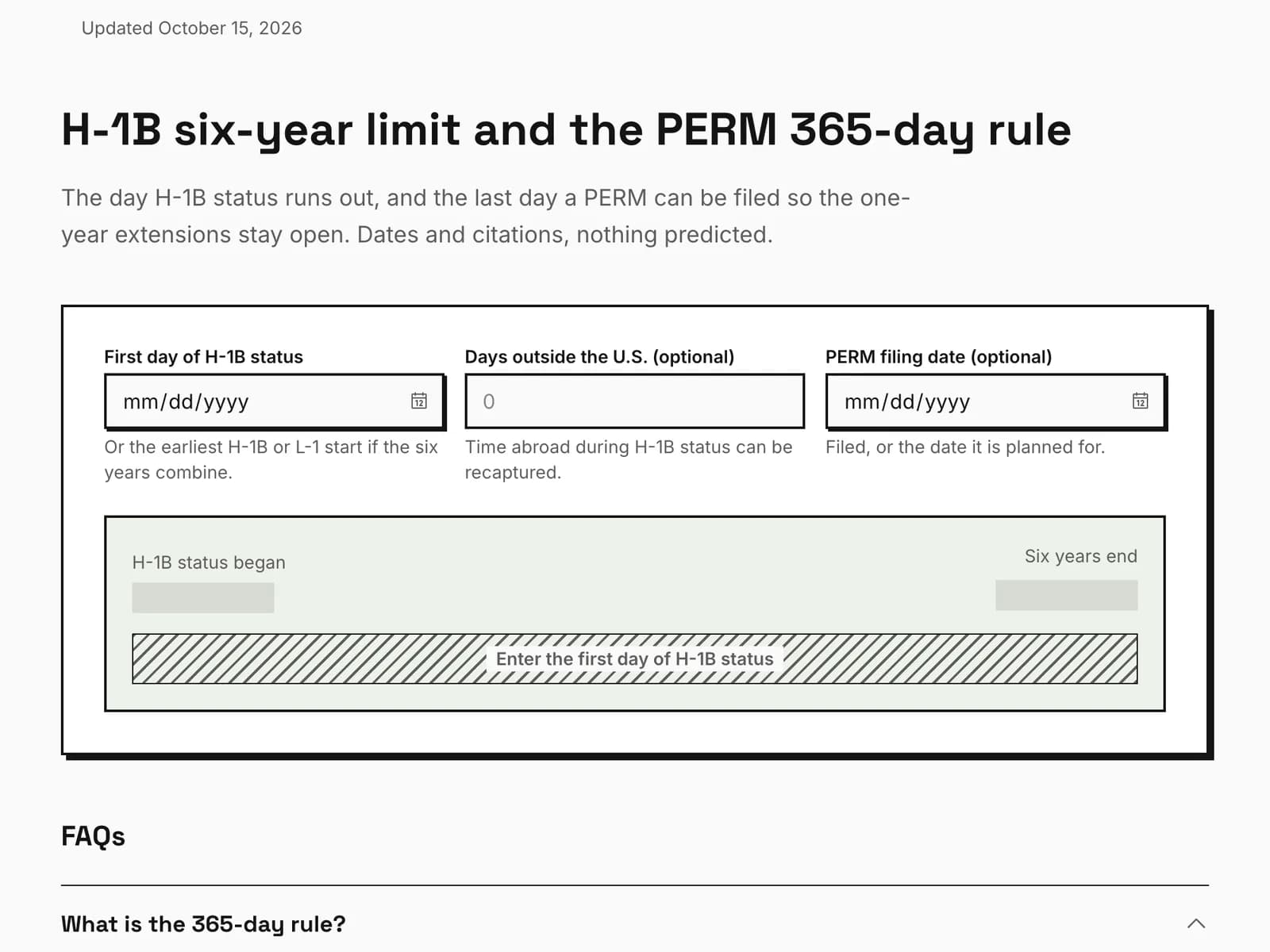
- Three-year H-1B extensions past six years need "the beneficiary of an approved immigrant visa petition" whose date is held back only by the per-country limit, and they run until a final decision to revoke the approval (8 CFR 214.2(h)(13)(iii)(E)). A new H-1B employer can use the old approval ((E)(4)).
- An H-4 spouse's work permit needs the H-1B to be the beneficiary of an approved I-140, or to hold H-1B time past six years under AC21 (8 CFR 214.2(h)(9)(iv)).
The six-year guide covers the extensions with dates.
What to keep, and what to ask
Keep your own copies
The I-140 approval notice, the certified ETA 9089 and the receipt numbers. A new employer's attorney will want them, and it's easier to keep them now than to ask a former employer later.
Write down three dates
The I-140 approval date, the I-485 receipt date if you have one, and the date you left.
Ask the new employer's attorney
Can the new I-140 carry my old priority date? Is my I-485 past 180 days, so that Supplement J applies? Can the old approval support my next H-1B extension?
Nothing here is legal advice. The rule turns on dates and documents the attorney can check.
What this guide can't tell you
- Whether your former employer withdrew the I-140. The withdrawal goes to USCIS, and neither DOL's record nor this site shows it.
- Whether a new job is "same or similar". USCIS decides that on Supplement J.
- What a new PERM will need. That's a new case at a new employer, with its own recruitment and wait.