A layoff at the sponsor touches a green card case at three different points, and three different rules apply. One is DOL's and runs before filing. Two are USCIS's and run after the I-140. Which one matters depends on where your case is, so this guide takes them in order.
🚨 Three rules, three stages
Before filing: 20 CFR 656.17(k), the layoff look-back. After I-140 approval: 8 CFR 205.1(a)(3)(iii)(C), the 180-day withdrawal protection. Losing the job itself: 8 CFR 214.1(l)(2), the 60-day grace period for H-1B status.
Before the PERM is filed: the six-month look-back
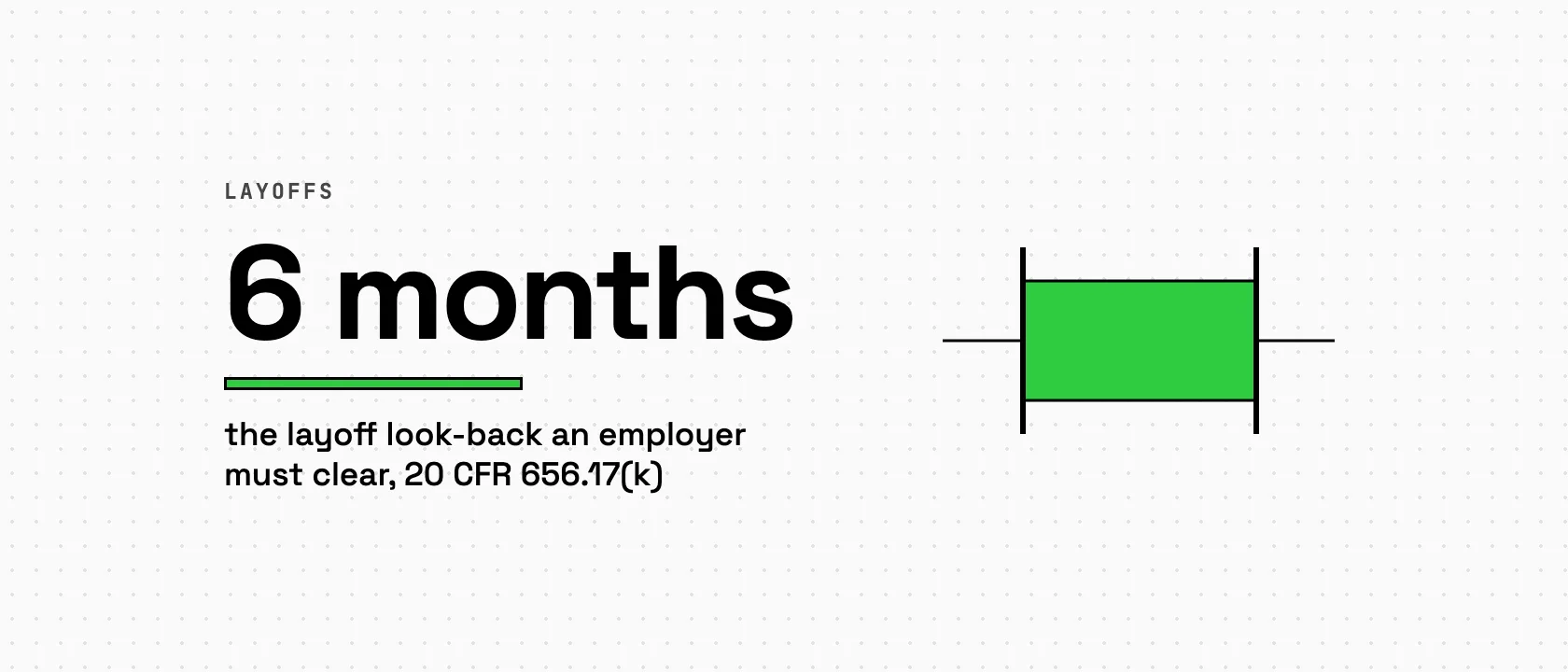
Under 20 CFR 656.17(k), if the employer has had a layoff in the area of intended employment within six months of filing, in the occupation the PERM is for or a related one, it has to document that it notified and considered all potentially qualified laid-off U.S. workers for the job. The employer attests to this on the form, and an audit calls for the documentation.
Two things follow. A layoff in the same occupation and area inside that window doesn't bar the filing, but it adds a recruitment obligation the employer has to be able to prove. And a layoff outside the window, or in an unrelated occupation, is outside the rule. Whether yours is inside it is a question of dates, location and job title that the attorney can answer and this site can't.
A PERM that's already filed
DOL decides the application it received. A layoff after filing doesn't change the attestations the employer made, and a pending PERM doesn't get pulled from the queue because the employer cut staff elsewhere. What can change is the employer's willingness to keep the job offer open, and a PERM is an offer of a job: if the position is eliminated, the employer withdraws the case, and WITHDRAWN is the status it shows.
If the employer is still sponsoring you, the case's place in line is unaffected. The queue page shows where the filing month sits.
An approved I-140: the 180-day line
Once the I-140 has been approved for 180 days, an employer's withdrawal, or the employer going out of business, no longer revokes it automatically. Inside 180 days it does. That's 8 CFR 205.1(a)(3)(iii)(C) and (D), and it matters for two things: using the petition for an H-1B extension beyond six years, and using it as the basis of a pending I-485.
The priority date is a separate question and a better one. Under 8 CFR 204.5(e)(1) the date from an approved I-140 is retained for a later EB-1, EB-2 or EB-3 petition unless USCIS revoked the approval for fraud, willful misrepresentation, material error or an invalidated labor certification. An employer's withdrawal isn't on that list. So a new sponsor's PERM and I-140 can carry the old date. The retention calculator puts the dates on it.
A pending I-485: portability at 180 days
If an I-485 has been pending 180 days, INA 204(j) and 8 CFR 245.25 let it be approved on a new offer in the same or a similar occupation, filed on Supplement J. Whether the new job is same or similar is USCIS's determination, not arithmetic. Before 180 days, a withdrawal of the I-140 takes the I-485's basis with it.
Losing the job itself: the H-1B grace period
8 CFR 214.1(l)(2) gives an H-1B worker whose employment ends up to 60 consecutive days, or until the end of the authorized validity period, whichever is shorter, in which to find a new petitioner, change status or leave. A new employer's H-1B petition filed inside that window keeps the status; a PERM by itself does not, because a PERM isn't a status.
The H-1B six-year limit calculator shows whether a PERM or I-140 on file keeps the one-year extensions available.
What the record can show you
The employer page for your sponsor shows every PERM it has filed, decided and pending, by month, so a filing freeze is visible as a gap in the record. The under-review page shows which employers hold unusual shares of their pending cases at RFI, on hold or in appeal. What none of it shows is a layoff itself: DOL's files don't record one. A WARN notice, where a state publishes them, is the public record of a mass layoff, and that isn't in this site's data yet.
What this guide can't tell you
- Whether your employer's layoff is inside the 656.17(k) window for your PERM. That's dates and job titles the attorney has.
- Whether your job will be cut. Nothing in DOL's record predicts it.
- Whether a new job is "same or similar" for portability. USCIS decides that on Supplement J.
Related
- The three 180-day clocks
- Employer stopped filing PERMs, for reading a sponsor's record
- Every case status, explained