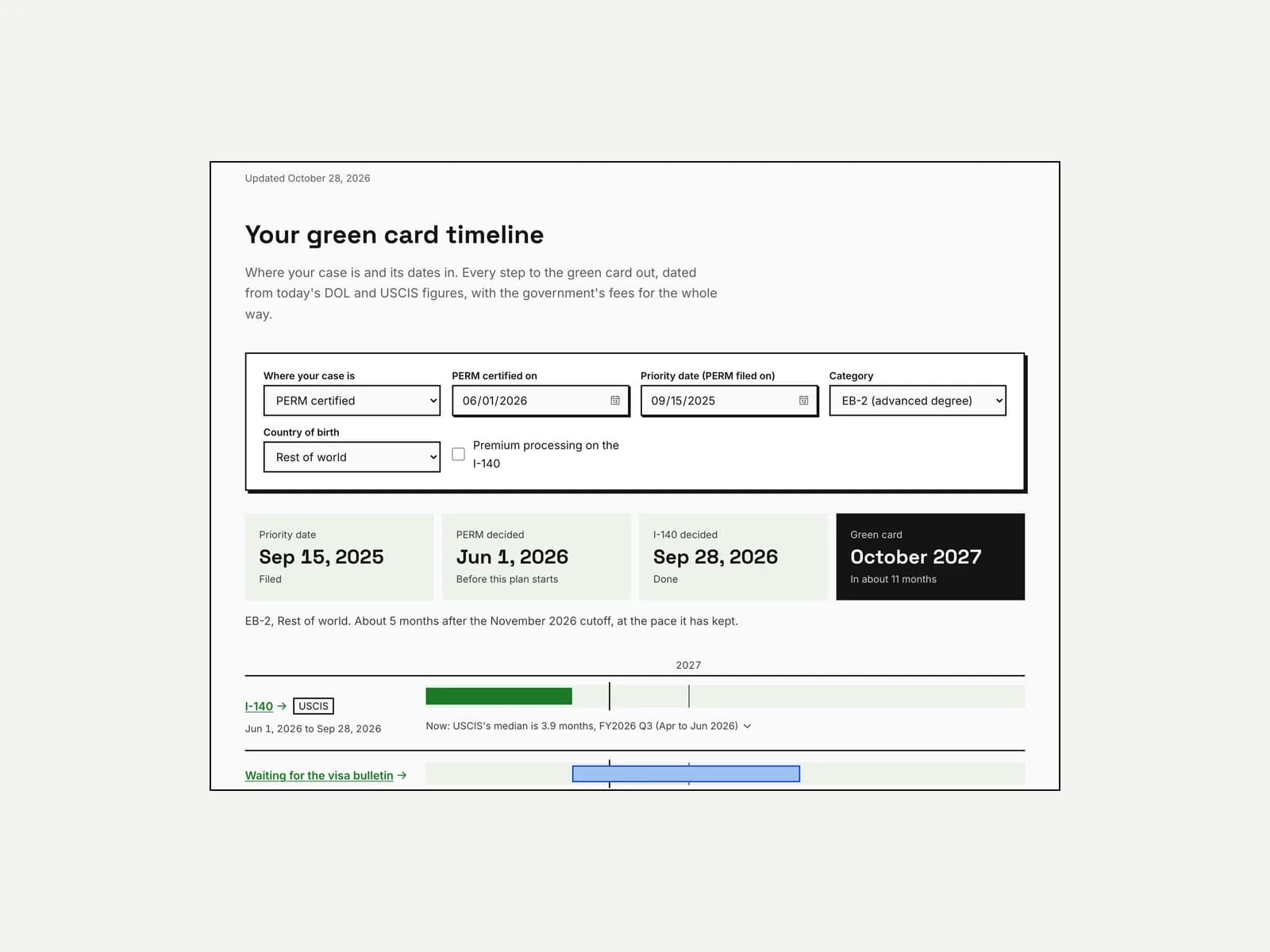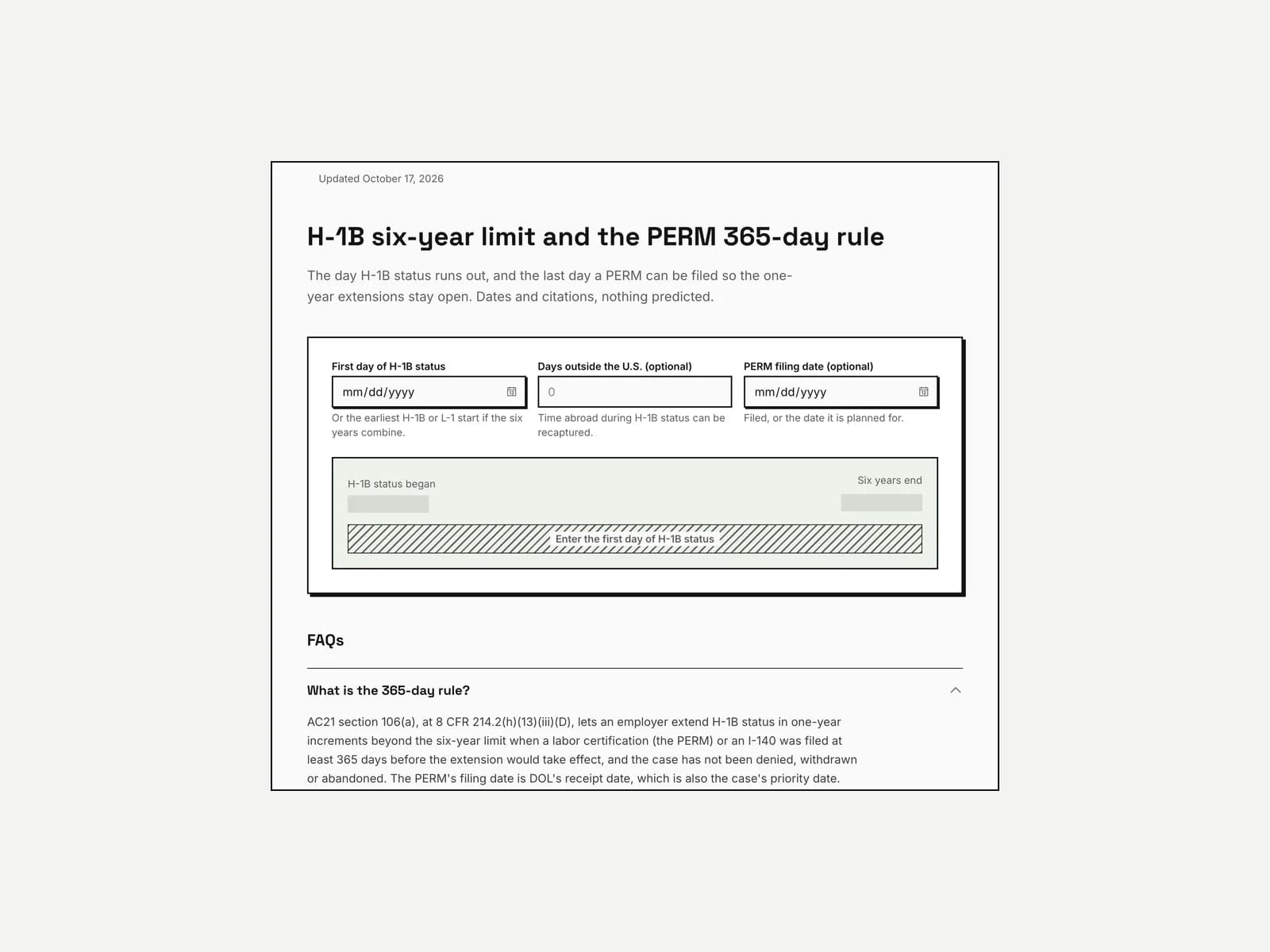
This guide is for people on an H-1B whose employer is starting a green card case, and for the HR teams and attorneys who write it. It answers a question that comes up early: does the PERM job have to be the job you do today? It doesn't. A PERM application offers a permanent job you'll hold once you're a permanent resident, so its title, duties and wage can differ from your H-1B job. To see how pay for the two compares, PERM Tracker's free Compare my offer tool places a salary among certified H-1B LCAs and certified PERM offers for the same occupation and state, and the number you type stays in your browser.
The short answer
The PERM job is a real opening the employer intends to fill with you once the green card is approved. It can be a different job from the one on your H-1B. It has to be open to U.S. workers, and its wage has to meet the prevailing wage for that job. If you already work there, its requirements are held to what you had when you were hired, with two exceptions.
Why it's a future job
Two filings describe two jobs. Your H-1B is a temporary status, and its job is the one on the labor condition application (LCA) your employer filed for it (what an LCA is). PERM is DOL's labor certification for a permanent job offer, the first step of most EB-2 and EB-3 green cards.
The PERM rules are written about work that begins later. The employer attests that "the wage the employer will pay to the alien to begin work will equal or exceed the prevailing wage that is applicable at the time the alien begins work or from the time the alien is admitted to take up the certified employment" (20 C.F.R. § 656.10(c)(1) (2025)). It also attests that "The job opportunity is for full-time, permanent employment for an employer other than the alien" (§ 656.10(c)(10)).
The next filing, the I-140 petition with USCIS, is open to "Any United States employer desiring and intending to employ an alien" (8 C.F.R. § 204.5(c)). Desiring and intending are both about the future.
Form ETA-9089 asks whether the worker is "currently working for the employer submitting this application" (question G.4), so it expects either answer. Part 656 compares the offered job with the worker's history at the employer. It has no rule that the offered job be the job the worker holds now.
What "bona fide job opportunity" means
"Bona fide" means genuine. The regulation uses the phrase for "a bona fide job opportunity, i.e., the job is available to all U.S. workers" (§ 656.17(l)). Every employer attests that "The job opportunity has been and is clearly open to any U.S. worker," and that U.S. applicants "were rejected for lawful job-related reasons" (§ 656.10(c)(8), (9)). A job opportunity is "a job opening for employment at a place in the United States to which U.S. workers can be referred" (§ 656.3).
So a future job passes when it's real. The employer recruits for it in good faith, turns away U.S. applicants only for lawful job-related reasons, and means to put you in it on approval. Section 656.17(l) asks for more proof in an audit when the worker owns part of a closely held company, is related to its owners or officers, or is one of a small number of employees.
The same job, from PERM to green card
The job DOL certifies is the job that travels. The certification is "valid only for the particular job opportunity" (20 C.F.R. § 656.30(c)(2)), and each later step checks that job.
| Step | What has to hold for the offered job | Rule |
|---|---|---|
| PERM, at DOL | A genuine opening, open to U.S. workers, at a wage that meets the prevailing wage when the work begins | 20 C.F.R. § 656.10(c); § 656.17 |
| I-140, at USCIS | The position is the same as or similar to the one DOL certified, you qualified by the PERM filing date, and the employer can pay the wage from that date until the green card | 8 C.F.R. § 204.5(c), (g)(2); Policy Manual, vol. 6, pt. E, ch. 6 |
| I-485, at USCIS | A valid offer of that job when the I-485 is filed and when it's decided, and you intend to accept it | 8 C.F.R. § 245.25(a) |
| I-485 pending 180 days or more | A new job can carry the case if it's in the same or a similar occupation | INA 204(j); 8 C.F.R. § 245.25(a)(2) |
USCIS's Policy Manual checks the I-140 position against "the position that the DOL certified" (vol. 6, pt. E, ch. 6). The I-485 is the application to adjust status, which means becoming a permanent resident from inside the country. Its rule asks for "a valid offer of employment based on a valid petition at the time the application to adjust status is filed and at the time the alien's application to adjust status is adjudicated," and the applicant "must intend to accept such offer of employment" (8 C.F.R. § 245.25(a)). Supplement J is the form that confirms it (Supplement J explained).
Intent runs through every step. The Policy Manual says "the original petitioner must have had the intent to employ the beneficiary, and the beneficiary must also have intended to undertake the employment upon adjustment" (vol. 7, pt. E, ch. 5). And 8 C.F.R. § 245.25(a)(3) asks you and the employer to show you intend the job to start "within a reasonable period upon the applicant's grant of lawful permanent resident status." Read together, these rules ask for the intent now and the job after approval.
AC21: the future job can change, within limits
AC21, the American Competitiveness in the Twenty-First Century Act of 2000, added INA 204(j). Once an I-485 has waited long enough, the petition "shall remain valid with respect to a new job if the individual changes jobs or employers if the new job is in the same or a similar occupational classification as the job for which the petition was filed" (8 U.S.C. § 1154(j)). The wait is 180 days or more from filing.
The yardstick is "the job for which the petition was filed," which is the PERM job. USCIS reads "same" as an occupation that "resembles in every relevant respect" the original and "similar" as one that "shares essential qualities or has a marked resemblance or likeness" with it. It adds that a move "may involve lateral movement, career progression, or porting to self-employment." Changing jobs after an I-140 approval works through the three dates that decide a move.
Where the experience rules limit it
The future job can be a step up, and the experience rules decide how big a step. If you already work for the employer, the PERM job's requirements can't exceed what you had when you were hired. Two exceptions apply: the experience here came from a job that wasn't substantially comparable, or the employer shows it can no longer train someone (20 C.F.R. § 656.17(i)(3)). Experience gained with the employer works through both, with examples.
This example is invented to show how the pieces fit.
| Your H-1B job today | The PERM job | |
|---|---|---|
| Title | Software engineer | Engineering manager |
| Most of the time goes to | Writing and testing code | Leading a team: hiring, planning, design reviews |
| Wage floor | The higher of the actual wage and the prevailing wage, attested on the LCA | The prevailing wage DOL sets for the manager job |
| Experience asked | Two years, which you had when hired | Four years in software engineering, two of them gained here |
| Why it can work | The LCA covers the job you do now | The engineer job spent about 10% of its time on the manager job's duties, so it wasn't substantially comparable and the years here can count |
The PERM job gets its own prevailing wage, set from its own duties and requirements (how DOL sets a prevailing wage). And if your employer moves you into the PERM job before the green card, that's a change to the H-1B job. The H-1B rule says the employer "must file an amended or new petition" for "any material changes in the terms and conditions of employment" (8 C.F.R. § 214.2(h)(2)(i)(E)).
Check your own case
Put the two jobs side by side, then check the experience rule and the dates before anything changes.
Read the PERM job beside your H-1B job
The PERM job's duties and requirements are on the wage request, Form ETA-9141. Your H-1B job is on the LCA and the H-1B petition.
Write down what you had when you were hired
Every month of experience before your start date, with letters from those employers.
If the PERM job is a step up, check the experience route
Compare your jobs here with the PERM job, duty by duty, before the wage request goes in.
Before you change jobs, count the days
Before the I-485 has been pending 180 days, an approved petition doesn't stay valid for a new job. After that, the new job has to be in the same or a similar occupation.
What this guide can't decide
Three questions turn on your own facts, and someone other than this guide decides each one.
- Whether a job is bona fide in a small or family company. Section 656.17(l) asks for documents, and DOL weighs them.
- Whether moving into the PERM job early is a material change. That's a question on your H-1B, for the attorney on it.
- Whether a new job is same or similar. USCIS decides that on Supplement J.
Nothing here is legal advice. Check your own facts with the attorney on your case.
Related
- Experience gained with the employer, for when your years here count
- I-485 vs I-485J, on confirming the job offer and porting it
- Changing jobs after an I-140 approval, on the dates that decide a move
- What an H-1B labor condition application is