This guide is for attorneys, paralegals and HR teams writing a PERM for someone who already works for the employer. It also answers the worker's own question: do the years here count toward the job's experience requirement? Often they don't. DOL looks at what the worker had on the day they were hired, and experience gained after that counts in two narrow cases the employer has to prove with records. To start the comparison, type both job titles into PERM Tracker's free job code finder, which shows the codes employers filed each title under in DOL's own PERM and H-1B files.
The short answer, 20 C.F.R. § 656.17(i)(3)
If the worker already works for the employer, the employer can't require more training or experience than the worker had when hired. Experience gained here counts in two cases: when it came from a job that wasn't "substantially comparable" to the one offered, or when the employer shows it's "no longer feasible to train a worker to qualify for the position." A job is substantially comparable when it requires "the same job duties more than 50 percent of the time."
The rule
PERM is the labor certification from the U.S. Department of Labor (DOL) that most EB-2 and EB-3 green cards need first. Its requirements have to be the employer's "actual minimum requirements for the job opportunity," the least it would accept from anyone (20 C.F.R. § 656.17(i)(1) (2025)). When the worker is already on the payroll, paragraph (i)(3) tests that against the worker's own history:
(3) If the alien beneficiary already is employed by the employer, in considering whether the job requirements represent the employer's actual minimums, DOL will review the training and experience possessed by the alien beneficiary at the time of hiring by the employer, including as a contract employee. The employer can not require domestic worker applicants to possess training and/or experience beyond what the alien possessed at the time of hire unless:
(i) The alien gained the experience while working for the employer, including as a contract employee, in a position not substantially comparable to the position for which certification is being sought, or
(ii) The employer can demonstrate that it is no longer feasible to train a worker to qualify for the position.
The "alien beneficiary" is the worker. "Domestic worker applicants" are the U.S. workers who answer the ads. Time placed here through a staffing firm counts as time with the employer.
The Board of Alien Labor Certification Appeals (BALCA), DOL's appeals board, gives the reason. The employer "is not allowed to treat the alien more favorably than it would a U.S. worker." Purchasing Partners Inc., No. 2012-PER-01663, slip op. at 4 (BALCA June 21, 2016) (quoting Your Employment Service Inc., No. 2009-PER-00151 (BALCA Oct. 30, 2009)).
Two more parts of paragraph (i) matter. Here "employer" means "an entity with the same Federal Employer Identification Number (FEIN)," its federal tax number (§ 656.17(i)(5)(i)). And education or training the employer paid for doesn't count "unless the employer offers similar training to domestic worker applicants" (§ 656.17(i)(4)).
Route one: a job that wasn't substantially comparable
The first exception lets experience from a different job at the same employer count. Paragraph (i)(5)(ii) draws the line:
A "substantially comparable" job or position means a job or position requiring performance of the same job duties more than 50 percent of the time. This requirement can be documented by furnishing position descriptions, the percentage of time spent on the various duties, organization charts, and payroll records.
DOL wrote this test in 2004 in place of the Board's older factors from Delitizer Corp. of Newton, which it called "unnecessarily complex and in practice difficult to administer." 69 Fed. Reg. 77,326, 77,354 (Dec. 27, 2004).
In practice the comparison is a table. List the earlier job's duties with the share of its time each took. Mark every duty the offered job also has. Add up the marked shares. Above 50 percent, the jobs are substantially comparable and this route is closed.
In this table, the first two cases are invented to show the arithmetic. The third is a real Board decision.
| Case | The worker's history here | Shared with the offered job | Does that experience count? |
|---|---|---|---|
| Example: the same job, more years | Hired as a data analyst with 1 year of experience, and the PERM for that same job asks for 3 years | Every duty | No, because DOL reviews the 1 year held at hire and 3 years fails unless training is no longer feasible |
| Example: a different job first | Hired as a QA analyst (60% test plans, 25% defect triage, 15% small scripts) and sponsored as a developer, with 2 years of QA or development work accepted | The scripts, 15% of the QA job's time | It can, because the QA job wasn't substantially comparable and the requirement accepts QA work |
| MSA Partners, 2016 | Two years of market research before hire and four years here as a technical writer and translator, for a job needing a master's or a bachelor's and 5 years | Not reached | No, because the years here didn't qualify the worker for the job, so the Board never reached the two exceptions |
The third case is MSA Partners, LLC, No. 2012-PER-01232, slip op. at 4 and n.3 (BALCA Nov. 30, 2016) (en banc). It shows the other half of the test. Experience from a different job still has to be the kind the requirements ask for.
The regulation counts time on "the same job duties" and stops there. It doesn't say how alike two duties have to be. Describe each one concretely, in the words the job used at the time.
What proves it
In Your Employment Service, the employer sent a letter from its vice president and a staffing certificate, with no job descriptions, organization charts or payroll records. The denial was affirmed: "Merely saying that the jobs were not substantially comparable is not the same as providing documentation to support the assertion." Slip op. at 7.
The file needs the regulation's own list for each job the worker held here:
- a dated position description
- the share of time on each duty
- organization charts from before and after the move
- payroll records that show the change
Route two: it's no longer feasible to train
The second exception covers an employer that trained the worker and can't train a new hire now. The Board reads it narrowly. "An employer must demonstrate a change in circumstances in order to meet the infeasibility to train exception," and it "must present more than a bare assertion that it is infeasible to train new workers." Purchasing Partners, slip op. at 4. That employer cited "a significant industry-wide change in technology" with nothing to back it, and lost. Id. at 4-5. DOL expected the route to be rare: "the 'infeasibility to train' argument is rarely claimed in practice." 69 Fed. Reg. at 77,354.
Neither the rule nor these decisions lists what's enough. They ask for the change, the date it happened, and documents that show it.
Where it shows on the form
Section G of Form ETA-9089 asks about all of this:
- G.4: is the worker "currently working for the employer submitting this application"?
- G.5: does the employer rely solely on experience gained while working for it?
- G.5a: did any of it come "in a position substantially comparable to the job opportunity"?
- G.5b: did the employer pay for education or training the requirements need?
The form's instructions tie a yes on G.5a to route two. The employer should "be prepared to provide documentation, upon request from the Certifying Officer, demonstrating why it is no longer feasible to train a U.S. worker to qualify for the position." The certifying officer is the DOL official who decides the case, and can deny on the form alone. DOL denied Purchasing Partners that way without an audit, and the Board upheld it. Slip op. at 5.
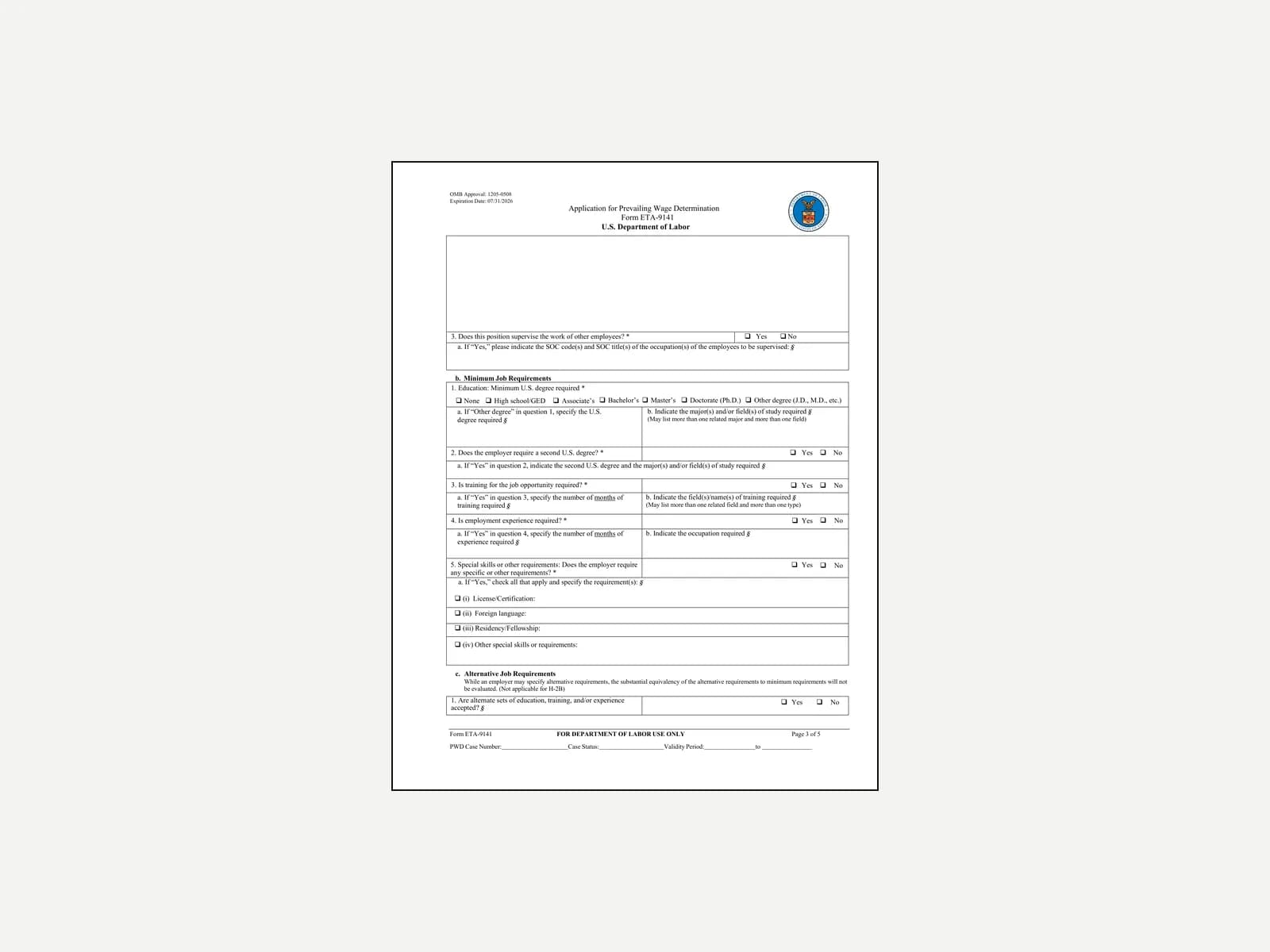
Since June 1, 2023, the requirements go on the wage request, Form ETA-9141, and no longer on the ETA-9089 (USCIS Policy Manual, vol. 6, pt. E, ch. 6). So this check belongs at intake.
USCIS checks the same dates
USCIS reviews the worker's qualifications on the I-140, the employer's immigrant petition. Its Policy Manual says a petition "is not approvable if the beneficiary was not fully qualified for the classification by the filing date of the permanent labor certification (the petition's priority date)." Experience that counts has to be complete by the day the PERM is filed. Each experience letter needs "a specific description of the duties performed by the alien" (8 C.F.R. § 204.5(g)(1)).
What to do
Build the worker's history at intake, then pick the route before the wage request goes in.
Record what the worker had at hire
The start date, the first title, and every month of experience before it, with letters from those employers.
Compare each job here with the offered job
List duties and the share of time on each, from records made at the time, and add up the shared ones.
Choose the route before the wage request
Experience from before hire, a job here that wasn't substantially comparable, infeasibility to train, or a requirement no higher than what the worker had at hire. The employer questionnaire asks for the history.
Answer G.4 and G.5 to match, and keep the file
The audit file guide lists the records, and answering a PERM audit covers sending them.
What this guide can't decide
Three questions need the real jobs and the attorney's judgment.
- Whether two duties are "the same." That's a judgment on the real jobs, made by the attorney on the case.
- Whether time at a related company counts. On the regulation's words, a company with its own FEIN isn't "the employer" for this rule. A merger or a change of FEIN can complicate that.
- Whether a change in circumstances is enough for route two. The Board has set the bar high and hasn't listed what clears it.
Nothing here is legal advice. Check the facts with the attorney on the case.
Related
- The PERM job is a future job, on how the green card job can differ from the one held today
- Business necessity in PERM, for requirements above what's normal for the occupation
- The PERM employer questionnaire, for the worker's history at intake