This guide is for anyone whose USCIS case is taking longer than it should: an I-485, an I-140, a work permit or anything else USCIS decides. A congressional office can ask USCIS about a case for you, but only once the case is late by USCIS's own measure. PERM Tracker's free case inquiry date tool reads USCIS's newest cutoff for your form and office, says whether you can ask now, and drafts the note to the office.
The short answer
Wait until your case is outside USCIS's normal processing time. Ask USCIS first through its online case inquiry. If that doesn't move it, ask your representative or one of your senators, and sign their privacy release. The CIS Ombudsman and, last of all, a lawyer come after that.
When a case counts as late
USCIS answers questions about a case only once it has waited longer than the time USCIS took to finish 93% of similar cases. Its processing-times page explains the arithmetic: "Case Inquiry Date = [time to complete 93% of adjudicated cases] – [today's date – receipt date]," and "If the calculation for the case inquiry date produces a negative number, you will be able to submit a question about your case" (USCIS, More Information About Case Processing Times). That page turns scripts away, so its wording here is from the Internet Archive's capture dated Feb 1, 2025.
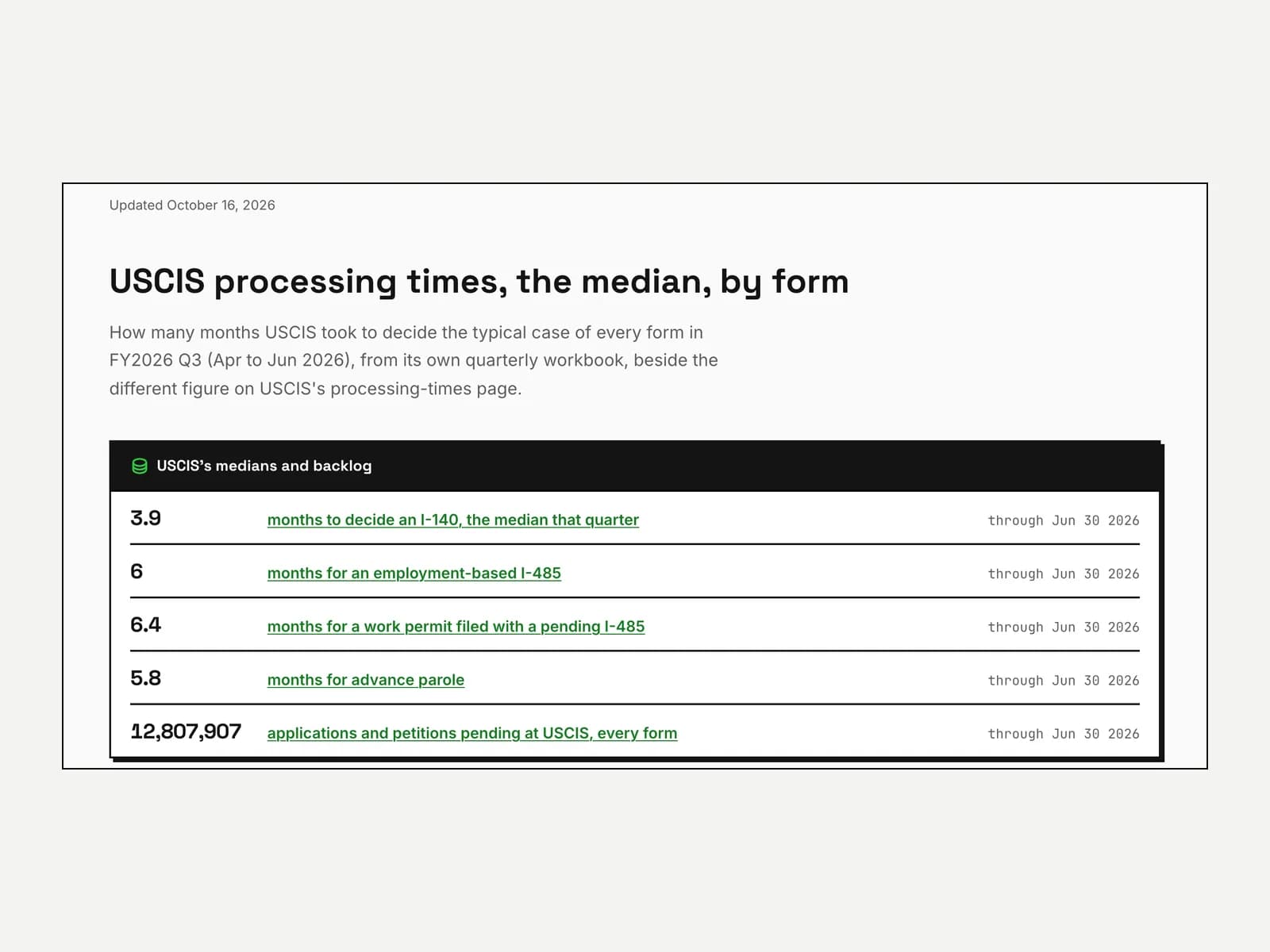
That's a later point than the processing time USCIS prints, which is the time it took to finish 80% of cases. So a case can pass the printed time and still be inside normal processing. USCIS's page turns all of this into one date per form, category and office: the receipt date before which a case may ask.
Where USCIS posts no time for a form, its default applies: "you may submit an inquiry if your case has been pending more than six months" (USCIS's processing-times FAQ).
Ask USCIS first
Every later step expects you to have done this. USCIS's own page on a pending case says "We do not research the status of cases that are within the expected processing times" (While My Case is Pending), and links its online case inquiry for one taking longer than expected. You can also call the Contact Center at 800-375-5283.
USCIS's Policy Manual says the "goal for resolution of service requests is 15 business days from the date of creation." Keep the reference number its reply carries. The Ombudsman asks for it later.
How a congressional inquiry works
Your representative's and your senators' offices have caseworkers who ask federal agencies about constituents' cases. They don't decide anything, and they can't make USCIS approve a case. They can get an answer when the usual channels haven't.
| What the office needs | Why |
|---|---|
| A privacy release you sign | USCIS tells an office about a case only with "a privacy release" from the person the information is about (USCIS Policy Manual, vol. 1, pt. A, ch. 7) |
| Your receipt number, and your A-number if you have one | USCIS's sample release asks for them, and for no Social Security number |
| The form, the date and place filed, and what's happened | So the caseworker can say what's late and since when |
| That you live in the district or state | Offices serve their own constituents |
The person the case is about signs the release. USCIS's guidance for congressional offices says a spouse, a relative or an attorney "cannot authorize the release of information on behalf of the individual." Many offices also say they won't ask while a case is still inside normal processing.
Find your representative by ZIP code at house.gov, and your senators at senate.gov. Each office's site has its own immigration casework form.
After Congress: the Ombudsman, then a lawyer
The CIS Ombudsman is an office inside the Department of Homeland Security that helps with stuck cases. Its case assistance page sets the rule for a delay: "Before you request assistance from us, you must have contacted USCIS in the last 90 days and given the agency at least 60 days to try to resolve your problem." It also says it can't help "if it has been fewer than 45 calendar days since your congressional representative made an inquiry."
Mandamus is the last step. It's a lawsuit asking a federal judge to order USCIS to decide the case, under 28 U.S.C. § 1361. The Supreme Court has called it a remedy "only if he has exhausted all other avenues of relief" (Heckler v. Ringer, 466 U.S. 602, 616 (1984)). Whether a delay is long enough is a question for an immigration attorney.
What this can't tell you
- Whether an inquiry will speed up your case. It gets you an answer, and USCIS decides the timing.
- Your office's own rules. Each congressional office sets its own form and what it needs.
- Anything about your own case's merits. Nothing here is legal advice.
Related
- When can I ask USCIS about my case?, the tool that reads USCIS's cutoff and drafts the note
- USCIS processing times, the figures USCIS posts and the medians behind them
- Waiting on your green card
- Silent updates on a USCIS case