This guide is for the attorney, paralegal or HR lead filing a PERM for someone who works from home, all week or part of it. It also explains to the worker why their home address can end up on the form. In PERM, the place the work is done sets most of the case. It decides the wage and where the job is advertised, and it decides who sees the notice of filing. PERM Tracker's free wage level tool shows the wage for the worker's home area, read live from DOL's own wage search.
The short answer
PERM draws its area around the address where the work is done. For someone who works from home every day, the form lets that address be the home. The wage, the job order and the newspaper ads then follow the home's area. The rule doesn't spell out where the notice of filing goes, so settle that with the attorney on the case before recruitment starts.
Everything follows the area of intended employment
Every step of a PERM is tied to one area, drawn around the address where the work is done. 20 C.F.R. § 656.3 defines it: "Area of intended employment means the area within normal commuting distance of the place (address) of intended employment." A metropolitan statistical area (MSA) is a metro area as the federal Office of Management and Budget defines it. Inside one, "any place within the MSA or PMSA is deemed to be within normal commuting distance of the place of intended employment."
So the address comes first, and every step that names an area reads from it. In this table, the SWA is the State Workforce Agency, the state office that runs the public job bank.
| Step | What the rule ties to the area | Rule |
|---|---|---|
| Prevailing wage | The mean wage "of workers similarly employed in the area of intended employment" | § 656.40(b)(2) |
| Job order | Placed "with the SWA serving the area of intended employment" for 30 days | § 656.17(e)(1)(i)(A) |
| Sunday ads | In "the newspaper of general circulation in the area of intended employment" | § 656.17(e)(1)(i)(B)(1) |
| Notice of filing | Posted "at the facility or location of the employment" | § 656.10(d)(1)(ii) |
| Layoffs | Any layoff "in the area of intended employment within 6 months of filing" | § 656.17(k)(1) |
| The certification | Valid only for "the area of intended employment stated on" the form | § 656.30(c)(2) |
How the ETA-9089 asks about remote work
The Form ETA-9089 filed in DOL's FLAG system since 2023 never uses the words telework or remote, and neither do its General Instructions. Section F, "Area of Intended Employment Information," asks for the type of worksite instead. Question F.a.1 reads "Type of worksite location that best describes where work will be performed (Choose only one)" and offers four boxes:
- Business premises
- Employer's private household (includes live-in and domestic household worker)
- Employee's private residence (when work is performed directly out of the residence)
- No one specific worksite address or physical location
The third box is the home worker's. The General Instructions say why the address matters: "It is important for the employer to define the area of intended employment with as much geographic specificity as possible by identifying every worksite location where work will be performed. This information is used for purposes of reviewing and verifying regulatory compliance with advertising, notice posting, and prevailing wage requirements."
The worksites also have to match the wage request, Form ETA-9141, which comes first in the case. Any extra worksite on the PERM "must be one or more of the additional worksites identified in Appendix A of the Form ETA-9141 for this specific job opportunity." So settle the remote arrangement before the wage request goes in.
Hybrid and roving set-ups
A hybrid job splits the week between home and an office. A roving one moves between places.
| How the job is done | What Section F offers | What to settle first |
|---|---|---|
| From home, every working day | "Employee's private residence" in F.a.1, with the home's address, county and metro area | That the wage request named the same address |
| Hybrid, with the office in the same metro area as the home | One area covers both, because any place in a metro area counts as commuting distance | Which address is the worksite, and where the notice goes |
| Hybrid, with the office in another metro area | "Yes" to F.b.1, which asks about work in areas beyond the one in F.a, plus Appendix B listing the others | Recruitment and notice for each area |
| No set place, such as moving between client sites | "No one specific worksite address or physical location," then F.c, where a roving job is entered as "Various Worksites" | Recruitment and the wage for the headquarters' area, which DOL's FAQ asks when the worksites can't be known |
The worksite guide covers roving jobs, client sites and what a move does to a case.
Where the notice of filing goes
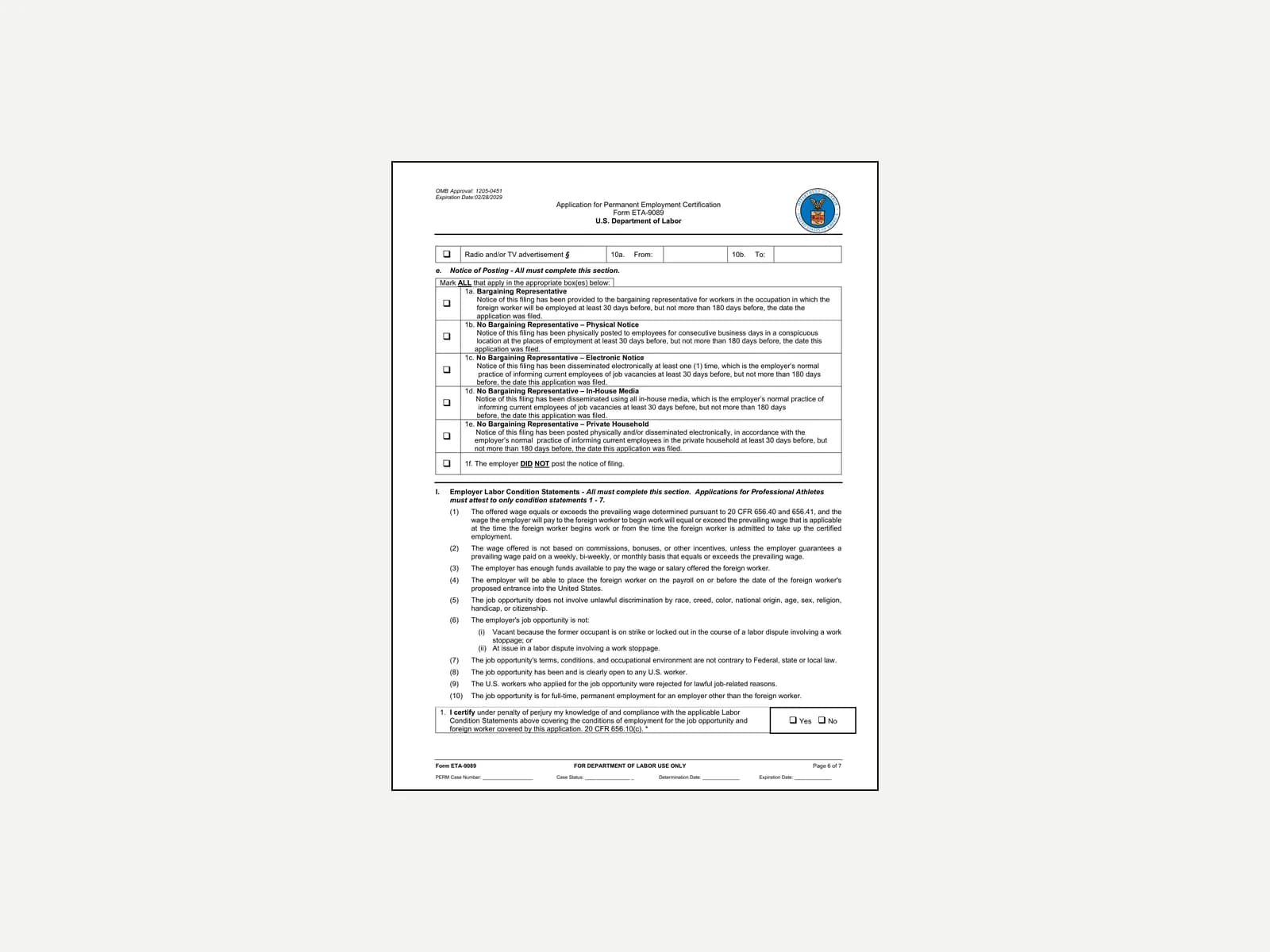
The notice of filing tells the employer's own staff that a PERM is being filed for the job. When no union represents the occupation, 20 C.F.R. § 656.10(d)(1)(ii) calls for a "posted notice to the employer's employees at the facility or location of the employment." It also has to go out in "any and all in-house media, whether electronic or printed."
The form's instructions put the notice "at the facilities or location(s) of employment, as indicated in" Appendix B. A worksite in the same metro area "should also be listed if a Notice of Filing will be posted at that location." For Section H they add: "please note that 1c and 1d should only be selected if 1b is selected." Box 1b is the physical posting, and 1c and 1d are the electronic notice and the in-house media. So on the form, the electronic notice comes on top of a physical posting.
Neither text says where the physical notice goes when the location of the employment is a home. DOL's nearest answer is a 2006 FAQ for workers placed at clients: the notice goes up "at that work-site(s) where the employee will perform the work," with the in-house notice beside it. It doesn't speak to a home. For a job whose worksites can't be known in advance, a 2019 FAQ puts recruitment and the wage on the headquarters' location. Settle these with the attorney:
- Is there an employer office in the same metro area, where co-workers would see it?
- Should it also go up at the office the worker reports to?
- Is any office used listed in Appendix B, as the instructions ask?
The notice of filing guide has a sample notice and the posting rules in full.
The job order and the ads
For a home worksite, the job order goes to the State Workforce Agency serving the home's area, which can be in a different state from the office. The Sunday ads run in a newspaper there. Each ad has to give the geographic area "with enough specificity to apprise applicants of any travel requirements and where applicants will likely have to reside to perform the job opportunity" (§ 656.17(f)(4)). For a job done from home, that's the area an applicant would need to live in. The attorney decides the wording. The Sunday ads guide covers the timing and the three extra steps for a professional job.
A worked example
This is an example case with no real employer behind it. The employer's only office is in Chicago. The worker lives in Columbus, Ohio, and works from home every day.
The wage request
The ETA-9141 gives the Columbus home as the worksite, so the wage comes from the Columbus metro area. The wage level tool shows DOL's four levels there.
Section F of the ETA-9089
F.a.1 is "Employee's private residence," with the home's address, county and metro area. F.b.1 is "No," because no work happens in another area.
The job order and the ads
The job order runs for 30 days with Ohio's State Workforce Agency. The two Sunday ads run in a Columbus-area newspaper and say the job is there.
The notice of filing
Chicago is outside the Columbus area, so this is the step to settle. The attorney decides where the physical notice goes and whether any office used is listed in Appendix B. Either way, the in-house notice goes out through the employer's normal channels.
The certification
It's valid for the Columbus area. A later move to Cleveland would put the job outside it.
What to do
Settle the worksite first, then the notice, then the dates, in that order.
- Settle where the work is done before the wage request, because the PERM's worksites have to come from it.
- Agree in writing with the attorney where the notice goes, before recruitment starts.
- Get the latest start for the job order, the first Sunday ad and the notice from the PERM deadline calculator, and keep dated copies of each step.
What this guide can't settle
Three questions turn on facts only the attorney on the case has.
- Where the notice goes for a home worksite with no office nearby. The rule names "the facility or location of the employment." The attorney on the case decides what that is.
- Whether a job that can be done from anywhere in the country fits PERM. Section 656.3 defines a job opportunity as "a job opening for employment at a place in the United States to which U.S. workers can be referred." That takes a place.
- Whether DOL will read a case the same way. A certifying officer decides each case first. Nothing here is legal advice.
Related
- Where to file PERM: headquarters, branch or client site, for jobs with more than one worksite and for moves
- The PERM notice of filing, with a sample notice
- How DOL sets a prevailing wage, for why a new area means a new wage
- Where PERM employers recruit, the newspapers and steps in DOL's own records