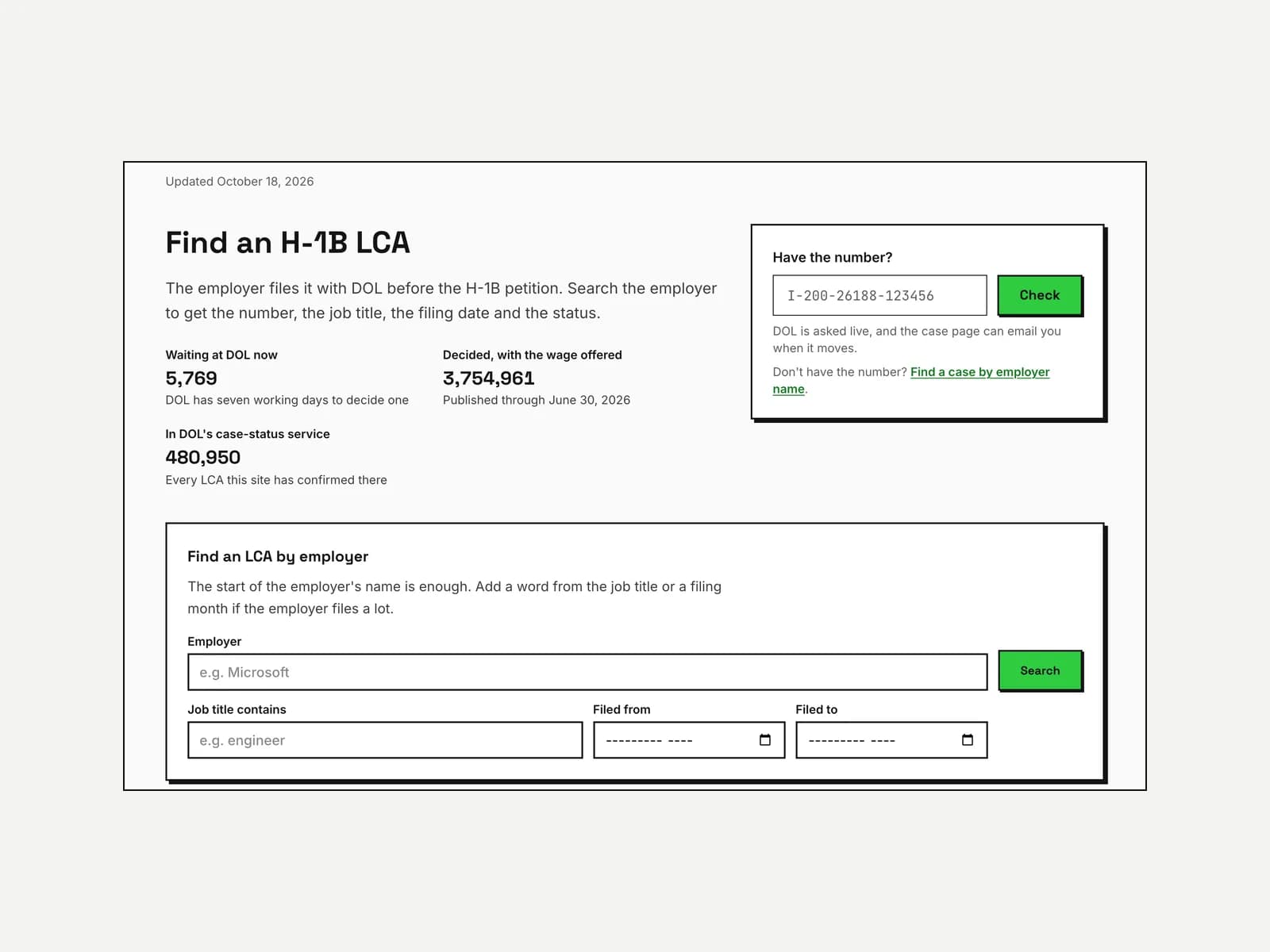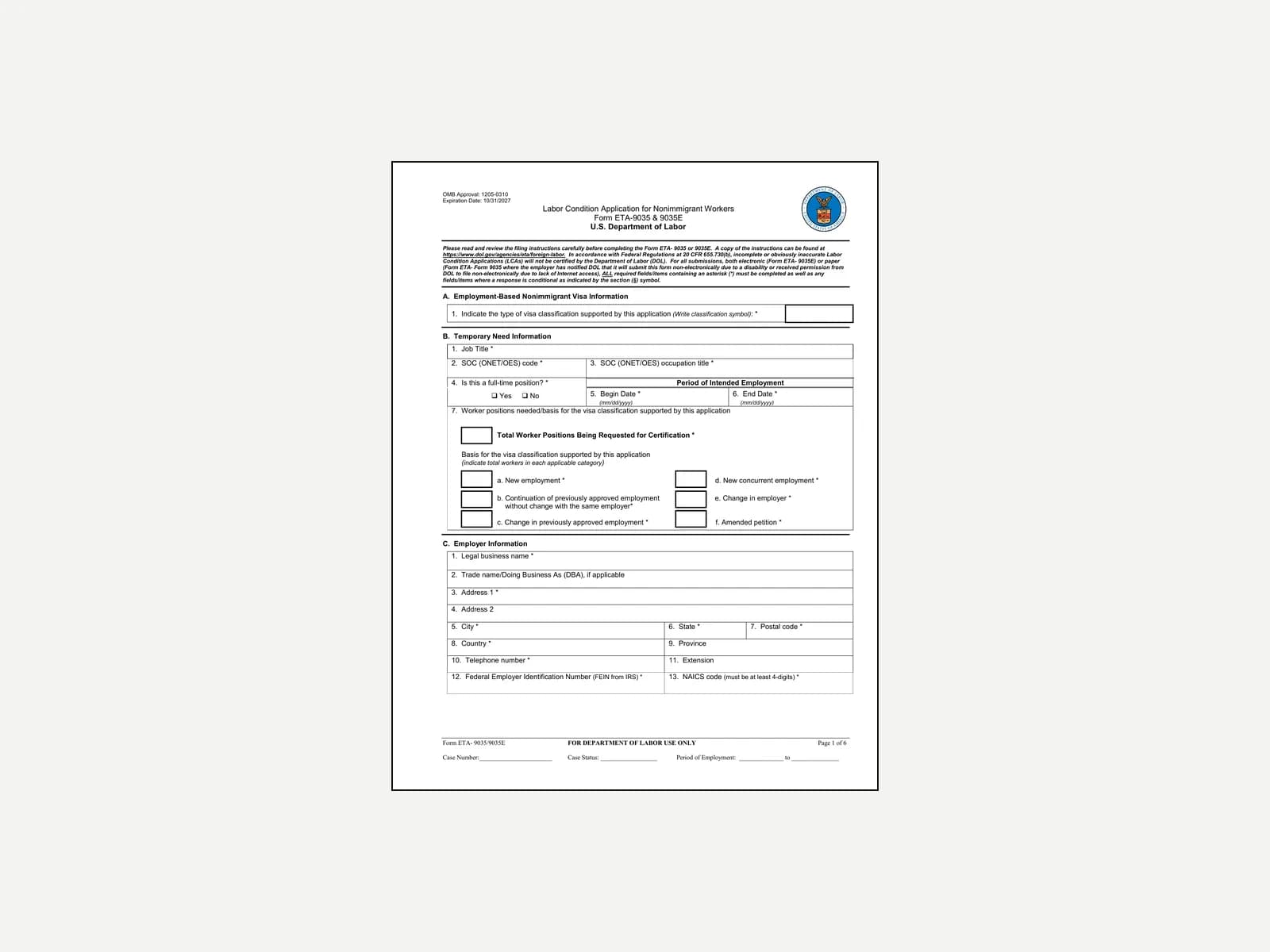
Before an employer can sponsor an H-1B, H-1B1 or E-3 worker, it files a labor condition application (LCA) with the Department of Labor. The LCA is Form ETA-9035, the employer's promises about pay and working conditions. A DOL rule gives the agency 7 working days to certify one or send it back. To see where an LCA stands, type its number into PERM Tracker's free case lookup, which asks DOL's case-status service live and can email you when a pending LCA's status changes.
The short answer
Seven working days from the day DOL receives the application. DOL certifies the LCA when every item is filled in and nothing on the form is obviously inaccurate. Otherwise it returns the LCA not certified, and the employer can correct it and file again.
The rule
20 CFR 655.740(a)(1) sets the clock:
"The Certifying Officer shall make a determination to certify or not certify the labor condition application within 7 working days of the date the application is received and date-stamped by the Department."
The Certifying Officer is the DOL official who decides. The count starts on the day DOL receives the application. It runs in working days, so a weekend uses none of it.
DOL says the same on its own LCA program page: "LCAs are reviewed by the Department within seven (7) working days for completeness and obvious errors or inaccuracies." Once DOL certifies one, it returns a certified copy to the employer. The employer then moves on to the visa itself, which USCIS and the State Department handle.
What DOL checks in those seven days
The check is of the form itself. The rule's definitions (655.715) call certification a finding that the application "is not incomplete and does not contain obvious inaccuracies."
Under 655.740(a)(2), DOL returns an LCA not certified for one of two reasons:
- The form isn't properly completed. A required box is left unchecked, or an item is missing, such as the occupation, the number of workers, the wage, the period or place of work, or the prevailing wage and its source.
- The form has an obvious inaccuracy. The rule's examples are a wage below the federal minimum wage, a wage below the prevailing wage the LCA itself lists, or a wage range whose bottom falls below it. Filing more than six months before the job starts counts too, and so does naming more than one occupation on one LCA.
DOL also refuses an LCA from an employer its Wage and Hour Division has disqualified from the program. DOL's debarment lists include the employers barred from H-1B filings.
DOL doesn't check whether the promises are true. Paragraph (c) of the rule says so plainly: "DOL is not the guarantor of the accuracy, truthfulness or adequacy of a certified labor condition application." The burden of proving what it attested to stays with the employer.
How it plays out in DOL's record
DOL's processing times page has no LCA section. It covers PERM, prevailing wage requests, H-2A, H-2B and CW-1. The H-1B row on it belongs to prevailing wage requests, which are a different filing.
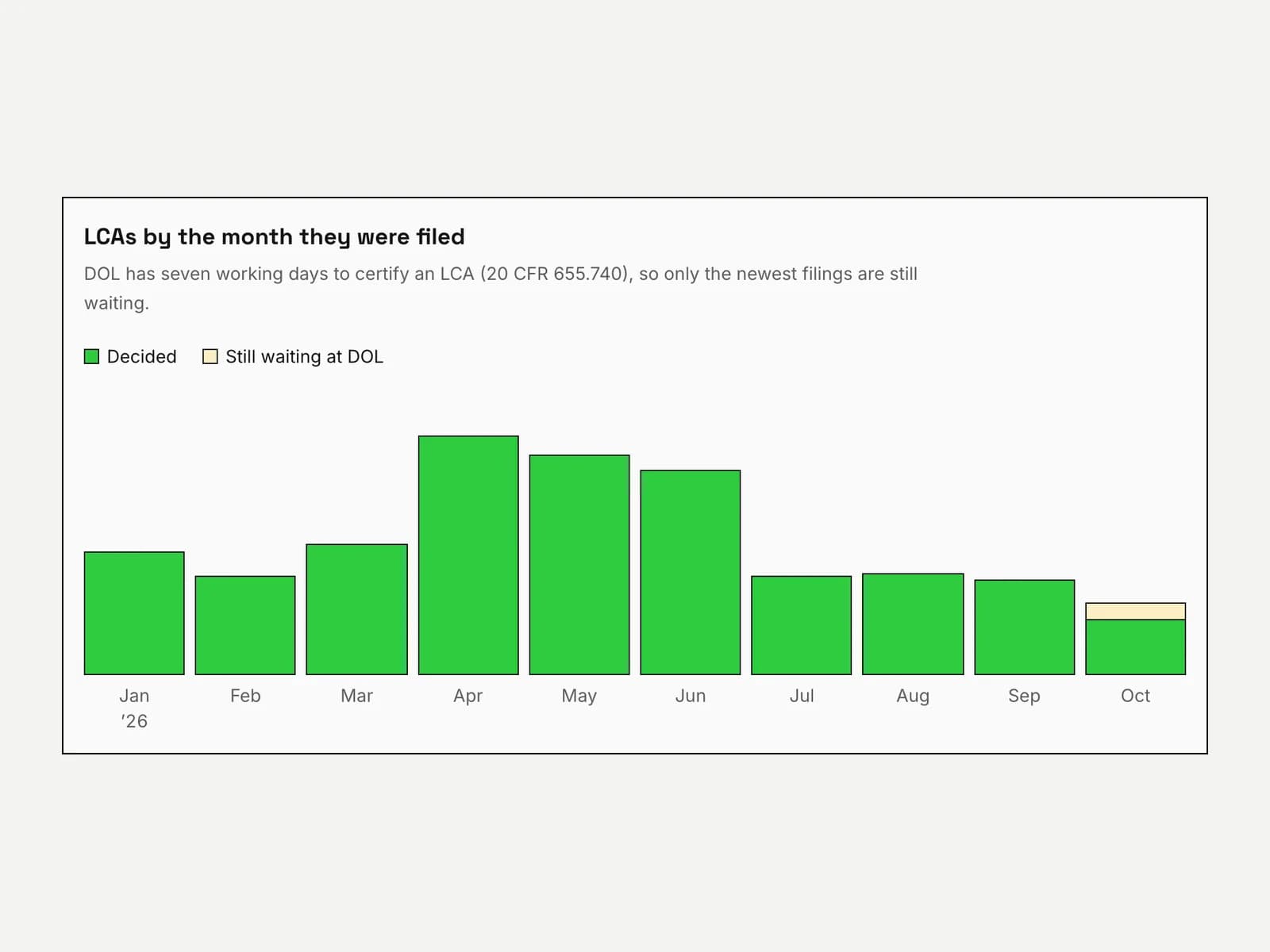
So the record to read is DOL's case status, one LCA at a time. PERM Tracker reads LCA statuses from DOL's case-status service daily. The LCA search charts what it finds by filing month, splitting each month into LCAs DOL has decided and LCAs still waiting. When DOL keeps to its seven working days, the waiting part sits in the newest filings and older months show next to nothing.
DOL's disclosure files add the rest. Each one lists every LCA DOL decided in the period, with the day DOL received it and the day DOL decided it. Counting the working days between the two for fiscal year 2025, October 2024 to September 2025, DOL kept to the rule every time. All 543,358 LCAs it certified were decided within 7 working days, and 502,543 of them on the fifth. The 3,921 it denied came back faster, nearly all of them the next working day.
What a delay means
An LCA still in process after seven working days is outside the rule's timeline. The public status won't say why. DOL sends its reasons for any return to the employer or its representative, and the employer can check each case's status in its FLAG account (FLAG is DOL's filing system).
Before reading a delay into it, rule out three ordinary causes:
- The count is in working days. A weekend or a federal holiday inside the week spreads seven working days over more calendar days.
- A corrected LCA starts again. It's a new application with its own filing day, so its seven working days begin then.
- A withdrawn LCA stops. FLAG's own FAQ lets an employer withdraw a case that's in process, and the status then reads Withdrawn.
Nothing in the rule tells a worker what to do about a slow LCA, and nothing here is legal advice. The employer or its attorney can see the case in FLAG.
What a denial means
On DOL's case status, an LCA DOL didn't certify reads Denied. Under 655.740(a)(3), DOL returns it to the employer "explaining the reasons for such return without certification." The rule goes on:
"The employer may immediately submit a corrected application to ETA. A 'resubmitted' or 'corrected' labor condition application shall be treated as a new application by ETA (i.e., on a 'first come, first served' basis)"
ETA is DOL's Employment and Training Administration, the part of DOL that runs labor certification. So a denied LCA means DOL found the form incomplete or obviously inaccurate, and the employer can fix it and file again. The one exception is an employer the Wage and Hour Division has disqualified. That refusal is final, and the rule bars a corrected filing.
How to check an LCA
Get the number, look it up, count seven working days from the filing date, and ask the employer if it's past that.
Get the number
An LCA number starts with I-200 for an H-1B, I-201 or I-202 for an H-1B1, and I-203 for an E-3. If the employer hasn't shared it, you can find it by the employer's name.
Look it up
Paste it into the case lookup. It shows DOL's status, the employer, the job title and the day the LCA was filed.
Count seven working days from the filing date
Inside that window, In process is the rule working as written. Leave an email address on the result and you'll hear when the status changes.
Past that, ask the employer
The employer can check the case in FLAG, and DOL's reasons for any return go to the employer or its representative. If the status reads Denied, ask whether a corrected LCA went in. It's a new application with a number of its own.
What this can't tell you
- The reason a particular LCA was returned. DOL explains that to the employer, and the public record carries only the status.
- Anything about the H-1B petition. USCIS decides it under its own receipt number, and the USCIS receipt number page says where USCIS shows its status.
- Whether the employer keeps the promises on the form. Certification doesn't test them. The Wage and Hour Division enforces them afterward.
- What you should do. Nothing here is legal advice.