Your I-140 is approved and nothing happens next. That's not a stall in your case. It's the design of the system: an approved petition gives you a place in line, and the line for EB-2 India is the longest USCIS publishes.
What "no visa number" means
USCIS explains the mechanism at https://www.uscis.gov/green-card/green-card-processes-and-procedures/visa-availability-priority-dates. The State Department's monthly Visa Bulletin carries two charts, "Application Final Action Dates" and "Dates for Filing", and USCIS says "you must use the Application Final Action Dates for determining when you can file ... unless otherwise indicated" by USCIS for that month.
The Policy Manual, Volume 7, Part A, Chapter 6, at https://www.uscis.gov/policy-manual/volume-7-part-a-chapter-6, gives the rule that binds the I-485: "In most cases, an immigrant visa must be available at the time of filing the adjustment application and at the time of final adjudication, if approved."
For a PERM-based case your priority date is the day the labor certification was filed with DOL. A visa number is available to you when the Final Action Dates chart for your category and country shows a date later than yours, or "C" for current. For EB-2 India the Sep 2026 bulletin shows "U", unavailable, and has since the Jul 2026 bulletin. The Jun 2026 bulletin's final action date was 01SEP13. The Dates for Filing chart has stood at 15JAN15. The visa bulletin page holds every month back to Oct 2014, and how the visa bulletin works explains the two charts and what "U" means.
How many are waiting
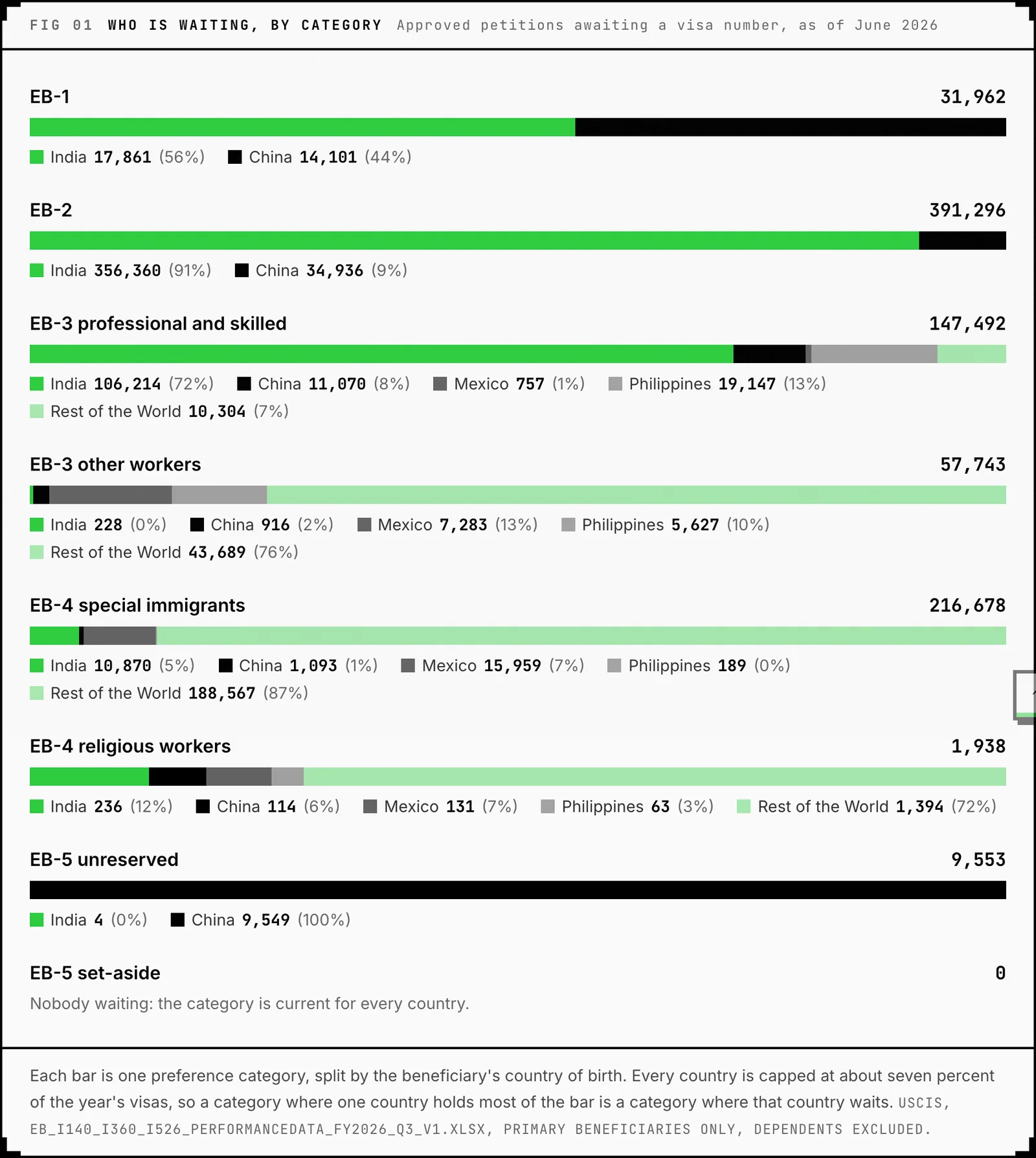
USCIS publishes a count of approved employment-based petitions whose beneficiaries are waiting for a visa number, by category and country. The current file is "as of June 2026" (queried Jul 2026): https://www.uscis.gov/sites/default/files/document/data/eb_i140_i360_i526_performancedata_fy2026_q3_v1.xlsx.
| Approved petitions awaiting visa availability, as of Jun 2026 | Count |
|---|---|
| EB-2 India | 356,360 |
| EB-2, all countries | 391,296 |
| EB-2 China | 34,936 |
| EB-1 India | 17,861 |
| EB-3 India | 106,214 |
| India, all employment categories | 491,773 |
| All countries, all categories | 856,662 |
EB-2 India is 91% of the EB-2 total and 42% of everyone waiting in every category from every country.
The file's own notes say what the count is and isn't. It counts primary beneficiaries only: no spouses or children. The priority date test is against the June 2026 bulletin's Final Action Dates. And it "may contain multiple petitions per person", so a worker with two approved I-140s from two employers is in it twice. It excludes people who already have permanent residence or citizenship.
And the queue keeps taking new entrants
USCIS's I-140 receipts by classification and country, https://www.uscis.gov/sites/default/files/document/data/i140_rec_by_class_country_fy2026_q3_v1.xlsx, gives the inflow. In fiscal year 2026 through Jun 30, USCIS received 30,316 EB-2 petitions for India and approved 23,664. In FY2025 it received 43,976 and in FY2024, 43,342. I-140 trends charts those series by quarter, and the I-140 awaiting visa page shows the waiting count by category and country with the date USCIS stamped on it.
What the wait actually is
It's this: a count of 356,360 primary beneficiaries with priority dates ahead of the chart, an annual supply of visa numbers set by statute and allocated by the State Department, and a monthly chart that moves when State decides it can. That's the whole of what's published.
What isn't published is the number you want, which is the date your priority date becomes current. Every forecast you'll read for it divides the count by a guess at the yearly supply. The green card line divides by the one supply that isn't a guess, the green cards the line actually got in the newest published year, and prints years at that pace. That's arithmetic on a past year, and here's why it can't be read as a date:
- The count isn't people. Multiple petitions per person inflate it; dependents, who each use a visa number, aren't in it at all. The two errors run in opposite directions and nobody outside USCIS and State knows their size.
- The supply isn't fixed. Unused family-based numbers spill into the employment-based total, and the State Department sets that after the fact. For FY2026 its Annual Numerical Limits sheet put the employment-based total at 186,000 against the statutory 140,000; the visa bulletin page shows that sheet's figures as the Department set them.
- The chart doesn't move at a steady rate. The archive on this site holds every bulletin since October 2014. The category has advanced, held and retrogressed, and a straight line through any window of it would have been wrong in the next one.
So the honest answer to "how long" is a count, a chart and its history. Read your priority date history shows how to read your own date against that history without turning it into a promise.
What you can do while waiting
- Keep the I-140 approval. A priority date can survive a change of employer under conditions the priority date retention tool walks through.
- Watch both charts each month. If USCIS designates the Dates for Filing chart for a month and your date is earlier than 15JAN15, an I-485 can be filed then, even though it can't be approved until the Final Action chart reaches you. The I-485 queue position tool shows how many filed I-485s sit ahead of a date, from USCIS's inventory.
- If an I-485 is already pending, the work permit and travel document ride on it; the EAD and advance parole guide covers those, and Supplement J covers changing jobs after 180 days.
What this can't tell you
- When your date becomes current. Nothing on this site forecasts the bulletin. A years figure at last year's pace is the closest it comes, and it says so beside the number.
- How many are ahead of you exactly. The awaiting-visa file is by category and country, not by priority date. The I-485 inventory the queue tool reads is by priority date, but it covers filed I-485s only, not approved I-140s that haven't filed. The green card line puts both together, with pending petitions and families, as a range by priority date, with years at last year's pace beside it.
- Whether EB-1 or a national interest waiver is open to you. Those are eligibility questions, and EB-2 vs EB-3 and PERM vs NIW describe the categories without judging a case.
- Your dependents' place. They aren't counted in the file, and they each need a number.