This guide is for anyone holding a prevailing wage determination who wonders why it ends on the day it does. A prevailing wage determination is DOL's written answer on the lowest wage a sponsored job may pay. The employer has to file the PERM, or start its recruitment, while it's valid. Some determinations last almost a year, and others exactly 90 days. PERM Tracker's free validity calculator takes the determination date and says which of the three cases set its expiry.
The short answer
The regulation sets two limits and no date: at least 90 days and at most a year from the determination date. DOL fills in the date from its wage year, which runs from July 1 to June 30. A determination runs to the June 30 that closes the wage year it was issued in, unless that's fewer than 90 days away. Then it runs 90 days. The date printed on your determination is the one that counts.
The rule: a floor and a ceiling
20 C.F.R. § 656.40(c) is the whole rule: "The National Processing Center must specify the validity period of the prevailing wage, which in no event may be less than 90 days or more than 1 year from the determination date. To use a prevailing wage rate provided by the NPC, employers must file their applications or begin the recruitment period required by §§ 656.17(e) or 656.21 of this part within the validity period specified by the NPC."
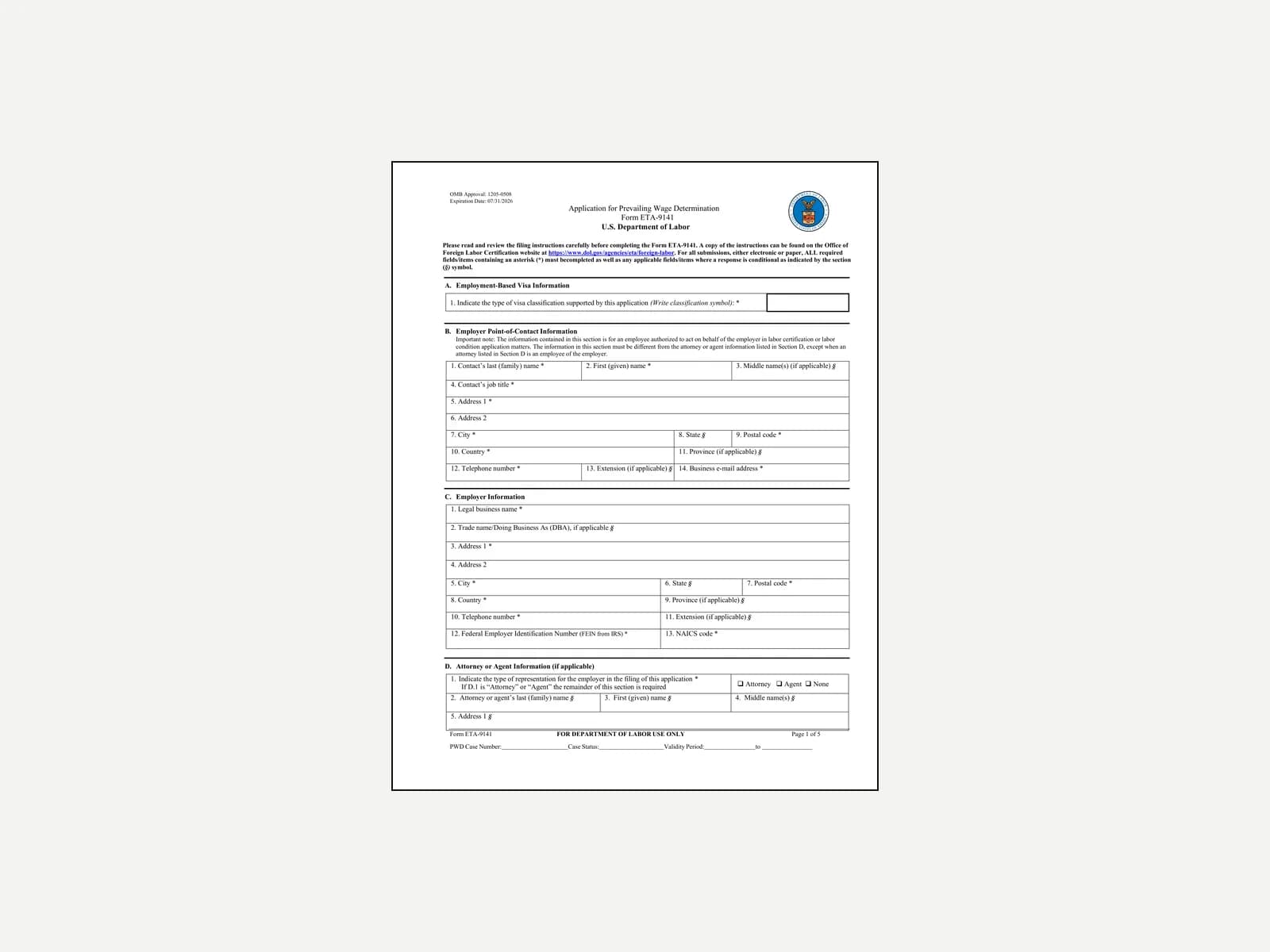
It names no month. So the end date comes from DOL, and it's printed on each determination. Form ETA-9141's Section G, which DOL fills in, has a "Determination date" at item 9 and an "Expiration date" at item 10. DOL's 2009 guidance to its own staff says each answer "shall also specify the dates the prevailing wage is valid."
Where June 30 comes from
Unless a union contract or an accepted survey applies, DOL prices the job from the Occupational Employment and Wage Statistics survey, or OEWS, which the Bureau of Labor Statistics runs. DOL loads a new year of its figures every July. Its notes for this year say it applies the survey's wages "for July 1, 2026 through June 30, 2027 (Wage Year 2026-27)", built from "BLS's May 2025 wage estimates" (OFLC technical release notes, effective July 1, 2026). That July to June stretch is the wage year. DOL's wage data page files each year's figures by it, the newest running 7/2026 to 6/2027. The guide to how DOL sets a prevailing wage covers the occupation and the level DOL picks inside those figures.
A determination's end follows that year. One issued between July 1 and April 1 runs to the next June 30, the day its wage year closes. The next year's figures take over on July 1.
Where 90 days comes from
The 90 days is the regulation's floor. Count back 90 days from June 30 and you land on April 1. So April 1 is the last day of the year when June 30 is still 90 days away.
From April 2, ending on June 30 would break the floor. So a determination issued from April 2 to June 30 gets 90 days instead. That's why an April 2 determination expires on July 1, a day past its wage year.
| Determination issued | Expires | Why | Example |
|---|---|---|---|
| January 1 to April 1 | June 30 of the same year | The wage year closes 90 days or more later | January 15, 2026 to June 30, 2026: 166 days |
| April 2 to June 30 | 90 days after the determination date | June 30 is fewer than 90 days away, so the floor applies | April 2, 2026 to July 1, 2026: 90 days |
| July 1 to December 31 | June 30 of the next year | A new wage year has just begun | July 1, 2026 to June 30, 2027: 364 days |
The two seams, a day apart
The rule changes on two dates each year. This table puts both on this year's calendar, worked by the site's own calculator.
| Issued | Expires | Days valid |
|---|---|---|
| Wednesday, April 1, 2026 | Tuesday, June 30, 2026 | 90 |
| Thursday, April 2, 2026 | Wednesday, July 1, 2026 | 90 |
| Tuesday, June 30, 2026 | Monday, September 28, 2026 | 90 |
| Wednesday, July 1, 2026 | Wednesday, June 30, 2027 | 364 |
Across the April seam nothing jumps: both days get 90. Across the July seam, one day adds 274 more. For a schedule, that's the difference between 90 days to begin recruitment and nearly a year.
The ceiling holds in a leap year too. A determination issued on Thursday, July 1, 2027 runs to Friday, June 30, 2028. That's 365 days, because February 2028 has 29. It's still inside a year.
What employers' own forms show
On the old Form ETA-9089, the employer typed the determination's expiration date from the determination itself. DOL publishes those forms. That makes the schedule checkable against what the determinations printed, and we counted the dates in DOL's fiscal year 2022 PERM disclosure file on November 9, 2026.
| The last day, as the employer typed it | Applications |
|---|---|
| June 30 | 75,595 |
| June 29 | 4 |
| 90 days after the determination date | 28,572 |
| 89 days after it | 7 |
Eleven forms in more than 104,000 carry a date one day short. The rest match the schedule above.
DOL's wage file lists the day before
DOL also publishes a prevailing wage disclosure file, and its expiration column runs one day early. It lists June 29 where the determination says June 30, and 89 days where the determination says 90.
We matched the two sources on November 9, 2026, using DOL's fiscal year 2024 PERM file. Of 30,185 determinations that appear in both, the wage file's date was exactly one day before the employer's on 30,116. One of them was determined on April 14, 2023. The employer typed July 13, 2023, and the wage file lists July 12.
So a spreadsheet built from that file, or a page that reprints it, shows a last day one day before the one on the determination. This site's own case pages did until November 9, 2026, and the corrections log has the entry. Go by the date printed on the determination.
Only the issue date counts
The day the request went in doesn't. The period runs "from the determination date". A request that sat in DOL's queue gets no credit for the wait. The wage request calculator shows where that queue stands.
A request still pending on July 1 lands in the new year. DOL's notes say the new year's wages apply from July 1, 2026. So a request answered on or after that day gets the new year's figures, and its determination runs to the following June 30.
What the expiry stops
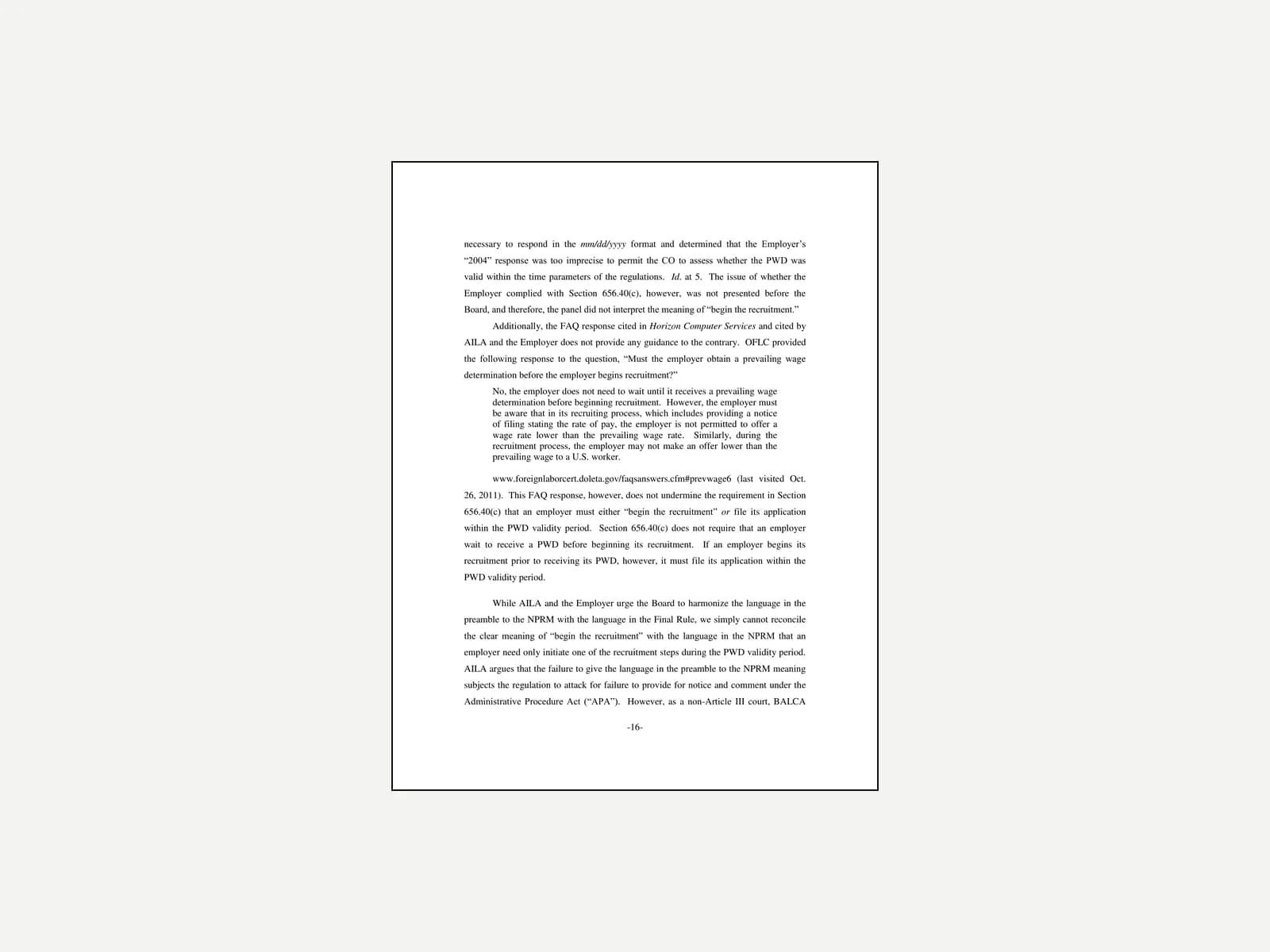
It's a deadline to start, and the filing can come later. Under 656.40(c) the employer must file the application or begin recruitment inside the validity period. If recruitment began inside it, the filing can follow the expiry, up to 180 days after the first step. If recruitment began before the determination was issued, the filing has to beat the expiry. Filing PERM after the prevailing wage expires goes through that rule and the two Board decisions behind it.
Check your own determination
Read its two dates, run the calculator, and plan from the printed one.
Read the two dates on it
Section G, items 9 and 10: the determination date and the expiration date. Every page of the form repeats them as its validity period.
Run the determination date through the calculator
The validity calculator says which case applied and how many days are left.
If the two disagree, go by the printed date
The regulation ties the deadline to "the validity period specified by the NPC". A mismatch is worth raising with the attorney on the case.
Plan recruitment from it
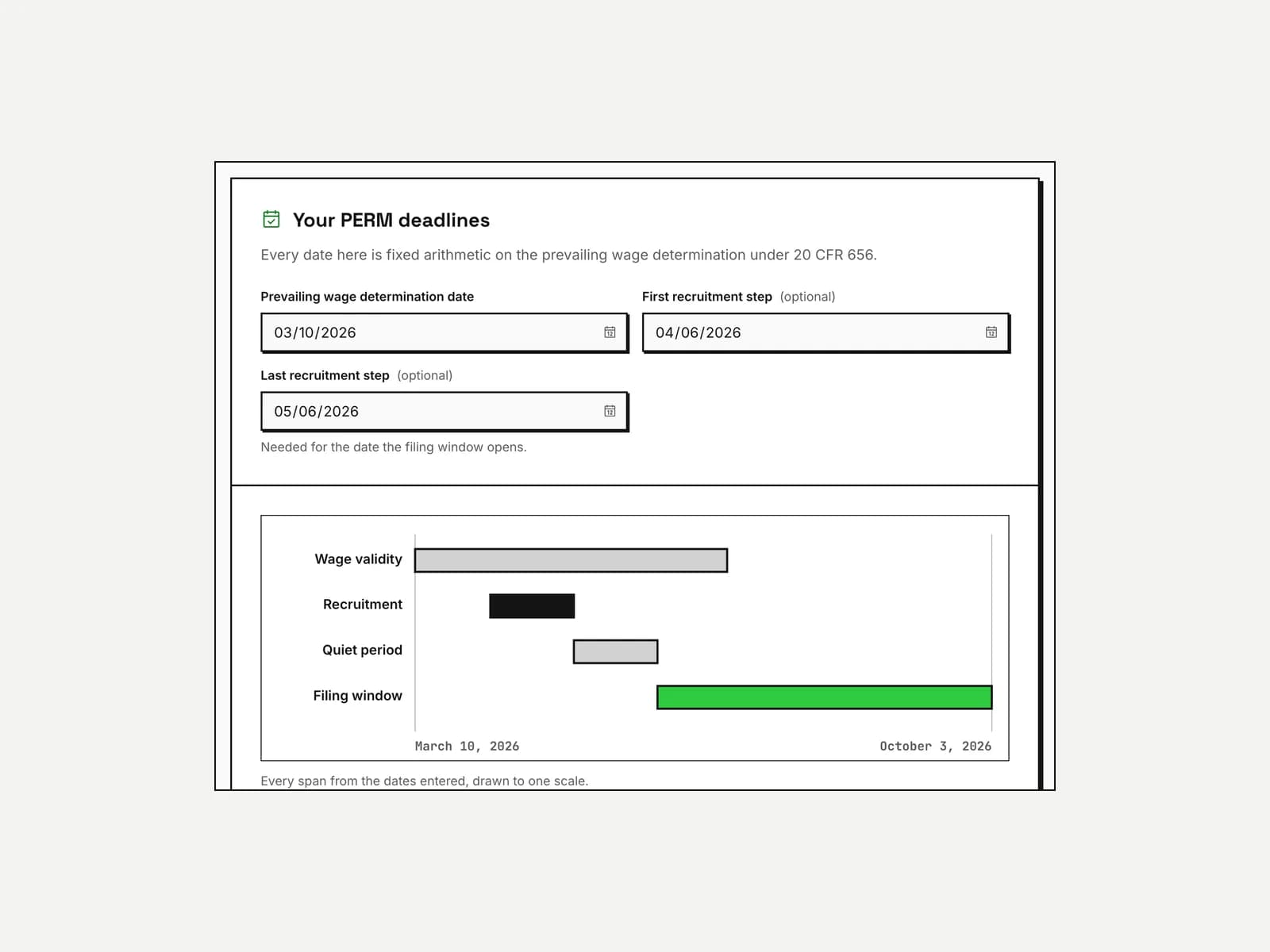
The deadline calculator builds the recruitment and filing windows from the determination date.
What this can't tell you
This guide can't give DOL's reasons, say what a redetermination does to the dates, or judge whether the wage still fits the job.
- Why DOL chose June 30. Neither the regulation nor DOL's 2009 guidance says. The schedule here is how DOL dates its determinations, and the date printed on yours governs.
- Whether a redetermination or a review restarts the period. Ask the attorney on the case.
- Whether the wage is still right for the job. A change to the duties, requirements or worksite can need a new determination whatever its dates.
Nothing here is legal advice.