On one day in August 2026, six public PERM tools were asked the same headline question, how long a PERM takes, and answered between 335 and 503 days. DOL's own published average that day was 372. The spread is not a rounding difference; it is five months on a wait that people plan their lives around. This guide is what an estimate can know, what it cannot, and what we measured when we checked our own.
What an estimate actually is
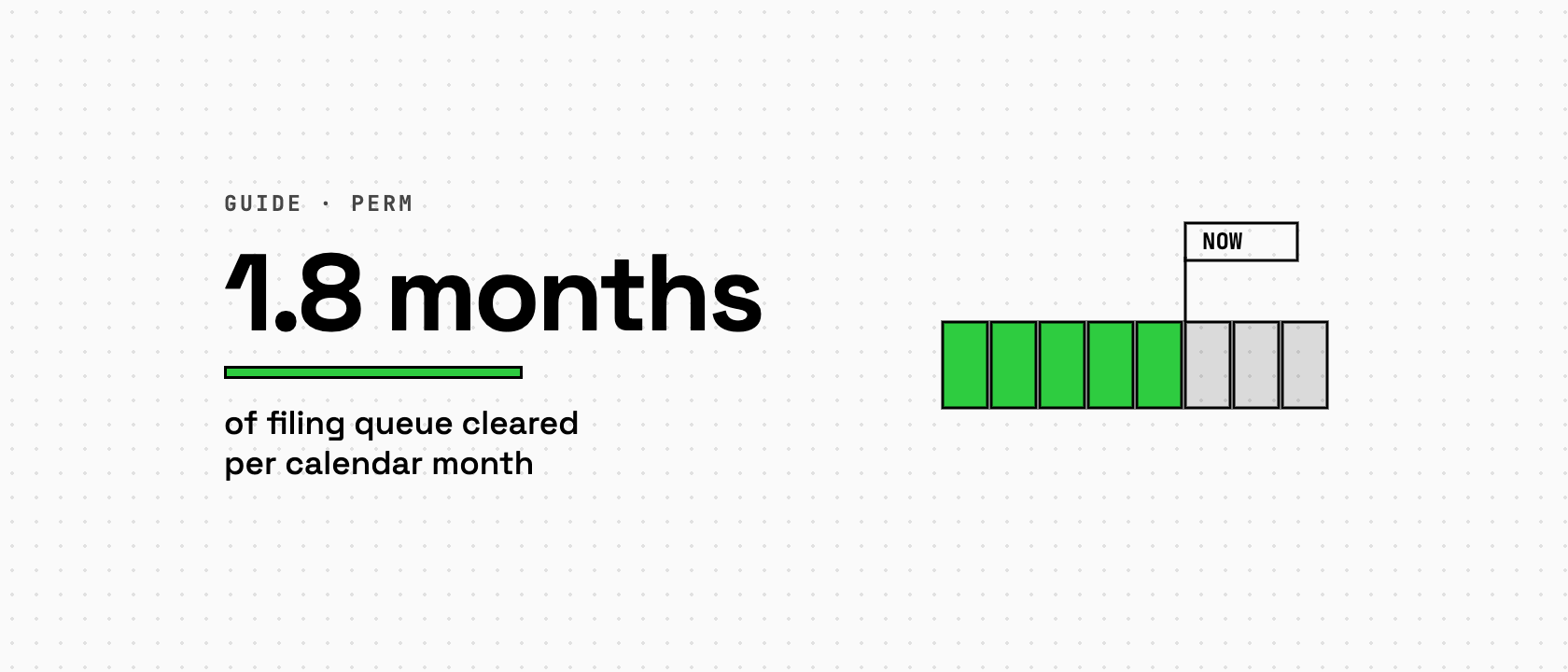
Every PERM estimator does the same arithmetic underneath. DOL works cases roughly in filing order and publishes which filing month it is deciding now. Your case has a filing month. The estimate is the distance between the two, converted to days using how fast the queue has been moving. Everything else a tool adds, an employer's initial, a "confidence" label, a colour, sits on top of that one subtraction.
That is also why estimates fail the same way. When DOL's queue slows, every tool built on the previous pace is late together. When DOL reorders work, as it did after the October 2025 shutdown, every tool is wrong in the same direction at once.
What we measured
Two numbers, both against decided cases in DOL's own disclosure files, and both printed on the pages that use them.
Our median miss, give or take
Measured against cases that have since been decided, the middle of our estimator's error is about 50 days. Half of estimates land closer than that, half further. We print the range on every estimate for that reason, and the single most likely date only next to it.
The second number is the one every rival talks about and nobody publishes: how much the employer's initial moves a decision. DOL works each filing month alphabetically by employer, so a company starting with A is reached before one starting with Z. That ordering is real. Its size is the question, so we measured it over 339,518 decided cases.
The measured effect is 27 days end to end: A decides about 11 days earlier than the average case in its month, Z about 16 days later. The published claim of plus or minus 80 days is the same effect inflated roughly six times. And in 6 of the 30 filing months we could check, the order ran backwards, with later letters decided first. So the initial is worth showing, with its size, and not worth building a forecast on.
What each estimator uses
The two rows marked "No" are the ones that produce the big misses, and they are the same for every tool. An audit adds months and is invisible until it is issued. No estimator, including this one, can see it coming.
How to read ours
Start from the most likely date
The estimate leads with the single date the strongest model gives, then the window under it. The window is the honest part; the date is the anchor so you have something to plan against.

Read the line about the employer's initial
If the initial moved the estimate, its own line says by how many days and reminds you that the whole alphabet is about four weeks. A tool that folds this in silently is choosing to look precise.
Check where DOL's queue is right now
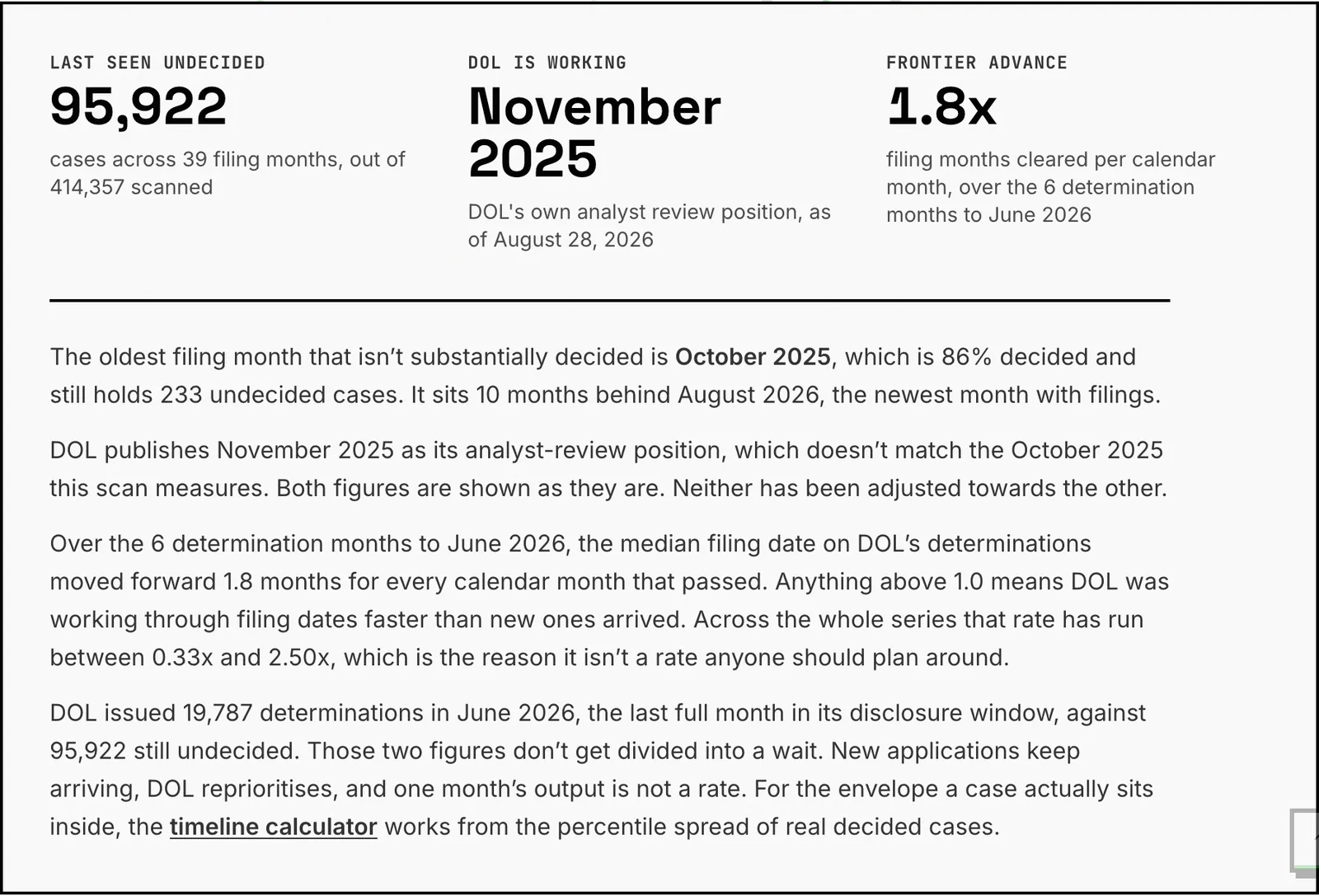
The estimate is anchored to DOL's published position. The processing times page shows that position with DOL's own as-of date, and the queue page shows how it has moved month by month. If DOL has not moved in weeks, expect every estimate, ours included, to drift late.
When we refuse to give a date
🚨 If DOL has already passed your filing month
Every filing-anchored model's date has elapsed, and printing a new one would be invention. The page says the queue passed your month, by how much, and that a case still pending at that point is usually in an audit, a request for information, or a hold. The per-case lookup is the next step, because it shows the status DOL actually holds.
We also print no estimate for a filing month too new to have a measured history, and no estimate at all for the stages an audit adds. A blank is a true answer; a confident wrong date is not.
What this cannot tell you
- Your decision date. It gives a range measured from cases like yours, and half of them missed the middle by more than 50 days.
- Whether your case will be audited. Nothing can, until DOL issues it.
- Anything about a case DOL has not received. An estimate needs a filing month, which needs a filing.
- How another tool got its number. Where a rival publishes a method we describe it; where it does not, we say so on the methodology page.