This guide is for H-1B workers, and their families, who've lost a job or worry they might. The short answer: the grace period of up to 60 days still exists today. DHS has proposed removing it, and a proposal changes nothing until a final rule is published.
Where it stands on October 16, 2026
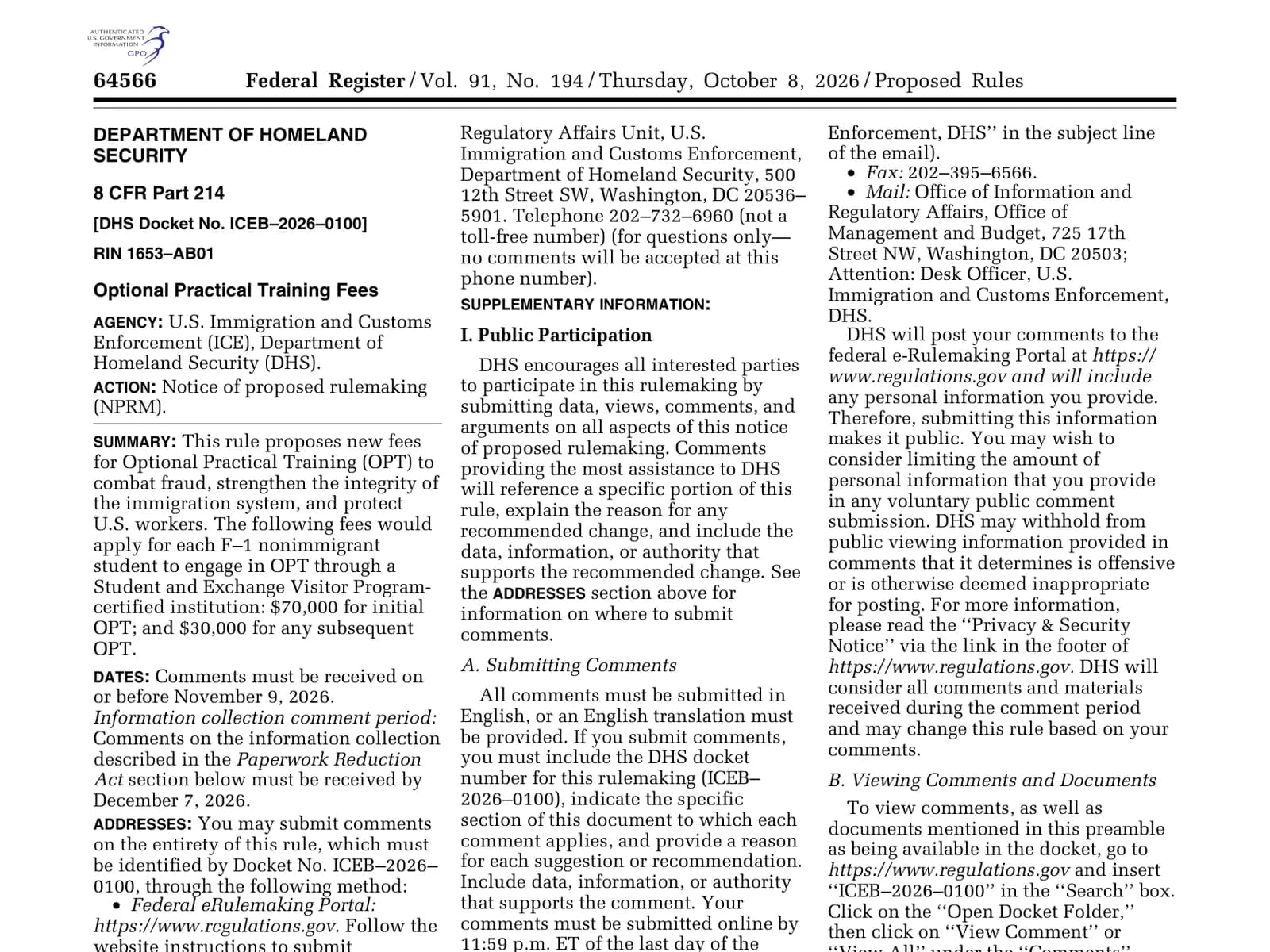
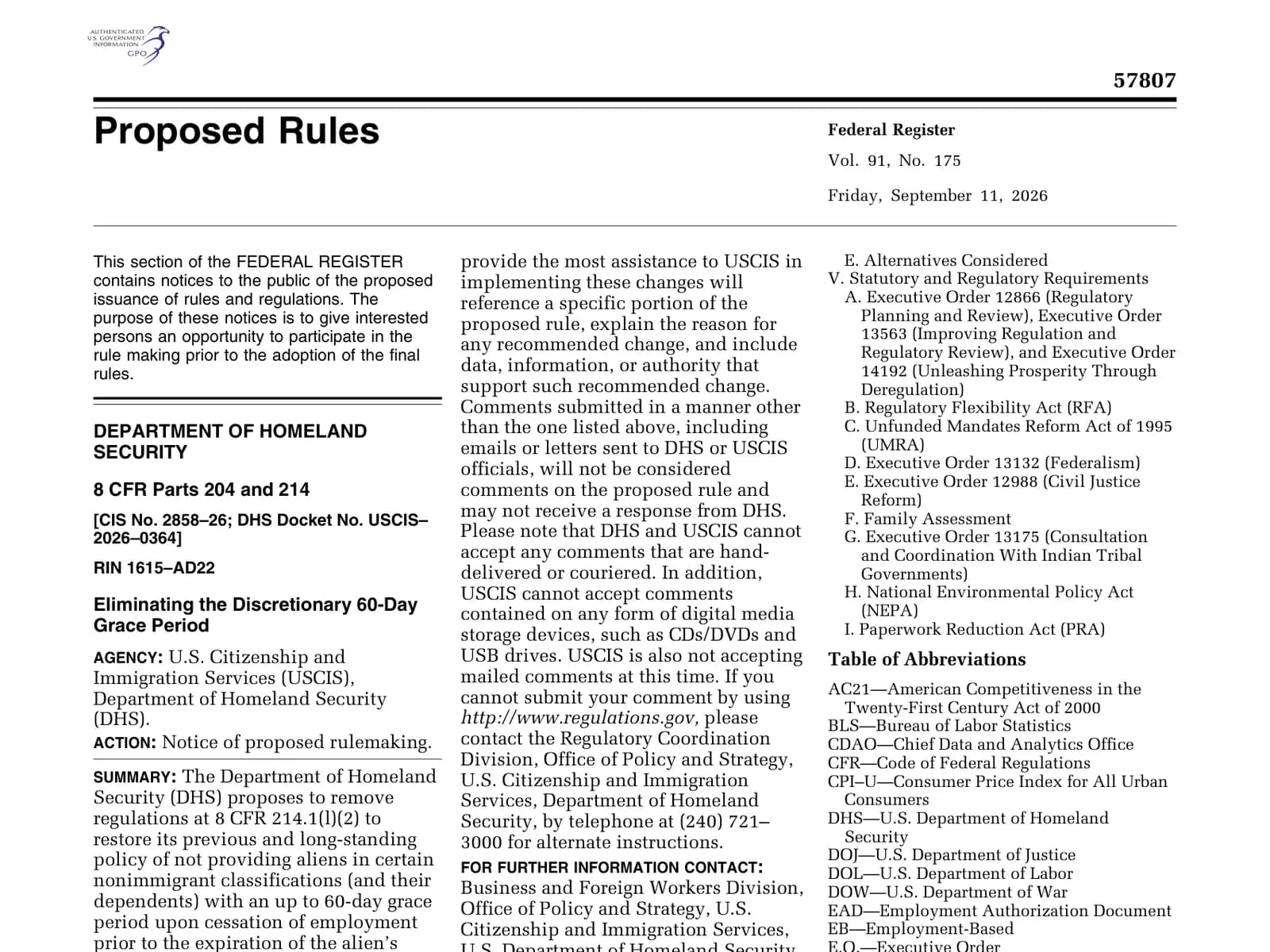
In force: 8 CFR 214.1(l)(2), up to 60 consecutive days after the job ends. Proposed: removal, in Federal Register document 2026-18631 (91 FR 57807, September 11, 2026). Comments close: Tuesday, November 10, 2026. Effective date: none. A proposed rule doesn't set one.
The rule today, in its own words
8 CFR 214.1(l)(2) says a worker in E-1, E-2, E-3, H-1B, H-1B1, L-1, O-1 or TN status, and their dependents, "shall not be considered to have failed to maintain nonimmigrant status solely on the basis of a cessation of the employment on which the alien's classification was based, for up to 60 consecutive days or until the end of the authorized validity period, whichever is shorter, once during each authorized validity period."
Four details in that sentence matter:
- Up to 60 days, or the end of the I-94, whichever comes first. A worker whose status ends in 20 days gets 20.
- Once per validity period. A second job loss inside the same approval doesn't get a second 60 days.
- No work. "Unless otherwise authorized under 8 CFR 274a.12, the alien may not work during such a period."
- It can be cut short. "DHS may eliminate or shorten this 60-day period as a matter of discretion."
During the period, paragraph (l)(3) lets you apply for an extension of stay or a change of status, if otherwise eligible. In practice that's where a new employer's H-1B petition, a change to another status, or a family member's status comes in.
In force, proposed, and what would change
| In force today | As proposed | What would change for you | |
|---|---|---|---|
| After a job ends mid-approval | Up to 60 days in status, once per validity period | No grace period. 8 CFR 214.1(l)(2) is removed | DHS's preamble says these workers "would be considered to have failed to maintain status starting the day after their employment ends" |
| After an approval's end date | Up to 10 days, under 214.1(l)(1) | Unchanged | Nothing. The proposal notes this period applies only after the validity period ends |
| Applying for an extension or change of status | Allowed during any (l) period, 214.1(l)(3) | Kept, renumbered as (l)(2) | Only the 10-day periods would be left for it to apply to |
| A work permit in compelling circumstances | Someone in the grace period with an approved I-140 can file the first request, if the other conditions are met, 8 CFR 204.5(p)(1) | The reference to the grace period is taken out | That first request would need to be filed while still in status, or in a 10-day period |
| Dependents (H-4 and others) | Covered with the principal | Removed with the principal | The family's status would follow the job's end date |
The proposal names who it covers: "E-1, E-2, E-3, H-1B, H-1B1, L-1, O-1 and TN nonimmigrant workers would no longer receive an up to 60-day discretionary grace period upon cessation of employment and would be required to depart immediately unless otherwise authorized to lawfully remain in the United States."
What a proposal does and doesn't do
Comments are open
Anyone can comment on regulations.gov under docket USCIS-2026-0364 until the end of Tuesday, November 10, 2026, Eastern time.
DHS reads them and decides
It can publish a final rule as proposed, change it, or drop it. There's no deadline for that step.
A final rule sets an effective date
Only then does anything change. Until a final rule is published, 214.1(l)(2) is the rule, and the policy changes page will show the final document the day the Federal Register publishes it.
If you've lost a job now
Today's rule applies. Count your days from the last day of employment, and check them against the end date on your I-94, because the shorter one wins.
- A new H-1B employer files a petition inside the period. The timing of the employer's labor condition application comes first, and its status can be checked by number on the LCA lookup.
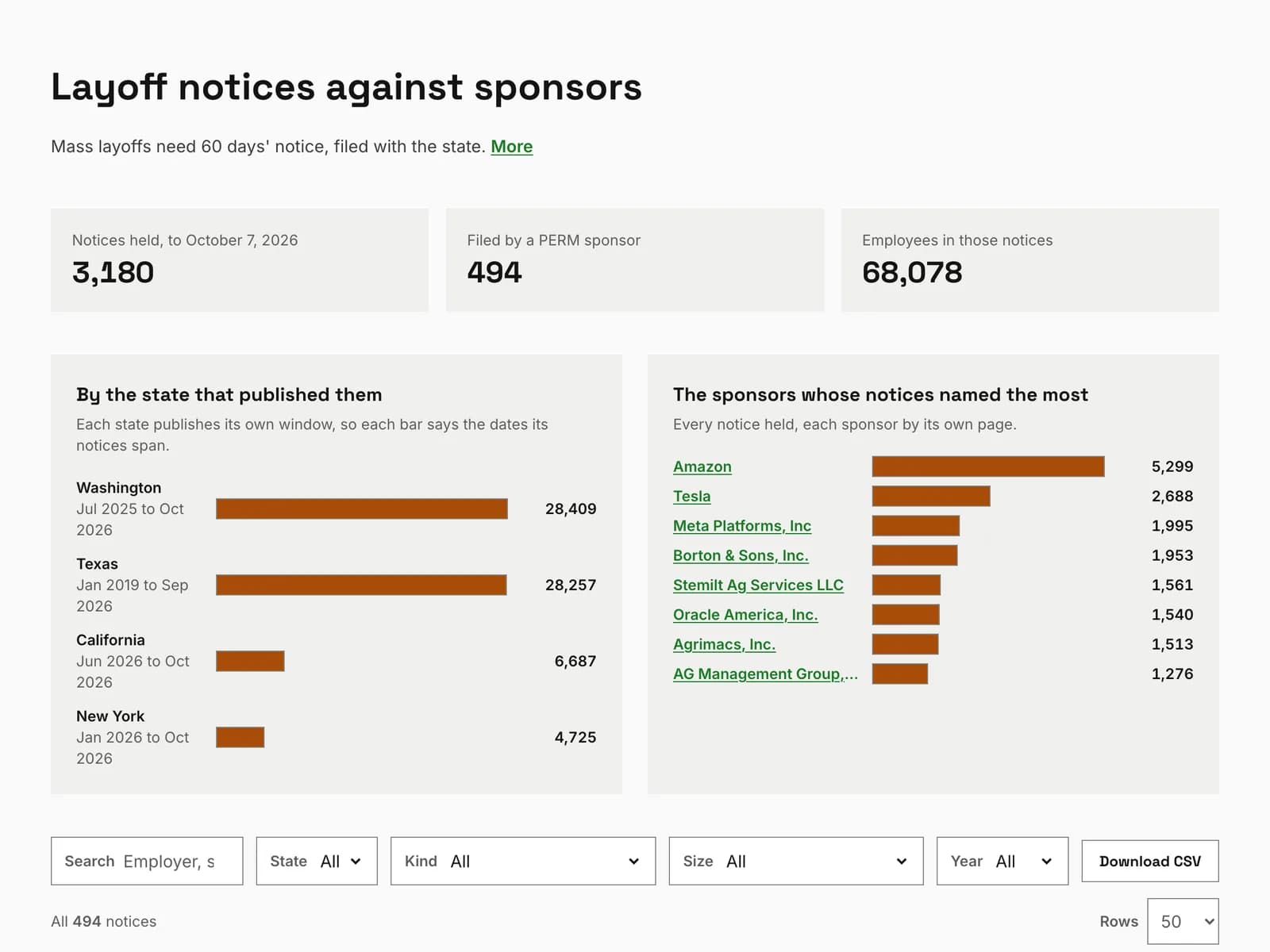
- A pending green card case keeps its own clocks. A layoff touches a PERM, an I-140 and an I-485 differently, and the layoffs guide takes them by stage.
- An approved I-140 can matter twice: for a compelling-circumstances work permit under 204.5(p), and for the priority date a new employer's petition can carry (8 CFR 204.5(e)).
Nothing here is legal advice. A grace period is short, and the attorney you talk to in its first week can do far more than one you reach in its last.
What this guide can't tell you
- Whether the proposal will become final, or when. DHS has published no timetable for a final rule in the proposal itself.
- Whether DHS will shorten your grace period. The rule has always allowed it as a matter of discretion, case by case.
- How long a new employer's filings will take. That's DOL's LCA queue and USCIS's petition queue, and both are shown on their own pages.