This guide is for anyone whose PERM case just changed to CERTIFIED, usually after a year or more of waiting. Certification ends DOL's part. Three things happen next, and one of them has a hard deadline.
The one date that can't slip
The employer has to file the I-140 with USCIS before the certification expires. The regulation says a certification "expires if not filed in support of a Form I-140 petition with the Department of Homeland Security within 180 calendar days of the date the Department of Labor granted the certification" (20 CFR 656.30(b)(1)). The certified form carries its own expiration date. Go by that printed date.
What certification gives you
| Piece | Where it stands now | The rule |
|---|---|---|
| The labor certification | Granted. Usable for an I-140 until the expiration date printed on it | 20 CFR 656.30(b)(1) |
| Your priority date | Fixed already: the day DOL accepted the PERM for processing | 8 CFR 204.5(d) |
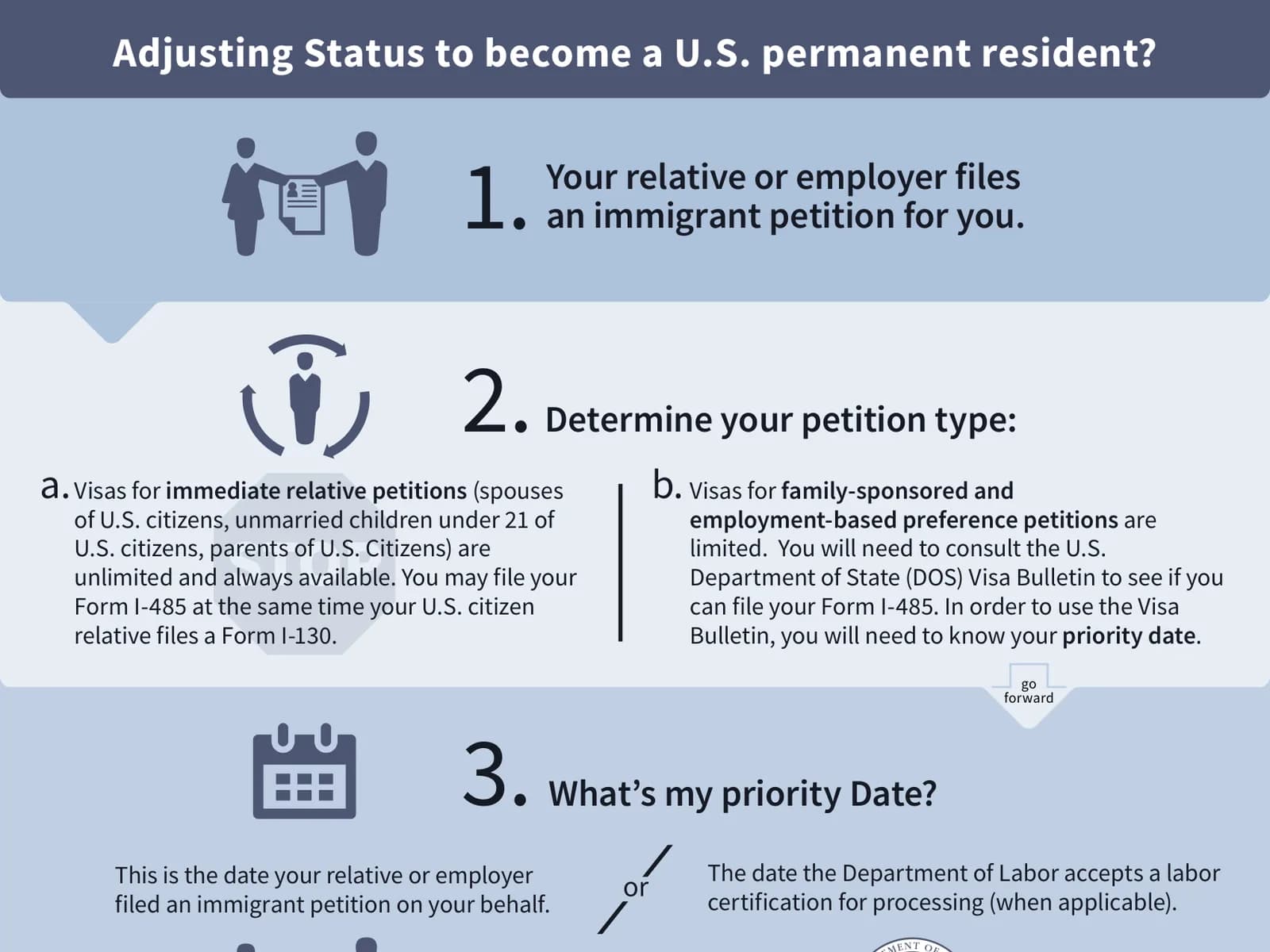
| The I-140 | Not filed yet. The employer files it, with the certification attached | 8 CFR 204.5(k)(4) and (l)(3) |
| The I-485 (green card application) | Waits for the I-140 and for your date on the visa bulletin | 8 CFR 245.2(a)(2) |
The priority date is easy to misplace. It isn't set by the certification or by the I-140. It's the PERM's own filing date, and it has been yours since the day the case was filed. That's the date you compare against the visa bulletin from here on.
What happens next, in order
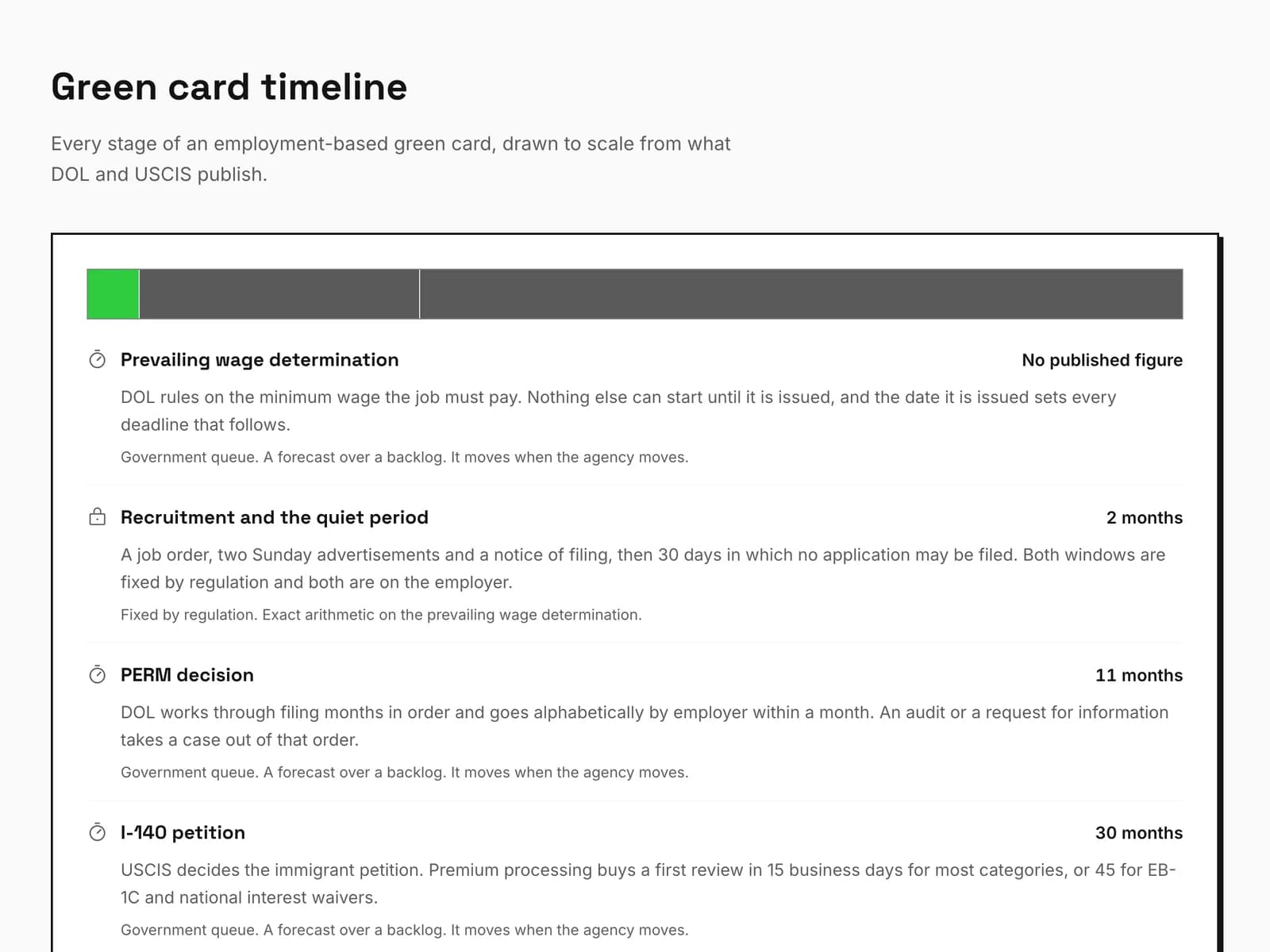
The employer files the I-140
Before the printed expiration date, which falls 179 days after the certification date: a case certified Monday, March 2, 2026 carries Friday, August 28, 2026. The filing is the employer's, so ask the attorney for the planned date and for a copy of the receipt when it arrives.
USCIS decides the I-140
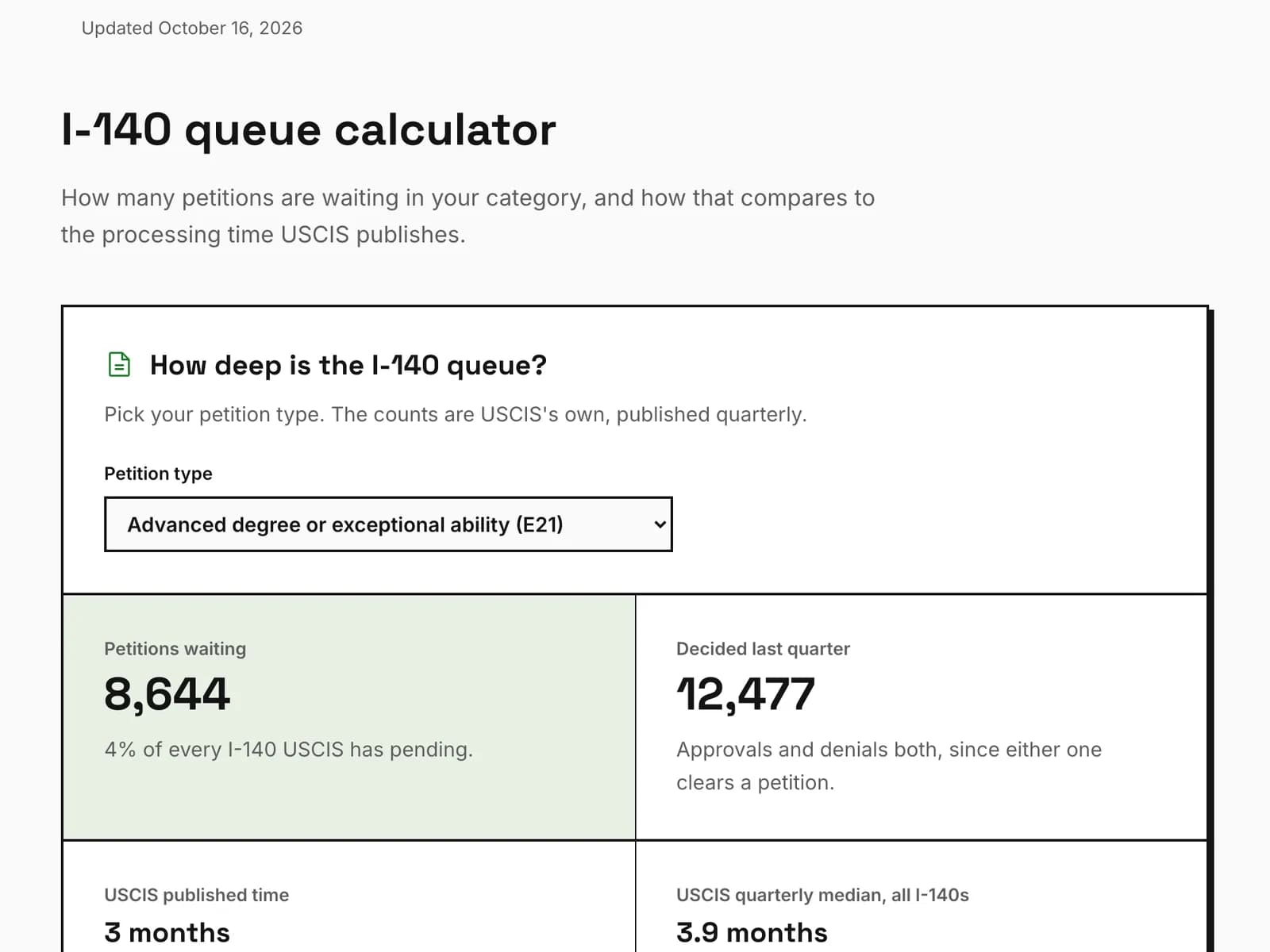
Ordinary processing or premium processing. USCIS's premium page guarantees action within "15 business days for most classifications", with 45 for E13 managers and national interest waivers. The USCIS processing times page shows the ordinary wait from USCIS's own quarterly figures, and the I-140 calculator puts it against your dates.
The visa bulletin decides when the I-485 can go in
If your priority date is current on the chart USCIS names for that month, the I-485 can be filed with the I-140 or after it (8 CFR 245.2(a)(2)(i)(B)). If it isn't, the I-140 goes in alone and the I-485 waits. For October 2026, USCIS told employment-based applicants to use the Dates for Filing chart.
The I-485, then the work permit and travel document
A pending I-485 is the basis for an EAD and advance parole. Renewals of that EAD no longer extend automatically, so the EAD guide covers when to file.
Your status may later read CERTIFIED - EXPIRED
This is a calendar event
DOL changes a certified case to CERTIFIED - EXPIRED once the 180 days pass. On our reading (DOL publishes no note on it) that happens whether or not an I-140 went in. DOL grants the certification and USCIS receives the I-140; nothing suggests DOL is told when one arrives. If the employer filed in time, the I-140 is unaffected. The status dictionary has the full entry.
Where you stand on the line
Certification doesn't move you up the line. The line is the visa bulletin, by category (EB-2 or EB-3) and country of birth. Three places on the site show it:
- The visa bulletin page has this month's cutoffs and an email alert for the day the next bulletin is published.
- Every category line has its own page showing where the cutoff stands on both charts and how it has moved, a fiscal year at a time.
- Your place in line counts the people USCIS reports ahead of your date.
None of them forecasts a month for you. The site doesn't guess one, and its scorecard shows how its own estimates have done.
If you're on an H-1B
An I-140 changes what's possible for your status. Once it's approved and your date is held back only by the per-country limit, a new H-1B petition can ask for three-year extensions past the six-year limit (8 CFR 214.2(h)(13)(iii)(E)). Until then, a PERM filed at least 365 days earlier already allows one-year extensions (8 CFR 214.2(h)(13)(iii)(D)). The six-year guide works through both with dates.
What to ask the attorney
- What date will the I-140 be filed, and will it go premium?
- Which category is it in, EB-2 or EB-3, and why?
- Is my priority date current on the chart USCIS is using this month? If so, can the I-485 go in with the I-140?
- Can I have copies of the certified ETA 9089, the I-140 receipt and, later, the approval notice? You'll need them for H-1B extensions and if you ever change employers.
- If my spouse is on H-4, when does the I-140 approval make an H-4 work permit possible?
Nothing here is legal advice. The attorney on the case has the file and the dates.
What this guide can't tell you
- Whether the I-140 was filed. DOL's record doesn't show it, and neither does this site. The receipt notice does.
- When USCIS will decide it. The processing times page shows how USCIS has been doing, which isn't a promise for one case.
- When your date will be current. The bulletin moves on demand and supply, and it can move backward. If it does after you file, the retrogression guide explains what stays in place.