This guide is for someone told by their employer or its attorney that "the labor market test failed" or "recruitment wasn't successful". It's a hard thing to hear with an H-1B clock running. Here's what it means, what it doesn't, and how to work out how much time you have.
The short answer
A qualified U.S. worker answered the job ads, so the employer can't truthfully file the PERM from that recruitment. Nothing went to DOL, so there's no case, no status to look up and no priority date. The employer can recruit again later. What matters for your H-1B is how soon a PERM can be filed, because the extensions past six years count from the filing.
What "failed" means
A PERM rests on the employer's attestations. Two of them, from 20 CFR 656.10(c), are the ones a successful applicant tests:
- "The job opportunity has been and is clearly open to any U.S. worker" (656.10(c)(8))
- "The U.S. workers who applied for the job opportunity were rejected for lawful job-related reasons" (656.10(c)(9))
DOL certifies only when there's no U.S. worker "able, willing, qualified, and available" for the job (656.24(b)(2)). And the bar for "qualified" is lower than people expect. Under 656.17(g)(2), a U.S. worker counts as able and qualified if they can learn the missing skills "during a reasonable period of on-the-job training." So an applicant who's close enough can end a recruitment.
The attorney reviews each applicant against those rules. When one qualifies, the employer can't sign those attestations, so the PERM doesn't go in.
What it does and doesn't do
| Question | Answer | Why |
|---|---|---|
| Was anything filed with DOL? | No. Recruitment happens before filing | 20 CFR 656.17(e) |
| Is there a priority date? | No. A priority date comes from a filed PERM | 8 CFR 204.5(d) |
| Can the employer try again? | Yes. Part 656 sets no waiting period after unsuccessful recruitment | 20 CFR part 656 |
| Can the old recruitment be reused? | Only steps still inside the 180-day limit at a new filing, and the qualified applicant they drew would still count | 20 CFR 656.17(e)(1) |
| Does it touch my H-1B status? | No. The H-1B rests on its own petition | 8 CFR 214.2(h) |
Some employers pause for months before trying again. That's company policy. The regulation doesn't require it, so it's fair to ask the attorney whether the pause is the employer's choice or a legal need.
What a second attempt takes
The steps, in the order the regulation puts them:
A prevailing wage determination
The employer asks DOL for the wage. As of September 30, 2026, DOL is issuing PERM wage determinations on requests filed in June 2026, 3 to 4 months after they were filed.
The mandatory recruitment
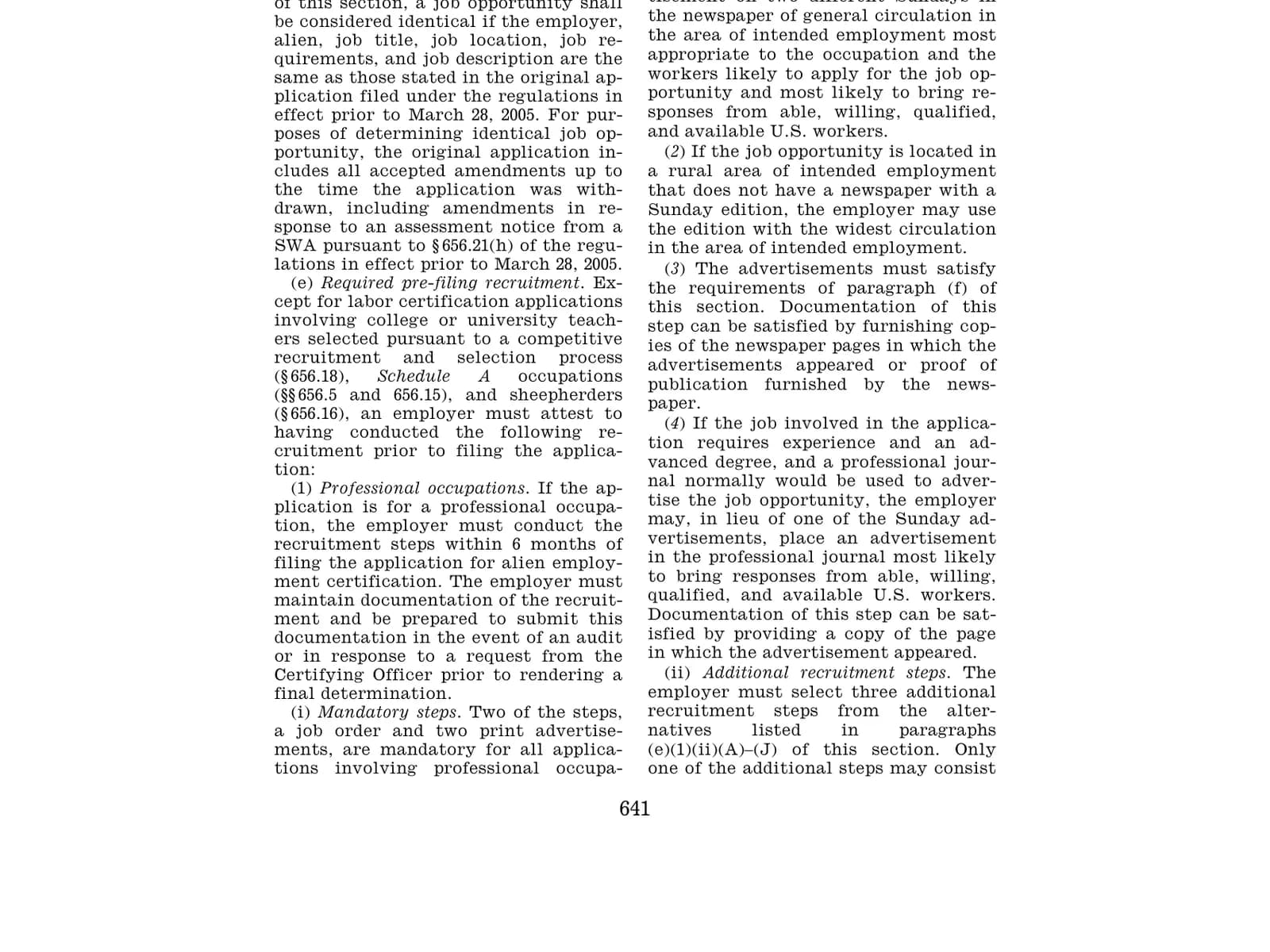
For a professional job, a 30-day job order with the state workforce agency and ads on two different Sundays in a newspaper. These "must be conducted at least 30 days, but no more than 180 days, before the filing of the application" (656.17(e)(1)(i)).
Three more steps from the regulation's list
Only one of them "may consist solely of activity that took place within 30 days of the filing" (656.17(e)(1)(ii)).
The filing
The day DOL accepts the PERM is the day both clocks start: your priority date, and the 365 days toward an H-1B extension.
The 30-day job order plus the 30 days the mandatory steps must sit before filing put the filing at least about two months after the job order starts, and the wage determination comes before that.
The H-1B arithmetic
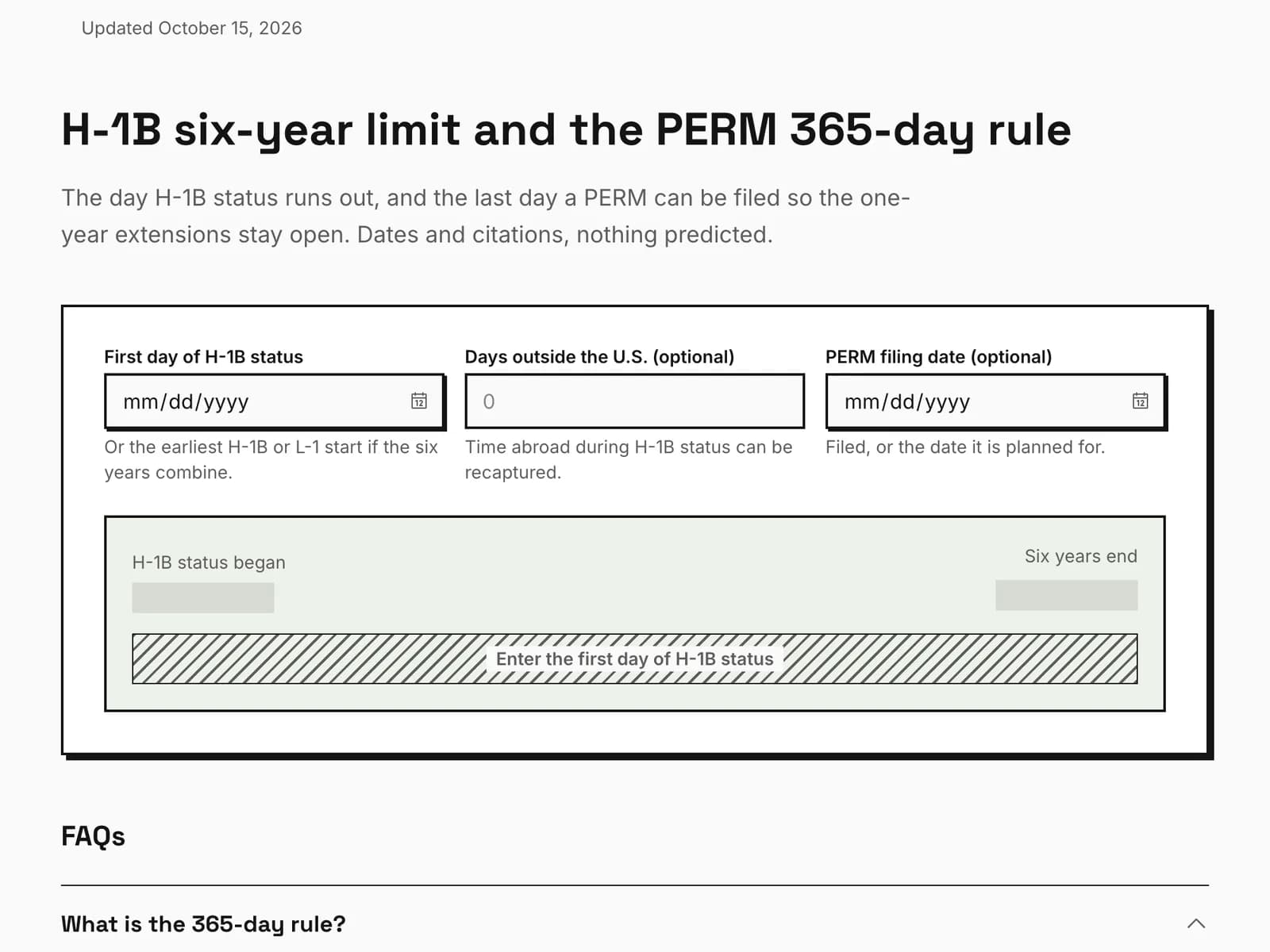
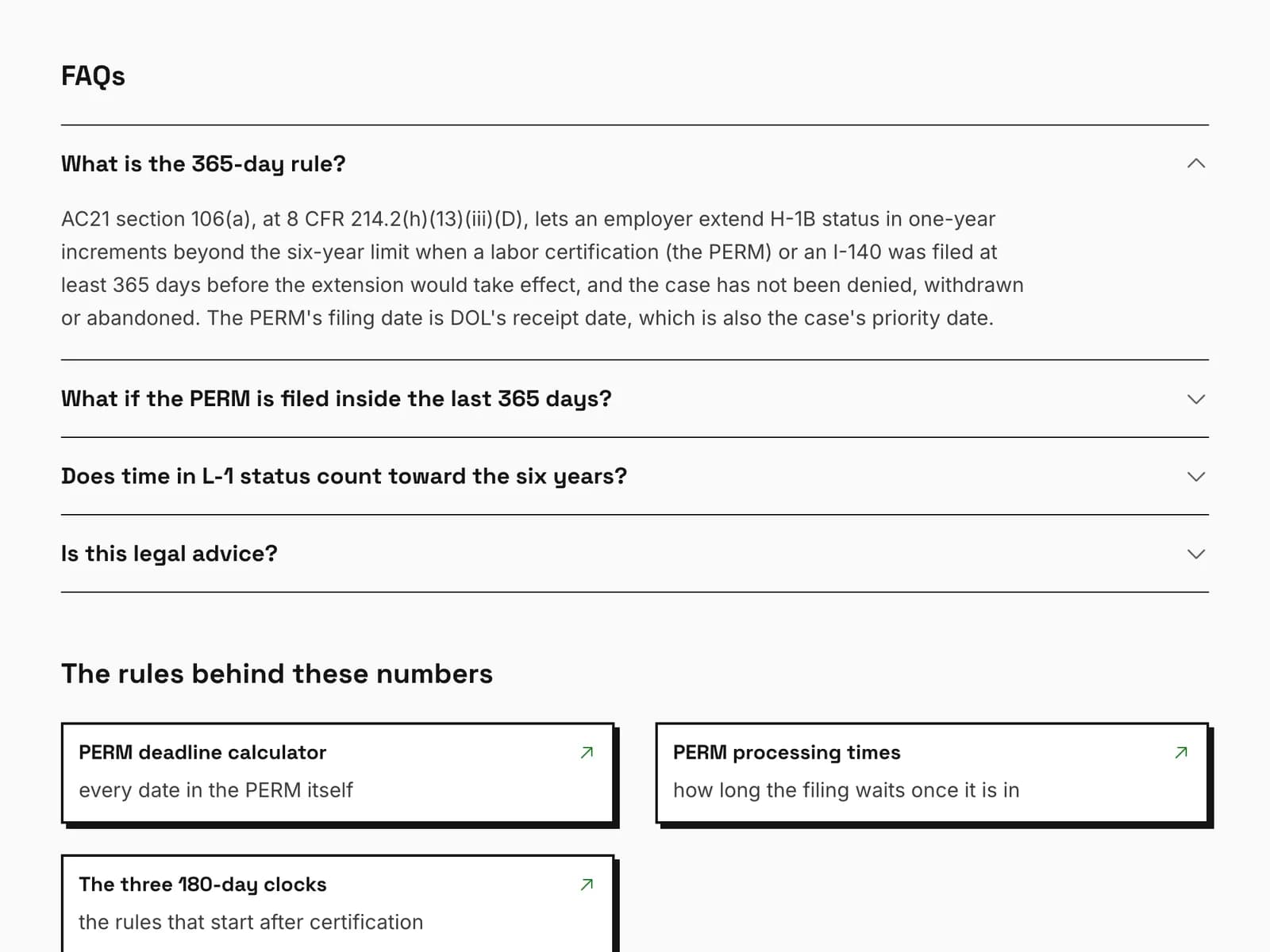
The one-year extensions past six years need a PERM or I-140 filed at least 365 days before the extension would start (8 CFR 214.2(h)(13)(iii)(D)). Failed recruitment produced no filing, so it started no clock.
Work backward from your end date. It's 365 days, so a February 29 inside the year moves the answer by a day, as in the second row:
| Your six years end | A one-year extension would start | A PERM must be filed by |
|---|---|---|
| Thursday, September 30, 2027 | Friday, October 1, 2027 | Thursday, October 1, 2026 |
| Friday, March 31, 2028 | Saturday, April 1, 2028 | Friday, April 2, 2027 |
If that filing date is already close or past, other routes may still exist, and they're the attorney's to weigh:
- An earlier PERM or I-140 for you that's still alive, from this employer or a past one. The H-1B employer doesn't have to be the one that filed it ((D)(6)).
- An approved I-140 with a date held back by the per-country limit, which supports three-year extensions under (E).
- Recaptured time spent outside the United States during your H-1B, which moves the end date later (8 CFR 214.2(h)(13)(iii)(C)).
- A year outside the United States, after which the six years start over (8 CFR 214.2(h)(13)(iii)(A)).
The six-year limit calculator puts your own dates in, and the six-year guide covers both exemptions.
Ask the attorney
- Was the applicant found qualified, or is the employer still deciding?
- When can recruitment start again, and is any pause a legal need or a company policy?
- What's the latest date a new PERM can be filed and still support my next H-1B extension?
- Do I have any earlier PERM or I-140 that still counts?
Nothing here is legal advice. Your dates decide this, and the attorney has the full picture.
What this guide can't tell you
- Whether the applicant really was qualified. That's a judgment on the résumé against the job's stated requirements.
- Whether the next recruitment will succeed. It depends on who answers.
- Which employers file PERMs for jobs like yours. That part the record can show: the sponsor finder lists employers by what they've filed.