Overview
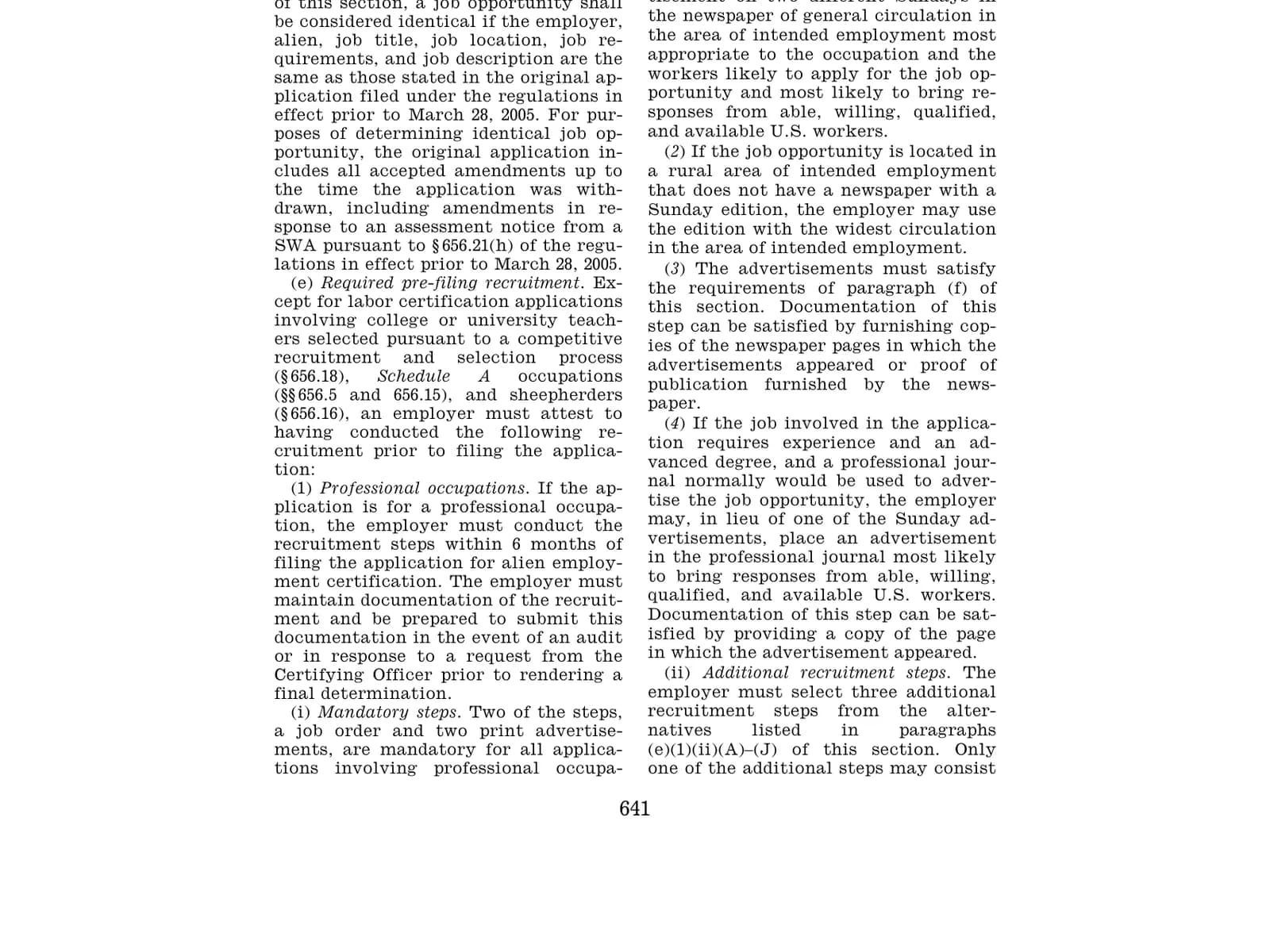
PERM recruitment runs on two mandatory activities under 20 CFR 656.17(e), a job order and two Sunday newspaper advertisements, plus a separate notice of filing under 20 CFR 656.10(d). Professional occupations add three more steps chosen from a list of ten.
That’s the easy part. The hard part is timing. The regulation doesn’t publish a due date for any individual step. It gives you two numbers and leaves you to work out what they mean for the ad you’re placing next week.
What an audit asks for
A PERM audit letter gives the employer 30 days from its date to produce the recruitment file, and what it asks for is the documentation below. DOL publishes no audit rate, so nobody can tell you the odds, and building the file from day one is the only part of it you control.
For step-by-step instructions on tracking these activities in PERM Tracker, see our recruitment tracking tutorial. For the broader filing context, see our complete filing guide or the Ultimate PERM Guide.
How the recruitment clock actually works
Every date in a PERM case comes from two sentences in 656.17(e)(1)(i). Both measure against the filing date rather than against each other:
The mandatory recruitment steps must be conducted at least 30 days, but no more than 180 days, before the filing of the application.
Read that twice, because it sets a floor and a ceiling on the same clock.
The 180-day ceiling
No mandatory step may be older than 180 days on the day you file. Your earliest step is therefore the one that matters: it starts a 180-day countdown, and the ETA 9089 has to be filed before that countdown ends. Miss it and the recruitment is stale. Filing quickly won’t save it and a late ad won’t cure it. You start over.
The 30-day floor
You also can’t file too soon. Every mandatory step has to be at least 30 days old when you file. Practitioners call this the quiet period or the cooling-off period, though the regulation itself never uses either phrase. Its purpose is to leave time for late applicants to respond.
Why your last mandatory step is really due on day 150
Put the floor and the ceiling together and a third date falls out that appears nowhere in the regulation:
filing  >=  last mandatory step + 30 days
filing  <=  first step + 180 days

therefore
last mandatory step  <=  first step + 150 days
Day 150 is the real deadline for your last mandatory recruitment activity. Everything after it’s waiting. If a Sunday ad slips to day 155, you haven’t lost 5 days of slack, you’ve lost the case, because the 30-day wait now pushes filing past day 180.
The most common way to lose a case
Teams track the 180-day date because it’s the one the regulation prints. The date that actually binds is day 150. By the time the 180-day deadline looks close, the window to fix anything has already been shut for a month.
The additional-steps exception
The 30-day floor applies to the mandatory steps. Additional steps for professional occupations follow a different rule in 656.17(e)(1)(ii):
Only one of the additional steps may consist solely of activity that took place within 30 days of the filing of the application.
So one of your three additional steps can land inside the quiet period, and exactly one. This is a genuine bit of slack in an otherwise rigid schedule, and it’s the piece most checklists leave out. The 180-day ceiling still applies to all of them.
What the PWD expiration limits
Your prevailing wage determination expires on its own schedule under 20 CFR 656.40(c), and the rule there is that employers "file their applications or begin the recruitment period" within its validity. Either one is enough.
So the expiry is the day recruitment has to begin by. Once the first recruitment step (the job order or a Sunday ad, or an additional step for a professional role; the notice of filing doesn't count for this) falls on or after the determination date and on or before the expiry, the expiry stops limiting the case. The application can be filed after the PWD expires, as long as it's inside 180 days of that first step. The Board of Alien Labor Certification Appeals read the rule this way en banc in Karl Storz Endoscopy-America (2011-PER-00040, December 1, 2011).
The expiry still binds in one case: recruitment that began before the determination was issued. Then the application has to be filed while the PWD is valid, and every deadline below tightens to fit before the expiry. Check with the attorney on the case before relying on a filing after the expiry.
The latest each step can start
The regulation gives you two numbers. Everything in this table is arithmetic on those two numbers. first means the first recruitment step; PWDED means the PWD expiration date, which enters only when recruitment began before the determination date.
| Step | Latest it can start | Where the number comes from |
|---|---|---|
| SWA job order | first + 120 (PWDED - 60 if earlier and recruitment began before the determination) | It has to run 30 days, then the 30-day wait, and filing still has to land inside the window. 30 + 30 = 60 days of tail. |
| First Sunday ad | first + 143 (PWDED - 37, likewise) | 143 is 150 minus a week, because the second ad has to fall on a later Sunday. |
| Second Sunday ad | first + 150 (PWDED - 30, likewise) | Day 150 is the last date any mandatory step can run and still clear the 30-day wait inside 180 days. |
| Notice of filing | 10 business days back from the close of the window | Business days, so weekends and federal holidays drop out. See below. |
| ETA 9089 filing | Opens at last step + 30, closes at first + 180 (or PWDED, if earlier and recruitment began before the determination) | The floor and the ceiling, applied directly. |
The notice of filing is measured in business days
656.10(d)(1)(ii) requires the notice to be posted "for at least 10 consecutive business days." Business days, which means weekends don’t count and neither do federal holidays.
A flat calendar-day approximation is wrong, and it’s wrong in the dangerous direction. Ten business days is 14 calendar days in a clean stretch, but a notice posted the week of Thanksgiving or between Christmas and New Year can need 16 or 17 calendar days to clear the same requirement. Subtract real business days from the end of your window, don’t subtract 14 and hope.
One more thing about the notice
Posting at the worksite is the fallback route. 656.10(d)(1) asks first whether there’s a bargaining representative for the occupation in that location. If there is, notice goes to them as a letter with a copy of the application. Only when there’s no bargaining representative do you post at the worksite.
And posting alone isn’t enough either. The same paragraph requires the employer to publish the notice "in any and all in-house media, whether electronic or printed, in accordance with the normal procedures used for the recruitment of similar positions." If the company posts openings to an intranet or a Slack channel as a matter of course, that has to happen too.
A worked example
A professional-occupation case where the PWD isn’t the constraint:
- Day 0. Job order opens with the SWA. The 180-day clock starts here, because this is the first step.
- Day 30. Job order closes after its 30 required days.
- Day 35 and Day 42. The two Sunday ads, one week apart.
- Day 60 to Day 74. Notice of filing posted for 10 business days. Fourteen calendar days, assuming no federal holiday falls inside.
- Day 100. Three additional recruitment steps completed. One of these could legally have run as late as day 155, since one additional step may fall inside the quiet period.
- Day 72. The earliest filing date: 30 days after day 42, the last mandatory step.
- Day 180. The last filing date.
That case has 108 days of filing slack, which is comfortable. Now move the second Sunday ad to day 155 and nothing else changes: earliest filing becomes day 185, the ceiling is still day 180, and there’s no legal day to file at all. The recruitment has to be redone from scratch.
Mandatory Recruitment Activities (All Cases)
1. SWA Job Order
- Filed with the State Workforce Agency serving the area of intended employment
- Active for a minimum of 30 consecutive calendar days
- Job description matches the ETA 9089
- Wage meets or exceeds the prevailing wage
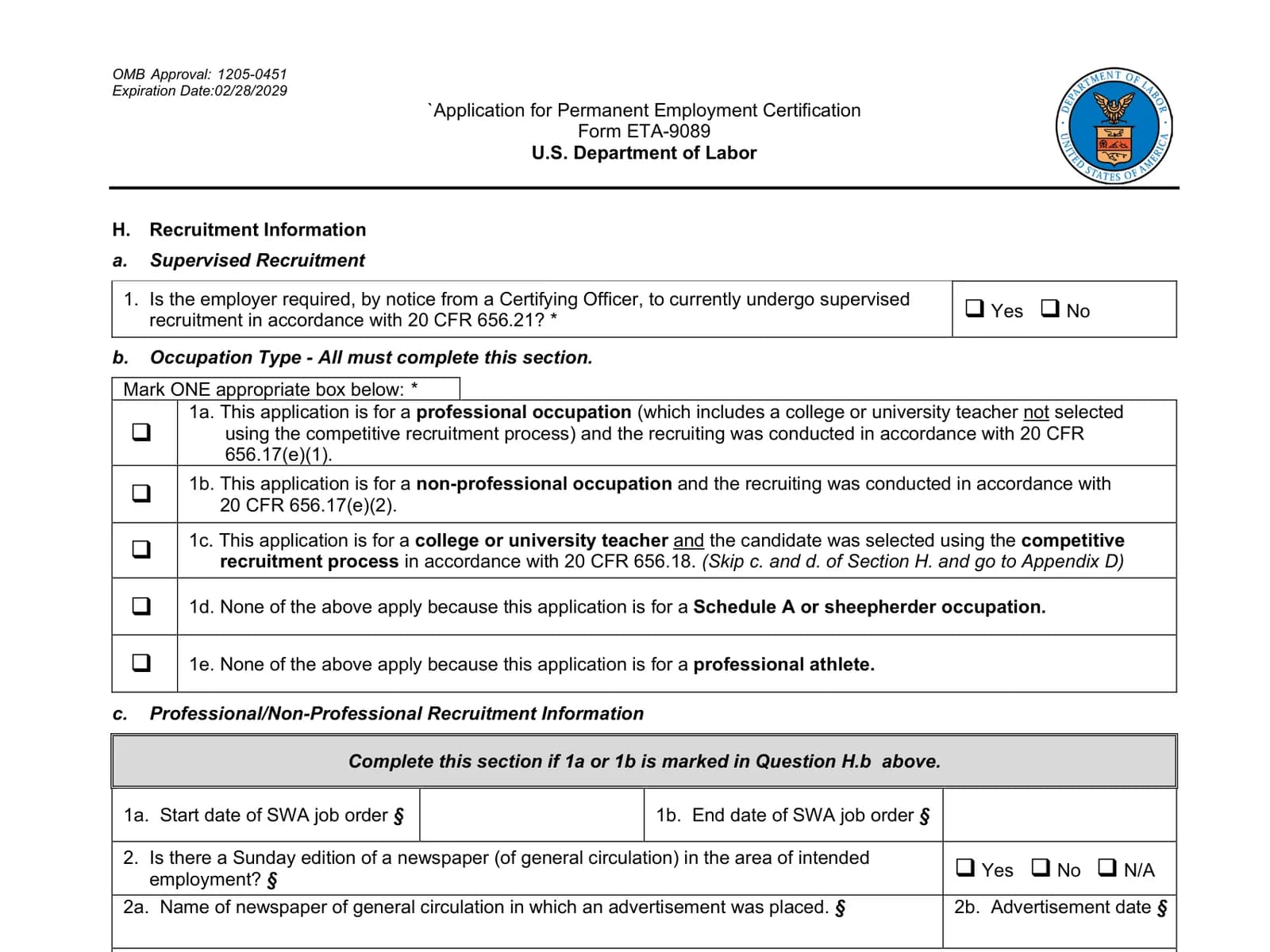
- Start and end dates recorded (these dates are themselves the documentation under 656.17(e)(1)(i)(A))
- Documentation saved (confirmation, job order number)
2. Newspaper Advertisement #1
- Published in a Sunday edition
- In a newspaper of general circulation in the area of intended employment
- Includes: job title, duties summary, requirements, application instructions
- Includes salary or wage range (if required by state law)
- Content satisfies 20 CFR 656.17(f)
- Tear sheet or screenshot saved with publication date
3. Newspaper Advertisement #2
- Published on a different Sunday than Ad #1
- Same newspaper or equivalent circulation paper
- Same content requirements as Ad #1
- Documentation saved
Two substitutions the regulation allows. If the job requires both experience and an advanced degree and a professional journal would normally be used to advertise it, that journal ad may replace one of the two Sunday ads. And if the area of intended employment is rural with no Sunday edition available, use the edition with the widest circulation in that area.
4. Notice of Filing
- Checked whether a bargaining representative exists for the occupation at that location
- If one exists: letter plus a copy of the application sent to them
- If not: posted at the worksite for 10 consecutive business days
- Clearly visible and unobstructed for the whole posting period
- Posted where workers read it on the way to or from work (near the wage and hour or OSHA notices is the example the regulation gives)
- Also published in all in-house media normally used for similar openings
- Includes all required information (title, duties, requirements, wage, contact)
- Copy of posting saved with dates and dated photographs
Additional Recruitment (Professional Occupations)
For professional occupations, complete three of the following. Only one of the three may consist solely of activity inside the 30 days before filing, and none may be older than 180 days at filing.
Option A: Job Fairs
- Recruitment at a job fair for the occupation involved
- Documentation: brochures advertising the fair, newspaper ads naming the employer as a participant
Option B: Employer's Website
- Posted on the employer's own website
- Documentation: dated copies of the pages advertising the occupation
Option C: Job Search Website (other than the employer's)
- Posted on a job search website other than the employer's own
- Documentation: dated copies of the pages
- Note: web pages generated alongside the required newspaper ads can serve as this documentation
Option D: On-Campus Recruiting
- Conducted at a college or university
- Documentation: the notification issued or posted by the placement office naming the employer
Option E: Trade or Professional Organizations
- Advertised through a relevant trade or professional organization
- Documentation: copies of newsletter or trade journal pages containing the ad
Option F: Private Employment Firms
- Engaged a private employment firm or placement agency
- Documentation: contracts with the firm, copies of ads the firm placed
Option G: Employee Referral Program with Incentives
- Program offers incentives and was advertised internally
- Documentation: dated notices or memoranda specifying the incentives offered
Option H: Campus Placement Offices
- Listed with a campus placement office
- Documentation: copy of the notice of the job opportunity provided to the office
Option I: Local or Ethnic Newspapers
- Published in a local or ethnic newspaper
- Documentation: copy of the page containing the advertisement
Option J: Radio or Television Advertisements
- Broadcast on radio or television
- Documentation: text of the ad plus written confirmation from the station stating when it aired
Timing Requirements
Per 20 CFR 656.17(e) and the DOL PERM program guidelines:
- No mandatory step older than 180 days at filing
- Every mandatory step at least 30 days old at filing
- Last mandatory step completed by day 150 from the first step
- At most one additional step falling solely inside the last 30 days
- SWA job order ran its full 30 days
- Notice of filing ran 10 business days, holidays excluded
- First recruitment step on or after the determination date and on or before the PWD expiration (per 20 CFR 656.40(c))
- If recruitment began before the determination date, filing before the PWD expiration
Documentation Checklist
For each recruitment activity, maintain:
- Proof of activity (tear sheets, screenshots, confirmations)
- Dates of activity (start and end)
- Description of applicant responses
- Interview notes (if any applicants were interviewed)
- Lawful job-related reasons for rejecting any U.S. applicants
- Final recruitment report
Keep it filed by activity rather than chronologically. An audit request names steps rather than dates, and a file organized the other way turns a one-hour response into a week of reconstruction.
Post-Recruitment Report
Before filing the ETA 9089, prepare a recruitment report documenting:
- Total number of applicants for each recruitment source
- Number of U.S. applicants interviewed
- Lawful job-related reasons for rejecting any U.S. applicants
- Conclusion that no qualified, willing, and available U.S. workers were found
Preparing for an audit
The DOL can request this documentation during an audit. Having it organized and readily available can mean the difference between a quick resolution and a lengthy process.
What forces a restart
Four situations end a recruitment cycle rather than delay it. There’s no cure for any of them once the date passes:
- The 180-day window closes before filing. Recruitment is stale and has to be redone in full.
- A mandatory step lands after day 150. The 30-day wait now pushes filing past the ceiling, so the outcome is the same as above even though the 180-day date hasn’t arrived yet.
- The PWD expires before recruitment begins. Recruitment has to begin while the determination is valid, so the case needs a new prevailing wage determination first. (Recruitment begun before the determination date has a stricter limit: filing by the expiry.)
- A step is documented but unprovable. An ad that ran without a retained tear sheet, or a notice with no dated photographs, is a step you can’t evidence in an audit. It counts as not having happened.
The first three are arithmetic and a calendar catches them. The fourth is the one that surfaces months later, during an audit, when the recruitment file gets opened for the first time since filing.
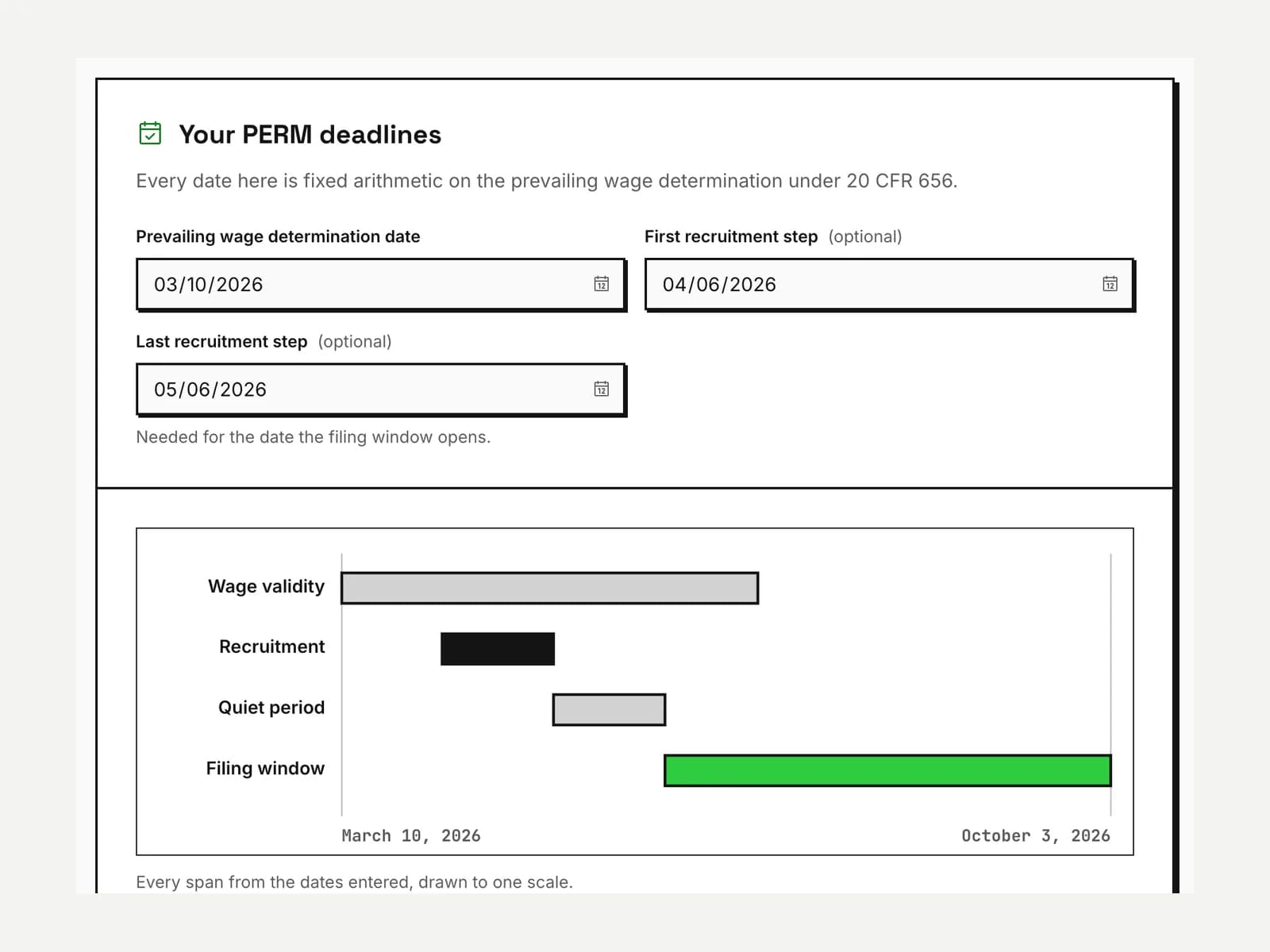
Every date on this checklist is arithmetic on the prevailing wage determination. The PERM deadline calculator works them out from yours.
Automate your recruitment tracking
PERM Tracker computes every deadline above from your PWD date, including the business-day math on the notice of filing, and warns you before day 150 rather than after day 180.
Start tracking free