This is for HR teams and employers budgeting a PERM, and for workers who've been asked to chip in. The short answer: the employer pays for the labor certification, including its own attorney's fees, and it can't pass those costs to the worker in money, in a paycheck deduction or in unpaid work. That's 20 C.F.R. § 656.12(b) (2025), in force since July 16, 2007.
The rule, in its own words
"An employer must not seek or receive payment of any kind for any activity related to obtaining permanent labor certification, including payment of the employer's attorneys' fees, whether as an incentive or inducement to filing, or as a reimbursement for costs incurred in preparing or filing a permanent labor certification application." 20 C.F.R. § 656.12(b)
Who pays for what
| Cost | Who pays | Where it says so |
|---|---|---|
| The employer's attorney, for the labor certification | The employer | 20 C.F.R. § 656.12(b) |
| Recruitment: the ads, the job order, the notice of filing | The employer | 72 Fed. Reg. 27,904, 27,920 (May 17, 2007): the rule bars making the worker cover "all recruitment costs" |
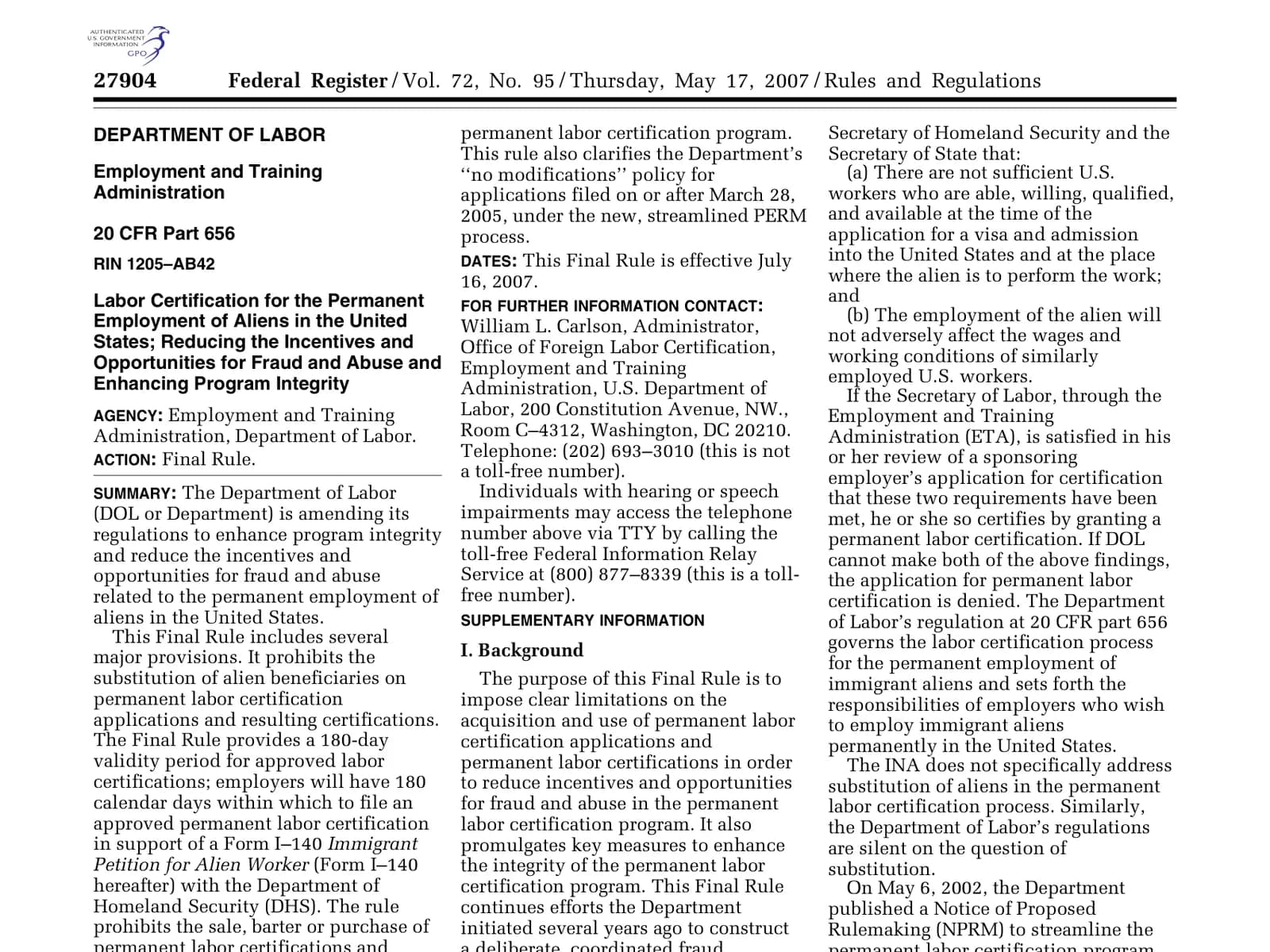
| Preparing and filing the ETA-9089 | The employer | 72 Fed. Reg. at 27,904: "the costs of preparing, filing and obtaining certification" |
| One attorney representing both employer and worker | The employer | § 656.12(b): "such costs shall be borne by the employer" |
| The worker's own, separate attorney | The worker may pay | § 656.12(b): an alien "may pay his or her own costs" |
| A third party whose business benefits from the work | May pay, in a narrow case | § 656.12(b): an "established business relationship with the employer" |
DOL put it plainly when it adopted the rule: employers file "with the full understanding that the costs they incur for the preparation and filing of the application and obtaining permanent labor certification are to be exclusively borne by the employer" (72 Fed. Reg. at 27,919).
What counts as payment
The regulation lists it, and the list is wider than a check from the worker. Under § 656.12(b), payment covers these, and the list is open-ended:
- monetary payments
- wage concessions, including deductions from wages, salary or benefits
- kickbacks, bribes or tributes
- in kind payments
- free labor
DOL's 2007 explanation adds that "any attempt by an employer to recover labor certification costs from an employee through deductions from wages, uncompensated additional work by the employee, or otherwise" would be an attempt to get around the rule. An agreement that takes the money back later, after the case is filed or approved, is an attempt to recover it "otherwise". Whether a particular agreement crosses the line is a question for the employer's counsel.
No exemption by employer type
When DOL proposed the rule, nonprofits, hospitals, public universities and small businesses asked to keep cost-sharing with the worker. DOL declined: "The Department disagrees. The recruitment, legal, and other costs associated with labor certification are transaction costs necessary for or, in the case of legal fees, desired by the employer to complete the labor market test" (72 Fed. Reg. at 27,923). The rule applies to every employer that files.
What happens if it's broken
Under § 656.12(c), evidence that an employer sought or received payment "shall be grounds for investigation" and may lead to:
Denial
Of the application, under 20 C.F.R. § 656.24.
Revocation
Of a certification already granted, under 20 C.F.R. § 656.32.
Debarment
Of the employer from the program, under 20 C.F.R. § 656.31(f).
DOL's reason goes to the heart of PERM: "Permanent labor certification is an employer-driven process; employers, not aliens, must file permanent labor certification applications" (72 Fed. Reg. at 27,920). A worker paying the employer's costs, in DOL's words, "casts suspicion on the integrity of the process and the existence of a bona fide job opportunity." Id.
What the rule doesn't decide
- Later steps. Section 656.12 is about the labor certification. It doesn't address the I-140 or the I-485; ask the attorney how those are handled.
- The worker's own lawyer. A worker may hire and pay a separate attorney. If one attorney represents both sides, the employer pays.
- Fee amounts. No government source publishes what PERM legal work costs, and quotes depend on the firm and the case, so there are no ranges here. Nothing on this site is legal advice; the attorney on the case is the person to ask about a specific arrangement.
For HR: a budget checklist
- Attorney fees for the prevailing wage request, recruitment and the ETA-9089, on the employer's budget
- Recruitment advertising (print ads and any additional steps), on the employer's budget
- No deduction, bonus clawback or repayment clause tied to the labor certification
- If one firm represents both employer and worker, the employer pays its fees for the labor certification
- The engagement letter says who the firm represents
- Records kept for 5 years from filing (20 C.F.R. § 656.10(f))
Related
- Look up a law firm's PERM record: how many cases a firm files and how they've been decided
- What law firm volume tells you
- The PERM recruitment checklist, for what the recruitment budget pays for
- The deadline calculator, to plan the recruitment dates
Sources
- 20 C.F.R. §§ 656.10, 656.12 and 656.24 on the eCFR, current to October 15, 2026.
- Labor Certification for the Permanent Employment of Aliens in the United States; Reducing the Incentives and Opportunities for Fraud and Abuse and Enhancing Program Integrity, 72 Fed. Reg. 27,904 (May 17, 2007) (final rule, effective July 16, 2007), read on federalregister.gov October 16, 2026.