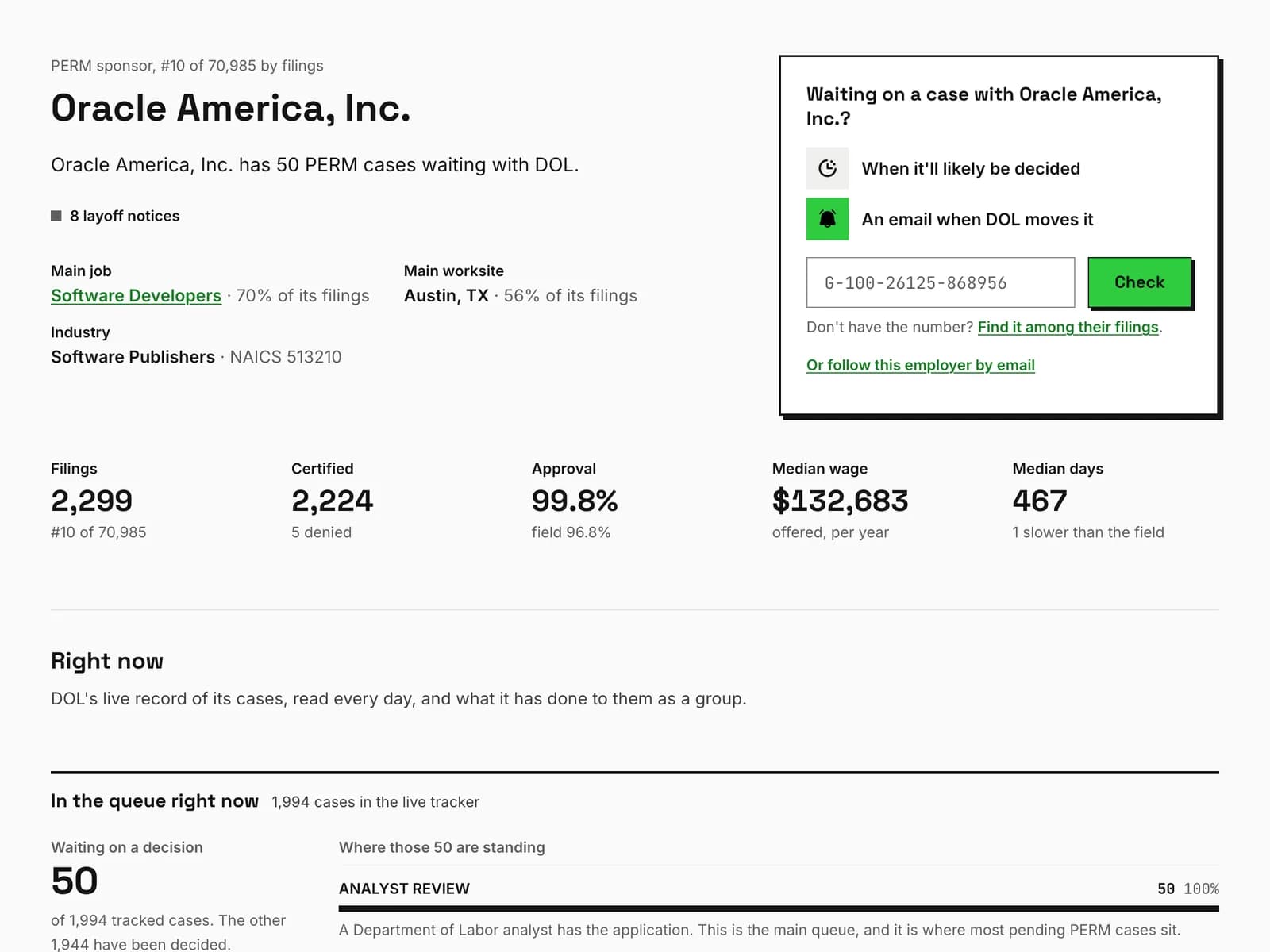
Every PERM application names the employer, and the Department of Labor publishes the file. Group those rows by sponsor and you get a record: how many cases a company has filed, how many were certified, how long they took, and which law firm filed them.
This explains what that record is made of. The more useful half is at the bottom, where it says what the record can't tell you about any one case.
Where an employer's numbers come from
There are two sources, and they see different things.
DOL publishes quarterly disclosure files listing cases it has decided. That's where filings, certifications, denials and median days come from. The current window runs through 30 June 2026. Every row in it already has an outcome, which means those files cannot show a single case that's still waiting.
The other source is DOL's own case status system, checked daily. It carries the current status of individual cases, pending ones included. That's how one page can say a sponsor filed 6,875 cases in the published files while separately tracking 5,535 of its cases live, 400 of them still undecided.
| Quarterly disclosure files | Daily case status | |
|---|---|---|
| Covers | decided cases only | pending and decided |
| How current | decisions through 30 June 2026 | refreshed daily |
| Carries | outcome, wage, law firm, worksite | status, job title, filing date |
Neither replaces the other, so both are on the page and every figure says which one it came from.

What volume actually tells you
Volume is the plainest number on the page and the one most often over-read. A high count means the company files a lot of PERM cases. That usually means it's large, it hires a lot of people who need sponsorship, and it has a process that runs.
It does not mean cases move faster. DOL works one national queue in filing order, whoever filed them, so a sponsor's rank has no bearing on where a case sits.
Two things distort a count. DOL prints the legal entity typed on the form, so a group filing through several subsidiaries shows up as several rows rather than one company. And spellings that differ only by punctuation or a company suffix get pooled into one sponsor here, which is right most of the time and occasionally merges something you'd rather see separately.
How to read an approval rate
Start with the baseline. Across the current files, a PERM case is denied 3.2% of the time: 11,357 denials in 355,130 decided cases. Withdrawn cases sit on neither side of that ratio, because a withdrawal is neither an approval nor a denial.
So almost every sponsor is high, and the interesting question is never whether a rate clears 90%. It's whether the count underneath it is large enough to mean anything. Four filings and one denial reads as 75%, and that is not a 75% employer. It's one case.
The comparison chart on each sponsor's page leaves out anyone with fewer than 30 decided cases for exactly this reason. A rate over a handful of cases lands wherever the handful landed.

The wage on the record, and the wage before it
There are two wages in a PERM, and they aren't the same thing.
The application carries an offered wage, the salary the employer put on the form. Before it could file, the employer had to ask DOL what the job pays. That request is Form ETA-9141, it gets its own P- case number, and DOL's answer sets the floor. Those wage requests appear on the same employer page alongside the company's H-1B labor condition applications, each linking to its own current status. One caveat worth carrying: DOL runs two wage queues, one for requests using the standard federal wage survey and one for everything else, and they move at different speeds. A case record doesn't say which queue it's in.
The employer page shows a median offered wage where the file carries one for that sponsor, and says so plainly where it doesn't. For the wage question itself, occupation is usually the better cut than employer, and that's on the wage data and by state pages.
Who filed it
Every PERM names the law firm that made the filing, so each sponsor's page lists the firms it uses and how much each one filed.
Read that ranking as volume and nothing else. Across the ten busiest firms, approval rates all sit above 99%, which is another way of saying the rate doesn't separate them.

The firm listed is the one that filed those decided cases, which may not be the firm handling a case today. Companies change counsel, and the file lags.
What none of this predicts about your case
This is the part worth reading twice.
- A sponsor's approval rate is not your case's odds. It's a historical average over cases with different jobs, different wages, different recruitment, filed in different years. Your case is one row, not a sample.
- A low rate at one employer is not evidence about you. It can be a single occupation, one recruitment habit, one bad year, or a volume filer in a category DOL scrutinises. It's a fact about a set of past filings and nothing more.
- A small denominator is noise, not a signal. Under about 30 decided cases, a rate mostly tells you what happened to a few people.
- The measured denial factors are not independent, which is why we publish them separately and refuse to blend them into one score. Wage correlates with occupation, which correlates with almost everything else. A single number would read as precision the data can't support.
- Volume, rank and median days say nothing about your wait. The queue is national and first in, first out.
- DOL doesn't publish reasoning. No record here says why a case was denied, audited or held.
- The record can't say whether an employer will file for you, when, or at what wage. A wage determination is a legal step, not a commitment.
Looking up the case itself
For an actual case, the record that matters is the case's own. The case status lookup takes any DOL number, PERM (G-100-, and the older A- form), prevailing wage requests (P-100-) and H-1B labor condition applications (I-200-, I-203-), and works out the program from the prefix. Pending cases included. If a number isn't already held here, DOL is asked for it at that moment and the answer is recorded.
You can leave an email address on a pending case and hear when the status changes. One email per change, confirmed by a link first, and no account needed for any of it.
Where a page gives an estimated decision date, treat it as an estimate. How close ours land is on the estimate scorecard.