
A PERM application ends one of three ways: certified, denied, or withdrawn. On the way there it can also be pulled aside for extra scrutiny, which is where the words audit and RFI come in. They get used interchangeably. They are not the same thing, and the difference matters more than most people expect.
Everything with a number attached below comes from the Department of Labor's own disclosure files or its case system, refreshed daily.
How often does a PERM case actually get denied?
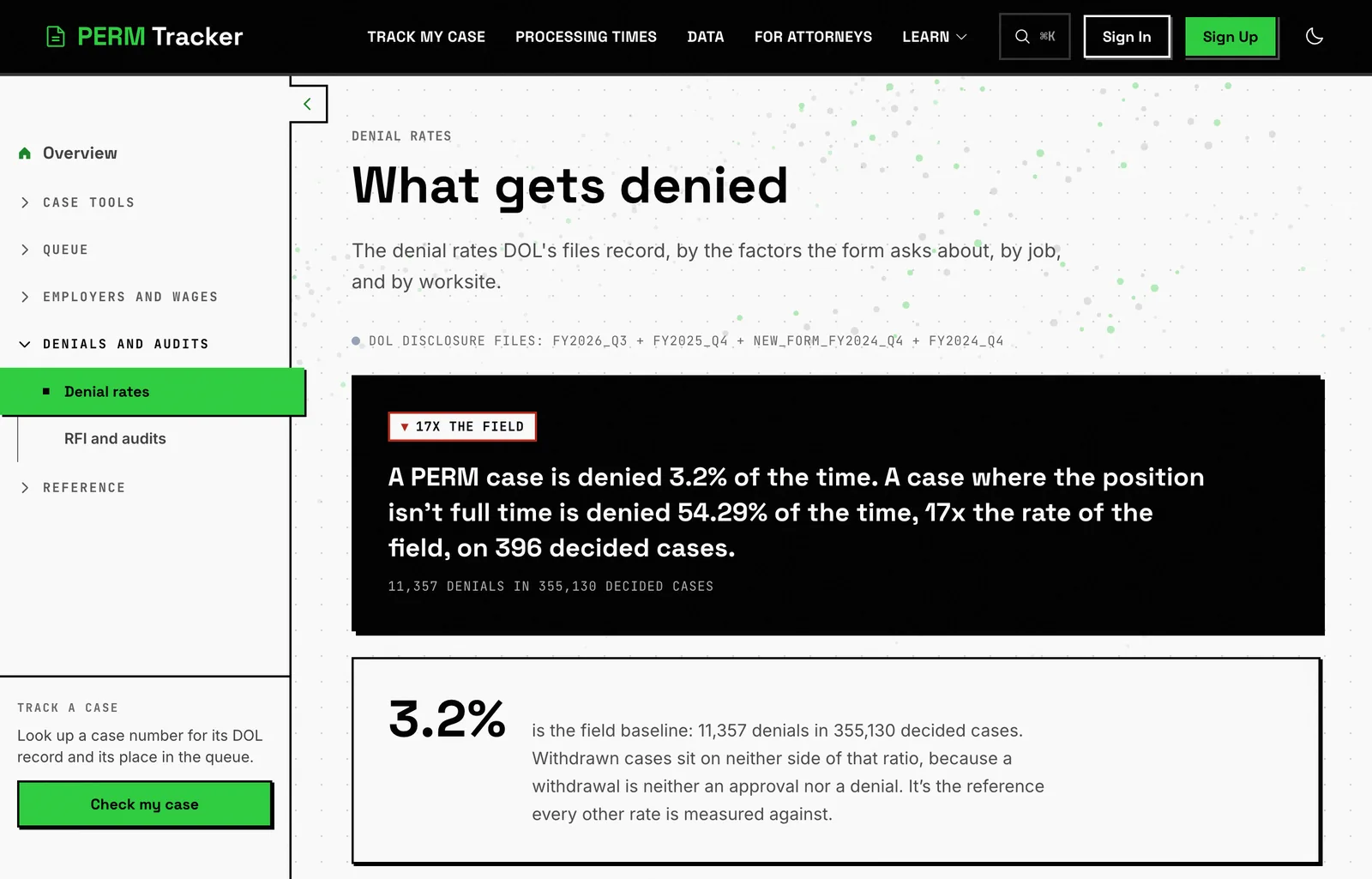
3.2% of the time. That's 11,357 denials in 355,130 decided cases. Withdrawn cases sit on neither side of that ratio, because a withdrawal is neither an approval nor a denial.
That single figure is less stable than it looks:
| Fiscal year | Decided | Denied | Denial rate |
|---|---|---|---|
| 2024 | 106,972 | 4,978 | 4.65% |
| 2025 | 140,251 | 2,500 | 1.78% |
| 2026 | 107,907 | 3,879 | 3.59% |
That's a 2.6-fold swing between 2024 and 2025 under the same rules, driven by nothing an applicant controls. A denial rate quoted without a year attached to it is worth very little.
What actually gets a case denied?
Three questions on the ETA-9089 carry the highest denial rates in the whole dataset.
| What the form declares | Decided | Denial rate | Against the field |
|---|---|---|---|
| Position isn't full time (Section G, Item 1) | 396 | 54.29% | 17x |
| Worker has an ownership interest (Section A, Item 16) | 1,308 | 21.02% | 6.6x |
| Employer had a layoff (Section G, Item 12) | 10,222 | 0.55% | 0.2x |
The third one runs backwards, and that's a useful warning about reading any of these as causes. Declaring a layoff triggers a notification requirement, so the employers who get as far as answering that question tend to be the ones already working through it with counsel. The association is real. The causation isn't there.
The other warning is size. Those three factors carry the steepest rates on the page and together account for only 4.8% of all denials. Most denials land somewhere far more ordinary. Cases offering under $40,000 are 23% of decided cases and 35% of every denial.
Wage tracks the outcome fairly clearly. The rate falls from 4.96% under $40k to 1.35% in the $130k to $160k band, then turns back up to 1.61% above $160k. The single highest band is $40k to $50k at 7.26%. Occupation tracks it too, and harder: combined food preparation and serving is denied 47.51% of the time on 221 decided cases, heavy truck drivers 29.91% on 2,434, while software roles sit well below the field average.
What is an audit?
An audit is a formal demand for the documentation behind the application: the recruitment report, the tear sheets, the notice of filing, the resumes, and the reason each U.S. applicant was rejected. Some applications are picked at random for quality control, so an audit on its own isn't an accusation.
The deadline is 30 days from the date printed on the letter, not from the day it arrives. The certifying officer may grant one discretionary extension of up to 30 days. Missing the date costs more than the case: under 20 CFR 656.20(a)(3) it counts as a failure to exhaust administrative remedies, and the appeal to BALCA is then not available at all.
Audited cases also leave the ordinary line. They wait in their own queue, which DOL publishes as its own figure, and the two advance independently.

How is an RFI different from an audit?
An RFI is a request for information. The analyst wants one point clarified before deciding, rather than the whole file produced. It's lighter, and its legal footing is much stranger.
| Audit | RFI | |
|---|---|---|
| In the regulations | 20 CFR 656.20 | nowhere by that name |
| Nearest authority | the audit procedures themselves | 656.20(d), which sets no deadline |
| Deadline | 30 days from the letter | whatever the letter says |
| Extension | one, up to 30 days, discretionary | not defined |
| Asks for | the whole recruitment file | usually one question |
| Missing it | denial, and no BALCA appeal | denial |
The 30-day figure that circulates online for RFIs is the audit rule wearing the wrong label. The date printed on the letter is the one that counts.
Does an RFI mean the case is about to be denied?
Usually not. Of the RFIs on record that reached a decision, 84% were certified, 1,799 of 2,152. Measured against every RFI ever issued the figure is 52%, because 1,279 of them have no decision yet. Which number you want depends on whether you're asking how these usually end or how many have ended.
Half of the RFIs that resolved did so within 33 days. That's a fact about 2,152 cases and not a schedule for any one of them.
An RFI also doesn't arrive at a random moment. Of the 1,091 open RFIs, the median case was filed 356 days ago, against DOL's own 336-day average from filing to determination. It shows up when a human finally opens the file, which is why it can feel like nothing happened for a year and then everything did.
Extra scrutiny of any kind is rarer than the forums suggest. Of 95,913 PERM cases waiting on a decision, 5,787 are at something other than the ordinary analyst queue. That's 6.0%.

Why we publish a rate per factor and refuse to blend them
Several sites will hand you one number, or a letter grade, for how risky your case is. We won't, and the reason is sitting in the tables above.
The factors aren't independent. Wage tracks occupation, which tracks employer, which tracks whether the filing was prepared with counsel. Combining them into one score counts the same underlying thing several times and then presents the result as precision.
A rate for a group isn't a probability for a case. "Truck drivers are denied 29.91% of the time" is a measurement of 2,434 decided cases. It is not a 30% chance for yours. DOL denies on the record in front of it, not on the job title.
Small groups are mostly noise. So every ranking carries a minimum population and prints a 95% range beside each rate. Without that floor, the two highest denial rates in PERM would be dishwashers at 100% and facilities mechanics at 90%, and both are one employer.
So the pages show measured rates, unblended, each with the population it was measured on. It's harder to read than a score. It's also the only version that's true.
What this can't tell you
- Why any particular case was denied. DOL publishes the outcome, never the reasoning. That's in the letter the employer received.
- Whether a case will be audited. Selection is partly random and DOL doesn't publish the criteria.
- Whether audits and RFIs are being issued more often than they used to be. The record holds one observation per case, so it can't see a case enter or leave a stage. No trend line through it would mean anything.
- Anything about the quality of the recruitment. The disclosure files record what was filed and what was decided. They never contain the documents.
- How a specific case is doing right now. For that, look the number up.
Related
- Denial rates, the full breakdown by wage, occupation, state and year
- RFIs, audits and appeals, with live counts at every stage
- What each PERM case status means
- Case status lookup, which reads DOL's record for a single case number


