The five most common PERM audit triggers are: (1) unusual or tailored job requirements that exceed the occupation norm, (2) foreign language requirements without clear business necessity, (3) related employer-beneficiary relationships, (4) recruitment documentation gaps, and (5) timing violations in the recruitment process. DOL publishes no audit rate, so nobody outside the Department knows the share, and some audits are random quality-control selections rather than a finding about the case.
Understanding PERM Audits
A PERM audit occurs when the Department of Labor selects an application for additional review. Audited cases leave the ordinary queue for a separate, slower one, and DOL publishes the filing month it has reached in each, so the cost of an audit in months is readable from OFLC rather than estimated. The audit itself requires the employer to submit supporting documentation under the procedures at 20 C.F.R. § 656.20 (2025).

How often DOL audits
DOL publishes no PERM audit rate, and figures circulating in the 30-40% range trace to no primary source we can find. What DOL does publish is a live Audit Review queue position on its processing times page, which is the audit backlog rather than the audit rate. 20 C.F.R. § 656.20(a) also provides for random selection for quality control, so an audit isn’t necessarily a finding about the case.
While audits can be random, certain application characteristics increase the likelihood of selection. Understanding these triggers helps attorneys prepare better applications and set realistic client expectations. For a comprehensive view of the entire PERM process and how audit preparedness fits in, see our Ultimate PERM Guide.
Trigger 1: Unusual Job Requirements
The DOL scrutinizes job requirements that appear tailored to a specific candidate. If the minimum requirements exceed what’s normally required for similar positions, expect an audit.
Common red flags:
- Requiring specific technologies that are uncommon in the field
- Experience requirements exceeding the SVP level for the occupation
- Dual degree requirements without clear business justification
- Combinations of skills that are unusually specific
How to avoid it:
- Ensure requirements align with the O*NET job zone for the occupation
- Document genuine business necessity for any above-normal requirements per 20 C.F.R. § 656.17(h)
- Review comparable job postings to benchmark requirements
Trigger 2: Foreign Language Requirements
Requiring fluency in a language other than English almost always triggers an audit. The DOL wants to ensure this isn’t a mechanism to limit the applicant pool.
How to avoid it:
- Only require foreign language skills when there’s a genuine business need
- Prepare detailed business necessity documentation
- Document the percentage of clients or business conducted in the language
- Consider whether the requirement can be listed as preferred rather than required
Trigger 3: Related Employer-Beneficiary Relationships
When the beneficiary has a familial, ownership, or other close relationship with the employer, the DOL will want to verify that the recruitment was genuine.
Common scenarios:
- Family-owned businesses sponsoring a family member
- Beneficiary who’s a partial owner of the company
- Small businesses where the beneficiary plays a key role
How to avoid it:
- Conduct thorough, well-documented recruitment
- Maintain detailed records of all applicants and interview notes
- Ensure the recruitment process is genuinely open to U.S. workers
Trigger 4: Recruitment Documentation Gaps
Inadequate or inconsistent recruitment documentation is a frequent audit trigger. The DOL expects complete records of every recruitment step.
What the DOL looks for:
- Proof of all required recruitment activities
- Complete records of applicant responses
- Documentation of why U.S. applicants were rejected (if any)
- Consistency between the job posting and the ETA 9089
How to avoid it:
- Create a recruitment file checklist before starting
- Save copies of all advertisements, job orders, and postings
- Document every applicant interaction with dates and outcomes
- Ensure job descriptions are consistent across all recruitment materials
Tip
Use a tracking system that timestamps and organizes your recruitment documentation. This makes responding to audits significantly easier.
Trigger 5: Timing Issues
The DOL pays close attention to the timing of recruitment activities under 20 C.F.R. § 656.17(e). Filing too early or too late relative to recruitment activities can trigger an audit.
The audit response window
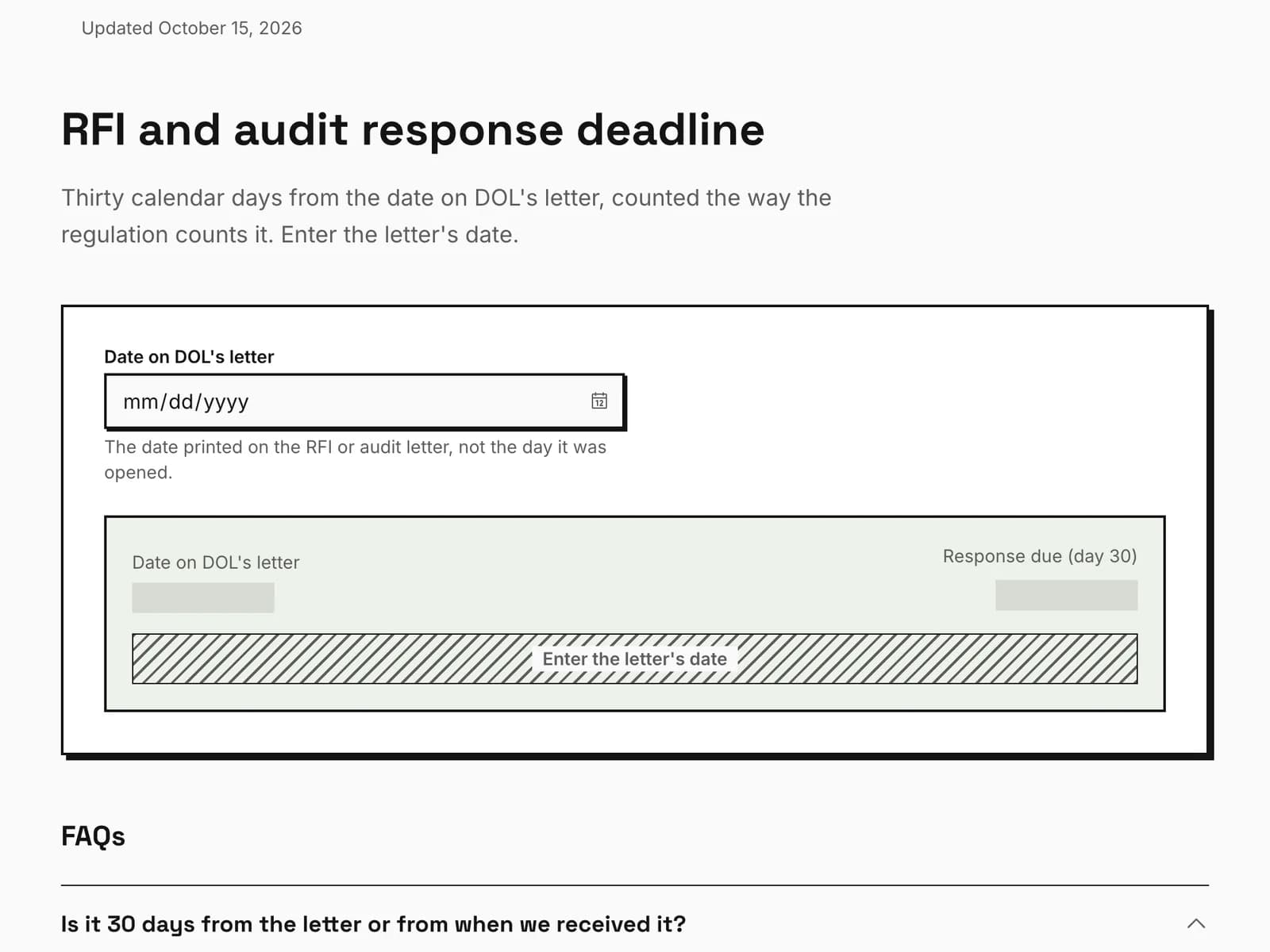
When the DOL issues an audit letter, you have 30 calendar days to respond with all requested documentation. This deadline is strict. Build your audit file from day one, well before any letter arrives.
Key timing rules:
- Recruitment must be completed within 180 days before filing
- The earliest recruitment activity must be no more than 180 days before filing
- There must be a 30-day "cooling off" period after recruitment ends
How to avoid it:
- Create a detailed timeline before starting recruitment. Our recruitment checklist covers every timing requirement
- Track all dates carefully using dedicated tracking tools
- Build in buffer time between recruitment end and filing
Best Practices for Audit Preparedness
Even with careful preparation, audits can happen. Being prepared is the best defense:
- Maintain complete files: Keep copies of everything from day one
- Respond promptly: You typically have 30 days to respond to an audit
- Be thorough: Err on the side of more documentation than required
- Track deadlines: Missing an audit response deadline results in automatic denial
Conclusion
While PERM audits add time and complexity, they’re manageable with proper preparation. The key is thorough documentation, genuine recruitment efforts, and careful attention to timing, from the very start of the process.
For the complete recruitment documentation requirements, see our recruitment checklist. For how an audit fits into the timeline, read what an audit actually means for a case, the complete filing guide, or the Ultimate PERM Guide.
Stay audit-ready
PERM Tracker helps you track recruitment activities, maintain documentation, and meet every deadline.
Start tracking free